
“The period of time from [Berenice
Chouteau’s] advent, until now, marks an era of history, an era of
transformation and development over more than half of the continent such as we
may safely say the world has never witnessed before.”
-John
Calvin McCoy, November 1888
Telling the story of the first
settlement of what would be Kansas City would never be complete without
covering the first white settlers in this region. Before there was a Town
Company purchasing land at the site of Kansas City in 1838, there were a few
dozen French Catholic families that uprooted their lives in the St. Louis area
and followed a young man and his stoic wife westward across the newly
established state of Missouri to establish a fur trading post along the river.
 |
| John Heller painting depicting fur trading in the wilderness of St. Louis. This would be a similar site to what would have been seen at the future site of Kansas City. |
After the Louisiana Purchase,
Americans led by William Clark established Fort Osage, 25 miles east of the
future site of Kansas City, in 1808. Its purpose was to provide a military
presence in the territory and to develop a healthy relationship with Native
American tribes- especially the Osage. In addition to its purpose as a fort, it
also functioned as a government-operated fur trading post that was in operation
until 1822.
The end of Fort Osage in Missouri
meant that business for independent fur traders could begin. This early
commerce on the western side of Missouri was launched when a newly-married
couple took a risk by settling on the edge of the frontier. The future of fur
trading in western Missouri would be directly connected to them, and Kansas
City likely wouldn’t have developed without the Chouteau’s enterprising spirit.
But before we talk about this incredible journey and what was accomplished in only a few years, we need to examine what was up in this area before they took the gamble in the wilderness on what was the westernmost edge of the United States.
As fate would have it, the Chouteau
family is linked to the two largest cities in Missouri. Francois Gesseau
Chouteau was born in 1797 in St. Louis, Mo., son of Jean Pierre Chouteau
(1758-1849). The area at the time was under the control of the Spanish. His
uncle, Auguste, co-founded St. Louis 33
years before his birth.
 |
| Oil painting of Berenice Chouteau. No photos exist of her. Courtesy of Native Sons. |
His family was strengthened by their
relationship with Native American tribes. As French fur traders and merchants,
the Chouteau family operated St. Louis Fur Company which held the rights to fur
trade with the Osage tribe in that area. Francois, known as “Gesseau” to
family and friends, was particularly close to the Osage- so close, in fact,
that at the age of seventeen he became a father for the first time after a
relationship with an Osage woman named Marie.
The fact of the matter is that these
French fur traders oftentimes had Native American wives or relationships with
Native American women.
In 1819 at the age of twenty-two,
Francois further connected his enterprises by marrying eighteen-year-old
Therese Berenice Menard, simply known as Berenice to family and friends.
Berenice was the daughter of Pierre Menard, a French-Canadian fur trapper who
settled across the river from Ste. Genevieve, Mo. in Kaskaskia, Illinois and
served as the first lieutenant governor of that state. She was described as
being strong and healthy with a personal connection to Native Americans. As a
child, she had played alongside Indian children in Kaskaskia.
St. Louis traders were ready to take over the fur business abandoned by Fort Osage. Twenty-two year-old Francois and his eighteen-year-old wife, Berenice opted for an interesting honeymoon. Kansas City founder John C. McCoy wrote in his memoirs, “Berenice first saw this place in 1819, when on her way from St. Louis to the frontier trading post of the Black Snake hills (St. Joseph). It was her bridal tour with her husband on a keelboat, requiring about six weeks to make the trip.”
Well isn’t that romantic….
 Even contemplating how stressful this
would be- paddling up a river moving at an average of six miles per hour- in a
keelboat to the wilderness is petrifying.
Even contemplating how stressful this
would be- paddling up a river moving at an average of six miles per hour- in a
keelboat to the wilderness is petrifying.
On this journey, the young Chouteau
couple saw the opportunities that could arise along the convergence of the
Missouri and Kaw Rivers and planned to return to the area to establish a new
trading post for the American Fur Company.
Originally known as Chez les
Canses (village of the Kanza), the region offered many chances to expand
the Chouteau’s St. Louis fur-trading business. In the fall of 1821, Louis
Berthold was sent up the Missouri with his wife, two employees and his stepson
to prepare for this new trading post on the south bank of the Missouri River
just opposite of Randolph Point. Randolph Point was a famous crossing place for
the Indian tribes of the north and south sides of the Missouri River.
Just a short time later, “a party of
Indians came along and tore down their cabin and ordered them to leave the
country on pain of losing their scalps or lives if the order was disobeyed.”
So much for friendly relations with
the Native Americans!
Instead of leaving, the little
company moved to the north side, built a simple structure, and awaited the
arrival of the Chouteau’s.
In early 1822, Francois Chouteau came
back to western Missouri with around 35 employees, three keelboats of supplies
and merchandise for the Indian trade, his wife, and two young children.
 |
| 1840 map drawn by Fr. Nicholas Point showing 26 Catholic families in Kansas City. Map adjusted by John Dawson to show current locations. |
The journey would have been tough without two babies in tow. I have some
serious respect for Berenice.
They erected extensive log buildings
on the north side near Randolph Point in Clay Co., cleared the dense forest of
river bottom lands and began trade with the Native Americans. Two Indian trails
ran nearby, offering trade from every direction- by land and by water.
Following Francois and his wife in
1825 were twenty-one year old Cyprian and sixteen-year old Frederick, brothers
of Francois. Their mission was to expand their fur trading business even further
to the west. At first, Cyprian settled on the south bank of the Kaw River about
six miles from the mouth while Frederick moved about eight miles above Topeka
and traded with the Kaws at Horseshoe Lake.
More on these two brothers in a minute.
In April 1826, a flood destroyed all
six buildings at the trading post. As luck would have it, the land to the
south- which was on higher ground and had better river access- had been ceded a
year prior by the Osage and was open for settlement.
A second post in 1827 in the heart of
what would be Kansas City, only in operation for one season, sat at the foot of
the river on the south bank near Troost Ave. The Chouteau’s acquired several
hundred acres, including a working farm. Francois moved his trading post a
final time to the south bank of the Kaw about two miles above the city of
Argentine.
A major cholera outbreak in 1827
slowed the Chouteau’s progress. Berenice baptized 75 dying Indian children,
lost two of her own children, sewed shrouds for those that died (including
using her own wedding gown as fabric), and established relationships with the
Kanza, Seminole and Osage tribes.
Again, Berenice was tough as nails.
 |
| Frederick Chouteau (1809-1891) |
By the early 1830s, at least one
hundred French Catholic families settled into the area, and many of these
families included Native American “half-breeds” from the continued
relationships with tribes. The Chouteau trading post was the center of
activity. All these families were involved in the fur trade, and most lived in
the West Bottoms near the mouth of the Kaw River. Most of the French fur
traders inhabiting the area were married to Blackfoot Indian women. This became
known as the “French Bottoms” and the Native Americans called it “Chouteau’s
Town.”
This sociable society was renowned
for having regular dances and celebrations that could be seen- and heard- for
miles. Most ran small farms; no large businesses existed except for a grocery
store and tavern. The old square- vieux carre- was erected and used as a
common area for the French Catholic families. As Kansas City would later
develop, this old town square was kept in-tact and is now known as the River
Market today.
Life for these French Canadians was
far from easy. In the book Cher Oncle, Cher
Papa, the everyday lives of these rough and tumble settlers was described
as pretty taxing. The changing river, government regulations and illegal
competition of Indian annuities resulted in some good and some not-so-good
years.
The process of how these French Canadians
survived in the new marketplace along the Missouri River surrounded around the
time of year. “When the fall harvest of furs arrived, the post boomed with
activity, then settled in for a hard riverfront winter,” Dorothy Brandt Marra
described. “With spring, the cycle began anew.”
 |
| Cyprian Chouteau (1804-1879) |
Francois continued his business
ventures by acquiring several hundred acres in the East Bottoms and a steamboat
landing spot known as Chouteau’s Landing. In 1838, tragedy struck when
Francois- later coined “The Father of Kansas City”- passed away (some records
indicate it was a heart attack while others state he was killed by “a
stampeding horse”), leaving his trading post, 1,200 acres and his sons to take
over the business.
Pierre Menard Chouteau, known as
Peter, was the second oldest of Francois and Berenice’s children. Turning sixteen
years old just ten days after his father died, he was quite young to take over
the booming fur trading business. Francois’ brother, Cyprian did as much as he
could to help manage his brother’s interest.
At this point, the land of the future
site of Kansas City had been sold to the Town Company and the fledgling city
was being platted nearby the Chouteau post.
By 1842, Frederick moved to Johnson
County, Ks. and made his home with the Native Americans. He was adopted into
the Shawnee tribe and was supposedly offered a position as chief but refused.
He married three Native American women and was the father of fourteen “half-breed”
children.
Dang.
In June 1844, another tragic flood
destroyed much of what was left of the French traders in the area. Berenice was
forced to move the warehouses, her homestead and the large farm to even higher
ground. The post was, according to John McCoy, “utterly obliterated with and
ruined by a deposit of from two to six feet of sand left over a large portion
of the land.”
The original families living in the
French Bottoms suffered as well; the flood swept away their cabins. Many young
men never rebuilt and opted to move to the mountains to the west. Other early
settlers, including Berenice Chouteau, decided to stay in the area.
So did Cyprian and Frederick.
 |
| The Bluejacket-Chouteau home in Shawnee, Ks. in cir. 1882. The house was later known as "The Groves." Courtesy of Johnson County Historical Society. |
Cyprian bounced back in forth between
Kansas City and Kansas Territory, settling for years in Shawneetown in Johnson
Co. In 1856, he retired from the Indian trade and took up farming. He bought a
farm which included a house built by Henry Bluejacket (yes, like the road). The
house was said to have been built in 1840. Cyprian added to this original house,
and its grandeur was known far and wide. The house was “a landmark” off the
Fort Leavenworth military road and stood as a stunning representation of the
French architecture these pioneers loved so much.
To be clear, the Chouteau's were slave
owners, and both Frederick and Cyprian brought this into Kansas Territory until
the free staters made this lifestyle next to impossible. In fact, Cyprian stayed
in his large home near Shawneetown until the Civil War made it hard for he and his family to stay safe in Jayhawker territory. Some accounts say he was "burned out" of his home by Quantrill's Raiders. He fled
back to Kansas City and built a home at 412 Charlotte. Some records indicate
the sturdy brick house was built by John C. McCoy.
 |
| Cyprian Chouteau's home at 412 Charlotte shortly before it was torn down. Courtesy of Missouri Valley Special Collections, KCPL. |
The home stood for 100 years until
the bulldozers took another landmark.
I’m getting really tired of using the words “bulldozers” and “razed” when telling the stories of Kansas City’s history.
Like real tired.
Naturally, when I discovered the unfortunate
fate of Cyprian’s house in Kansas City, I became very curious about this home
Cyprian Chouteau built near current-day Shawnee. What happened to this “landmark”
that people referred to even up until the 1940s?
Was it hidden beneath a more modern
structure?
This happens more than you think, so I
held out hope as I looked into the Cyprian Chouteau home in Johnson County.
I was hoping for a happy ending, you
know.
My research found that Cyprian sold
his Johnson County house along with 137 acres in 1877 to a man named Patrick McAnany.
The house was referred to as the “Bluejacket-Chouteau House” and later, the
McAnany clan called it “The Groves.”
 |
| McAnany stone house addition off the back of the Bluejacket-Chouteau homestead in Shawnee, Ks. Courtesy of Johnson County Museum |
The house and land miraculously stayed
in the McAnany family for generations. In 1913, the family added a rock home
attached to the back side of the original wooden frame structure built by Bluejacket
and enlarged by Cyprian.
In 1932, the family sold the home and
slowly sold off the land to be platted into subdivisions. The house stood on
the original military road, and this small stretch of street was renamed “McAnany
Drive.”
Subdivisions including “McAnany Estate”
and “Choteau Manor” (no one apparently checked on the spelling) stand today from
near 53rd and Switzer and to the west. Scrunched tightly in between
this land is none other than McAnany Drive.
So is the house still there?
I had to drive by and find out for
myself.
What I saw resembled the old stone
home that the McAnany’s built attached to the original Chouteau home- it had
been greatly altered over the years, but I was confident I was onto something.
What was missing, though, was the old Chouteau frame house.
 |
| Current-day view of what I believe to be the remainder of the Chouteau house in Shawnee, Ks. This is the 1913 addition built by the McAnany's. |
Then, an inquiry to the Johnson
County Museum confirmed my suspicions. In 1939, the oldest part of the home was
torn down because of extensive termite damage.
Ugh.
“Only the rock part attached to the
back, added by the McAnany’s in 1913, is standing on the old military road.”
Another one bites the dust.
Today, it is quite hard for us to
imagine what once was when this area of the country has done very little to
preserve the buildings and structures that were once so important- so prominent-
to the birth of our city.
The trading post in Kansas City was
officially closed in 1857, but the impact of the Chouteau’s on the future site
of Kansas City is unmistakable today. We have nothing left to mark their importance-
no landmark past a few Chouteau Society markers and a trafficway- to property
commemorate the early beginnings of Kansas City. They have been all but erased as
progress in our city seems to always include the demolition of our past.
After the death of Cyprian in Kansas
City in 1879 and the death of Frederick in Westport in 1891, the children of
these men claimed their Native American ancestry and left for “Indian Country.”
 |
| Artist rendering of the proposed Chouteau Heritage Fountain in North Kansas City, Mo. |
Berenice, coined “The Mother of
Kansas City,” died in 1888 and was buried next to her husband in St. Louis. She
outlived all of her nine children. In her lifetime, she was able to see with
her own eyes the creation of a city where a trading post once existed. When she
passed, the town along the bluffs had grown to a population of 156,000.
 |
| The bronze statue displayed at City Hall of Francois Chouteau. This will later be moved to the Chouteau Heritage Fountain. |
She came on a canoe, traveled back
and forth to St. Louis on a keelboat, saw the rise of the powerful steamboat and saw the city burst at the seams as the railroad weaved through the landscape.
The Chouteau name is synonymous with
“The City of Fountains,” and it is more than appropriate for there to be a
project in the works that tells the story of the Chouteau’s, their fur-trading
business and their relationship with the Native Americans.
If you ask me, this project is well overdue.
In partnership with the City of
Fountains Foundation and Kansas City Parks and Recreation, three statues,
designed by sculptor Kwan Wu, will depict a scene of Francois Chouteau trading
with the Native Americans. They will be perched atop water cascading over eight
foot limestone rocks. The Francois Chouteau and Native American Heritage
Fountain will be on the west side of Chouteau Parkway south of I-35 and north
of Parvin Rd.
The sculpture of Francois Chouteau is
already complete and on display in the Rotunda of City Hall. The Foundation has
already raised half the money needed for this extensive project, and the hope
is to have all funding in place so that the fountain will be complete before
the 200th anniversary of the first trading post, established on the north
bank of the Missouri River. To learn more about this project and to
donate, go to www.chouteaufountain.org.
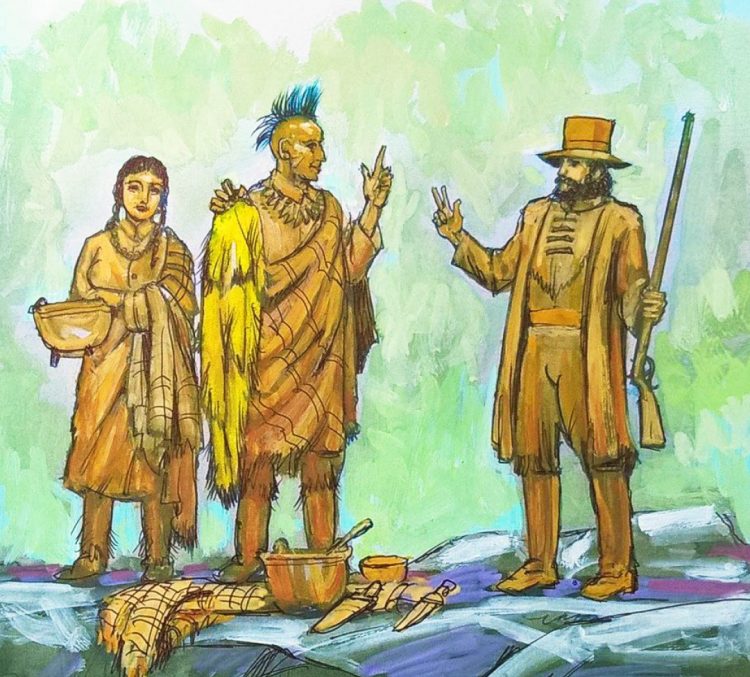 |
| Artist rendering of the Chouteau Heritage Fountain scene to be depicted of Francois and Native American traders. |
Telling the story of Kansas City is
intertwined with the ambitions of Francois and Berenice Chouteau and Francois’
two younger brothers, Cyprian and Frederick. Without much fear, these pioneers uprooted
their lives to live in the wilderness of western Missouri. These
French-Catholic fur-traders are at the very foundation of the City of Fountains
and should be a name synonymous with the history of our great city.
** Don't forget to check out my podcast with 610 Sports radio personality Bob Fescoe! You can access it through the free Radio.com app on your phone OR click here! It's free!
** Please search The New Santa Fe Trailer on Facebook and LIKE my page so you don't miss any of my cool KC stories!


