These images, pinned to the top of this blog, are shamelessly shared via-social media on personal pages, history blogs, and even the Smithsonian. The two photos side-by-side, one of a young girl
donned in a plaid dress and the other of a stoic woman with her hair pulled
simply back, have been timelessly interpreted to be “the richest Black girl in
America,” Sarah Rector - the very same Sarah Rector who lived out the majority
of her interesting life in Kansas City.
I have some important news to share with all of America.
 |
Headlines in 1913 captured only part of the story
of Sarah Rector |
Those images are not Sarah Rector.
I, too, fell victim to the forgery of these photos. Around Black History Month, I always see several posts about her story, complete with
these photographs of an unknown girl and a young woman. I mean, if credible sources are using the images,
they must be her... But they aren’t.
Just over a century ago, headlines spilled across America
and the world and are misrepresentations of what really happened to Sarah
Rector, her money and her family. The most important part lost in this saga is the
simple fact that her family got lost within the tabloids- tabloids worldwide
that painted a picture of a poor little Black girl from Oklahoma who slept on
a dirt floor, struck it rich, was taken advantage of, and lived frivolously.
Some of these statements are partially true, but the true
story of Sarah should be told through her family. It was, in fact, her family
that was there for her through thick and thin.
How did I get this information? How do I know for
certain those images aren’t Sarah Rector?
 |
The Rector women who made this research & writing possible.
L-R: Donna Thompkins, Deborah Brown, Rosina Graves, and
Diann Brown. They are the daughters of Rosa Rector, Sarah's sister |
I started where I always do- in the pages of research and of
history. If I was going to tell the story of Sarah Rector, I had to find living
descendants.
Families are the ones who hold the memories and records that
make up our collective history.
I always try to preface that history should be told in
stories, and those stories aren’t laced into the words of traditional history
books or told in timelines. You won’t likely find the real stories on the
Internet, and the good stuff is definitely not on Wikipedia. You learn the
truth behind the headlines by talking with people - with families- sitting down
with those that have collected the records, hold hundreds of photographs of
their own family, and can laugh as well as reflect on the past. I was lucky
that a line of the Rectors - Sarah’s nieces- were willing to talk to me and
share their story.
Let me tell you: Sarah's nieces are amazing, strong women.
 |
| L-R Debbie, Diane (the author of this blog) and Donna |
Through multiple meetings that always comprised of food
(including the best fried fish I’ve ever had) and laughs that made my stomach
hurt, I visited with Sarah Rector’s nieces and learned more than about the
richest Black girl in America- I learned about their rich history. These women
introduced me to some powerful stories of slavery, survival and then life after
striking it rich. It became vividly clear that this story isn’t about Sarah-
it’s about the Rectors.
I am blessed to be able to share their
true legacy with the world.
*****
Sarah Rector, touted to be the “richest Black girl in
America” in 1913 when she was just 11 years-old, holds more than just
wealth in finances. To tell this story the right way- in order to paint the
picture of the “richest Black girl in America” – we have to understand the
circumstances surrounding Sarah Rector’s ancestry and the family that raised
her.
 |
| Chief Opothle Yahola (1778-1863) |
Sarah Rector’s luck hit in part because of her ancestry and
the way in which land allotments for Native Americans- and their freedmen- occurred in Oklahoma. Sarah’s paternal grandparents were born into slavery and were enslaved by the Creeks in eastern Alabama. In the 1830s, history
tells us, the Five Civilized Tribes (which included Creek, Cherokee, Chickasaw,
Choctaw and Seminole Tribes) were forced to leave their lands. 20,000 Creek
Indians and their enslaved people were forced west.
The chief of the tribe, an Alabama-born man named Opothle Yohola (1778-1863) was one of these leaders who enslaved people. When he moved to
Indian Territory, he settled on a 2,000-acre plantation near the Deep Fork
River. One of his people in bondage was none other than a woman named Mollie,
and Mollie would marry a man who was once held in slavery by Reilly Grayson.
His name was Benjamin McQueen.
Chief Opothle Yohola may have owned chattel, but he wasn’t
willing to sacrifice it all and side with the Confederacy during the Civil War.
Even as most of the Creeks opted to follow the rebels, Opothle Yohola stayed
neutral during the early onset of the war. Due to the encroaching Confederate
troops, many Creeks fled into Kansas and joined the First Indian Home Guard.
Sarah’s maternal grandfather, York Jackson, served alongside Creek Indians as a
private. His father, Jack McGilbra (1821-1891) was enslaved by the Creeks.
Names in this family’s history can be complicated, so
bear with me. York had taken the surname “Jackson” in honor of being,
literally, "Jack’s son."
An enslaved woman held by Opothle Yohola named Mollie married
Benjamin McQueen and had a son named Jack Benjamin (another example of a
freedman choosing his father’s first name instead of a slave master’s surname).
Jack Benjamin left Indian Territory long enough to enlist in Lawrence, Kan. In
November 1863, he joined the Union Army as a private in the 83rd
Infantry, U.S. Colored Troops.

Even after these two men once in bondage left the service, they returned back to Indian Territory to rejoin
their family and friends.
At the onset of the Civil War in 1861, the Five Civilized
Tribes included 10,000 enslaved men, women and children - and they weren't freed just yet.
Jack Benjamin (cir. 1838-1915), for some reason, changed his
name to John Rector and married Bettie Corbner (b. 1846). York McGilbra Jackson
married Amy Manuel (1846-1936).
Shockingly, even though the Civil War abolished
slavery across the nation, that didn’t include Indian Territory. In 1866, a
treaty forced Native Americans to abolish slavery and allowed Creeks and these slaves (freedmen) to become United States citizens.
Freedmen such as Benjamin and Mollie McQueen, Jack Benjamin
(John Rector), Bettie Corbner Rector, York Jackson (McGilbra), and Amy McGilbra
were all freedmen born into slavery and eligible for land allotments according
to the treaty. At this time in history, Indian Territory had been reduced to 20
million acres. Each freedman was given 160 acres of land, and the Creek
Freedmen chose to settle together and form their own town.
 |
Amy Manuel McGilbra (1846-1936) with Joe and Rose
Rector's daughter, Rosa (1913-1992)
Photo courtesy of the Rector descendants |
Originally calling their settlement Twine after William H.
Twine, the first editor of an African American newspaper in Indian Territory
(who ironically rented land from John Rector), the town by 1904 became known as
Taft.
Sitting eight miles west of Muskogee, Taft today is one of
only thirteen all-Black towns still in existence in Oklahoma. At the time, it
was one of fifty settlements founded by freedmen.
John Rector and his wife, Bettie had a son named Joseph (b.
1878), and York McGilbra Jackson and his wife, Amy had a daughter named Rose (b.
1886). In an all-Black community concentrated on farming cotton and corn, it is
certain that these two families knew one another for quite a long time.
Just because they were allotted 160 acres apiece didn't mean they were resistant to poverty; it was quite the opposite.
To think that these families, mostly illiterate and lacking
formal education at the time, were able to build the bustling early 20th
century town of Taft is inspiring. According to the Oklahoma Historical
Society, Taft had two newspapers, three general stores, a
brickyard, drugstore, a soda pop factory, a livery stable, a gristmill, two
hotels, a restaurant, a bank and a funeral home- all before 1910.
Joe and Rose likely attended church, dances and social gatherings together for many
years before they decided to take the plunge. First came their daughter,
Rebecca (called Becky) in 1901 and Sarah followed on March 3, 1902. By 1906, a
boy named Joe Jr. joined the growing family.
They didn’t have much; the dusty streets of Taft were the center of their entire social existence. In 1907, the town’s population
clocked in at a whopping 250 with most of the community traveling to it
from their Indian allotment lands outside of town.
The growing Rector family resided in a two-room cabin
situated on Rose’s allotment of land. Yes, two rooms are tight- but it’s likely
to have been the condition of most, if not all, the freedmen that lived in the
area around Taft.
Allotments were about to run out, and the Rector’s knew it
was time to get in line for their children. The cutoff date of March 1906 only
allowed their three oldest children, Becky, Sarah and Joe Jr. to get a piece of the
lands even though they welcomed a daughter, Lou Alice in 1907.
 |
Sarah Rector's land allotments on the Cimarron River is highlighted
on "Hastain's Township Plats of the Creek Nation," 1910. |
By the time they had their chance to get a hold of land for
their children, the pickings were slim. Becky’s land was in Okfuskee County,
and Sarah and Joe, Jr. ended up with fragmented parcels of 160 acres 50 miles northwest of Taft. The government was grabbing at undesirable deeds that
didn’t even adjoin one another; Sarah’s land was near a bend along the Cimarron
River and was valued at around $500. At $3.50 an acre, she wasn’t shouting “I’m rich!”
just yet.
Nor did anyone ever in a million years think that a Creek freedman would become a millionaire.
To own land- even land with the rockiest, driest soil-
requires taxation. Taxes, people. Taxes always seem to play into the Rectors
rise and demise.
 |
"Home of the Creek Freedmen," Oklahoma Territory, cir. 1900
Image courtesy fo the Records of the Office of the Secretary of the Interior |
By 1909, Joe was trying to sell his three children's land
holdings. The fact that they had 160 acres per child became a pretty big tax
problem, especially since the land that landed in their laps was so far away.
He was successful only in selling Becky’s land for $1700 in 1910, a financial
windfall for the family.
But, was that enough? Was that $1700 going to support a
family that had now grown to seven mouths to feed? It was certainly a ton of money to a family
living in a two-room cabin.
There was soon a buzz within the tight knit community of
Taft. Oil- the black gold of America- was discovered in farms sprinkled across Oklahoma. It seemed that the richest soil in the area didn’t
necessarily hold the high dollars below ground… it could be anywhere.
…Especially on untouched rocky, grimy lands allotted to
freedmen.
By 1911, Joe was desperately trying to rid himself of
Sarah’s land. The new promotion of leasing land to these greedy
oil-diggers presented a new opportunity for the Rectors' useless
land so many miles away from them. Joe ended up quite satisfied when he was
able to lease Sarah’s land to an oil company out of Pennsylvania. He received a bonus of $160.
They still didn’t strike oil. The lease ran out and nothing
happened. But things had happened on other freedman lands, and the results led to nothing positive.
Money can, indeed, create problems.
 |
| Faculty at Taft School. Courtesy Oklahoma Historical Society |
Oil was discovered on other Indian allotment lands
given to children. In the same year, Harold Sells, 13, and his sister, Castella, 10, struck the big time when oil was discovered on what was assumed to
be useless land. In the middle of the night, dynamite was placed under their
house in Taft where the two children were sleeping. The house erupted into fiery pieces.
Harold was killed instantly. His little sister was trapped under burning timbers
and was not as lucky.
These kids were murdered for an estate valued at just over $50,000.
Several men, both Black and white, were implicated in the
crime, including Jim Manuel, likely a distant relative of the Rectors. The
surname “Manuel” was in fact Rose’s mother’s maiden name.
More on this connection soon.
 |
Headline in the Muskogee Daily Phoenix
April 26, 1915 |
Striking oil was surely a life-changer, but as the little
Sells children learned, it also brought greed and great weight on how to manage
what could be millions of dollars.
A year later, another lease for Sarah’s land came through-
but for only $80. At this same time, a “gusher” had been located about five
miles south of Sarah’s land. That’s when karma kicked in.
In March, when Sarah was attending school in nearby
Taft, oil driller B.B. Jones assembled the necessary equipment to
check out Sarah Rector’s land near the Cimarron River. Any oil produced would
give a 12.5% royalty to Sarah.
In late August 1913, B.B. Jones produced a “gusher” on the
land leased from Sarah’s allotment. Quickly, this oil gusher produced 2,500
barrels of oil per day. Sarah’s cut- per day- was $300.
That was a hell of a lot of money.
By this point, Sarah was the second oldest of six children,
her parents welcoming Alfred, Lillie and little Rosie by 1913.
New siblings weren’t the only thing new in Joe and Rose’s
life- they had a daughter who was transformed as a little Black girl from Taft into a millionaire headline overnight.
Headlines such as “Girl’s 112,000 a Year,” “Negro Girl Will
Pay Largest Tax,” and “Negro Girl Rich From Oil- Has Income of $475 Daily –
More Soon” sensationalized the story of a girl and her family’s reality. When
this gusher was found by B.B. Jones on Sarah’s land, the family
still lived frugally in their little cabin.
 |
| Photo courtesy of Oklahoma Historical Society |
It wasn’t uncommon for white guardians in Oklahoma to be placed by courts in
order to protect allotments of freedmen. For whatever the reason, Joe opted to
appoint Thomas Jefferson (T.J.) Porter as Sarah’s guardian in July 1913- just a
few months before the “gusher” gushed its millions.
Why T.J. Porter? Well, he was, according to the family, a trusted acquaintance. And boy, did the newspapers have a hey-day with his motives.
This may seem strange to us now, but it was commonplace in
this era to have white legal guardians taking a cut of the royalties in order
to supposedly “protect” an estate. Guardians got on average of two to six percent
of the profits, and in the case of T.J. Porter, he got less than two percent.
When I asked the Rector descendants on their personal
feelings about Porter, they described him as being a fair man.
Regardless, he was in control of all bankrolls from Sarah’s newfound
wealth.
In November 1913, Joe was receiving $50 per month for
Sarah’s care, which was a ton of money in those days.
They even eventually had a seven-passenger Cadillac, a big
upgrade from a horse “too old to work.”
It wasn’t long before the accusations came pouring in from
outsiders.
 |
| The headline on November 29, 1913 in the Chicago Defender |
Sarah and her siblings were perfectly content going to
school in Taft, but that didn’t seem to be acceptable of those outsiders looking
in.
Due to her newfound wealth, publications across America
wrote of marriage proposals, especially
those that came from four white men from Germany. “Evidently the color of an
heiress does not matter if the color of her gold is genuine,” wrote Edward
Curd, Sarah’s attorney. He also concluded that the men that wrote her were
“fine looking chaps.”
By October 1913, 11-year-old Sarah Rector received $11,567
in royalties from the gusher.
 |
| Booker T. Washington |
It was an article in a respectable Black newspaper called
the
Chicago Defender that turned
their worlds upside down. In November 1913, not aware of the monthly allotments
Sarah was getting, the newspaper headline read “Richest Colored Girl Forced to
Live in Shack.” Claims were made that Sarah was sleeping on the floor and her
guardian was only giving her a few dollars a month. The article claimed, "The parents are so ignorant they have no conception whatever the amount of her income and no inclination to assist upon a good education and befitting comforts to her, so little Sarah easily becomes the prey of white men."
That’s all it took. The Washington
Post went on to write that Sarah had “little mental capacity.”
These were all lies, perpetuated by the media.
The headlines didn’t shake the foundation of this family, and
T.J. Porter had to answer to so many of these accusations. In December 1913, Sarah received a
phonograph, a piano, and they built a new five-room home for her and her
family.
Between the marriage proposals, the mistreatment of funds, and the idea that Sarah was not being furthered academically became a target of
the public. The NAACP got involved due
to the continuous reports from the Chicago
Defender. W.E.B. DuBois personally wrote the judge overseeing her
allotments and asked that they ensure that little Sarah- not her siblings-
receive the best education offered.
 |
November 28, 1918 addition of the Chicago Defender created a stir
with the NAACP |
Booker T. Washington allegedly became so concerned about
Sarah’s condition- not those of the rest of the family- that he came to the
area in the summer of 1914 to inspect her home. Was Sarah sleeping on a dirt
floor? Was she in the condition that some had reported her to be in?
That would be a “no.”
It was reported that Sarah had still never slept in a bed
(but on a pallet) and she was still living in a “poor house” on her mother’s
land.
The truth was that the family was in what we could call in a
moderate condition; they were not in dire straits.
Even when the children were still attending school in Taft,
the financial problems continued. By Spring 1914, Sarah’s allotments had given
the family just over $55,000 in royalties. Just a short time later, the
pressure from the NAACP and Black leaders across America who had read her story
had Sarah leaving home and heading back to where, ironically, the story began:
Alabama. Sarah was enrolled in the Tuskegee Institute’s elementary school called
the Children’s Home, but she wasn’t going to do it alone. Her mother insisted
that older sister, Becky go along to ensure her younger sister was in good hands.
Even after Sarah and Becky left for Alabama for better
schooling, the newspapers reported that they were living in a tent.

Sensationalized media existed even then.
After one year, the girls went to Fisk University’s boarding
school before rejoining the Rector family for Christmas break in 1916. No
evidence exists that the girls returned to school in Alabama, and it's likely the family moved
shortly thereafter to Kansas City.
Most of Sarah’s money was held up in investments across the
community and in bonds. By the time she left for school, T.J. Porter had
arranged for her to buy over 2,000 acres of land that he then leased for a steady income. One of her
bigger investments was in a two-story building in Muskogee at 213-223 S. 2nd
St. that included the Busy Bee Café. The top floor was renovated and became the
Busy Bee Hotel.
Sarah’s family still remembers hearing stories of the Busy
Bee Café.
By the time Sarah was 18, she was worth well over one
million dollars. Likely in order to escape scrutiny and not wanting to be the
target of some greedy party’s act, Sarah’s family secretly slipped away and
moved north to Kansas City by 1917. By 1918, Joe Rector is listed as living at
1218 Euclid in the heart of what was becoming a booming African American
community. The family appears to have lived here for at least three years.
As fate would have it, the Rector family would further
reside in Kansas City and visit their beloved home of Taft when they could.
 |
The caption suggests Sarah Rector bought the home, but her mother, Rose did.
Published in the Kansas City Sun, September 11, 1920 |
I found it interesting that her family told me that Sarah
never really visited her “homestead” containing the "gusher" that made her millions of dollars; she fell on the wayside as a spectator of her
own wealth in the long run.
The Rectors settled into the east side of Kansas City in the home Rose
bought at 2000 E. 12th, now oftentimes referred to as the Rector
Mansion.
Even as the Rectors relocated to Kansas City, there were
transactions and business to attend in Oklahoma. By 1918, there were 50 oil
wells on Sarah’s land, and a new contract with a Kansas company resulted in a
$300,000 signing bonus...
...In 1918.
 |
Mama Rose Rector posing inside the Rector Mansion in the 1920s
Photo courtesy of the Rector descendants |
Getting that beautiful brick mansion at 2000 E. 12
th
was a statement to everyone in the community- they were reformulating the
boundaries of acceptance. That property had quite a bit of history that didn’t
involve African Americans, which further made the transaction monumental.
They just didn’t think that mansion was lovely, but they set
out to buy the whole block. By 1920, the Rector family, including 18-year-old Sarah,
were all living in a home previously occupied by Henry S. Ferguson, president
of the U.S. Water & Steam Supply Company. He had lived in the home for over 17 years.
The house, known today (inaccurately) as the Sarah Rector
Mansion or House, was actually purchased by Rose Rector for $20,000 after they
leased the home for several months. At the time the house was purchased, it was
said Sarah was worth one million. The house was known as “Sunset Manor."
Quickly, the entire frontage of 12
th St. from Euclid to Garfield was bought with Rector money. Just as had been done while Sarah was under guardianship of T.J. Porter, investing money and leasing land was part of the Rector portfolio.
Not every segment of the Rector history is rosy. Even before the family's wealth, Joe had his run-ins with the
law. Joe’s reputation may have made Rose’s parents a bit nervous when they decided to get married. In 1898, Joe was stabbed
twice in Twine, once in the right shoulder and once in the left chest. Although it was originally thought he would die from his injuries, he survived.
In 1916, Joe was involved in a lawsuit with his mother over falsified
deeds, and in 1920, there was a "disagreement" after a game of cards in Taft that had a
gun pulled on him. Luckily, even though the gunman shot at him twice, Joe was
unharmed.
Even Joe’s own brother, Fred tried to get in on the money
management of Sarah’s lands. That alone tells you how contentious (and how
important) it was that the family move away.
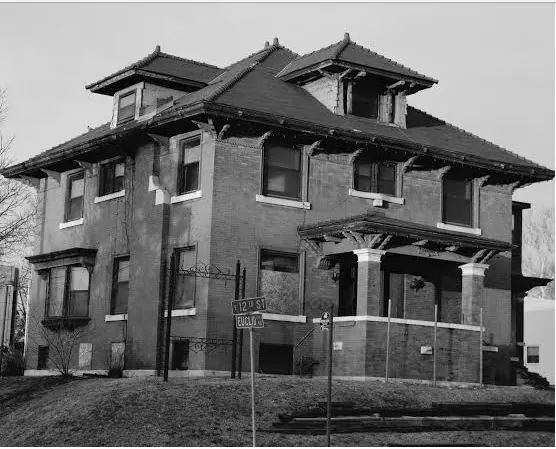 |
| The Rector Mansion at 2000 E. 12th St. |
The Rector family came to Kansas City for a new life and to
obviously avoid the misfortunes that overtook other freedman families over
money.
In 1922, the Rectors had a really big year-both good and
bad.
Sarah wanted nothing more than to have control over her own money after years of guardianship, and even though she had turned 18 in 1920, people still wanted their hands in the pot.
Luckily, a judge named Jules E. Guinotte (son of Kansas City pioneer Joseph Guinotte) released her from guardianship and set her free at last.
This was good and bad. At this same time, Joe Rector allegedly received a call from an old acquaintance named Jim Manuel.
Does that last name sound familiar?
Remember those two little children killed by dynamite after their allotments ended up with oil reserves on them?
 |
Headline from the Muskogee Times-Democrat
August 17, 1920 |
Jim Manuel had allegedly been involved in the dynamite explosion in
Taft that killed two children with oil allotments. However, he was not
one of the two men who were given life in prison for the heinous crime.
He also had a rap sheet that makes Joe look like a saint.
Jim Manuel had a rap sheet in Oklahoma that reached
back to 1895; he was labeled as a “notorious negro” arrested for forgery of
five checks, deeds, and for stealing a horse and buggy. He was labeled “a
dangerous hombre” when he tried to take a gun into a jail so he could shoot
officers.
In 1913, he was said to have a set of gold teeth that would
disguise his identity and that he had a warrant in almost every county in Oklahoma. He was
“charged with enough misdemeanors to send him to the penitentiary for life.”
Instead, they put him in for ten years.
That didn’t last.
 |
Headline featuring Jim Manuel's arrest in the Muskogee
Daily Phoenix, Oct. 19. 1913 |
In 1919, Jim Manuel was pardoned and then sent to St. Louis
to answer for a charge of “using the mails to defraud.” He was charged and
convicted of the crime.
Jim Manuel, about 40 years old, was always up to no good.
Maybe Joe didn’t see this for some reason, even though Jim was responsible for
defrauding his own sister in Taft years before.
As an inmate in the Missouri State Penitentiary, Jim
allegedly contacted a Mexican lawyer he knew from prior “endeavors.” The lawyer
then contacted the warden and claimed that Jim had lands gushing with oil worth
millions of dollars. Jim was described as “60 years old, skinny as a rail, bald
headed and without a natural tooth in his head.”
After pressuring the prison warden, Jim Manuel was able to
allegedly arrange a meeting at the Rector Mansion in Kansas City, Mo. with a prison guard
in tow. He pleaded with Joe, stating that he couldn’t get to the land worth so
much money in oil without his help, and he promised to give him half of the
money earned.
Rose Rector definitely didn’t like the scenario, but as her
descendants told me, “Mama Rose” was always “including Joe in financial
decisions.” Rose was a hard worker as a laundress prior to the financial
windfall, and she knew hard work in her day. It was said in many
records that she was “stingy.”
 |
Original telegram sent to Mama Rose Rector July 10, 1922 mentioning Joe Rector's body being
transported to Muskogee, Okla. Courtesy of the Rector descendants |
The Rectors certainly knew something of his criminal past,
but money may have been the motivator here. Sarah Rector had given Mama Rose control of her money, and her father, Joe didn’t have any say.
In order for Jim Manuel to show Joe Rector where the alleged
$40,000,000 oil gusher was in Mexico, he had to be free. In turn, Joe was able
to talk his wife (allegedly) into paying his $8,000 bond plus $2,000 in
expenses to go to Tampico, Mexico and get his half.
 |
Headline in the Muskogee-Times
Democrat, July 11, 1922 |
This story, for the record, is quite different than the
story told to me by the Rector family. They were told that Joe was working on
bringing cattle back from Texas when he was shot on a train.
Maybe? That could be true, but it is also a possibility that
what the papers reported were embarrassing for the rich Rector family. The
truth lies likely somewhere in between these stories.
While on their adventure, Jim Manuel and Joe Rector
arrived in Mexico on Joe’s dollar and all the money evaporated while trying to
target this land in Tampico. Not too long after arriving, Jim Manuel disappeared into
the sunset. All records indicate he never, under his legal name, surfaced in
his homeland.
This left Joe Rector all alone, broke, and with the heartache of
telling Rose what happened. The newspapers reported with much sensation that he
was desperate and finally wired his beloved wife at 2000 E. 12th for
the money to get home. Defeated, he “sobbed all the way” to Dallas where “his
sorrow killed him” as he traveled by train on his way back to Kansas City.
What?
Joe’s death record tells different story.
It shows that from July 7 to July 8, Joe was seen by a doctor at Baylor
Hospital in Dallas. His cause of death looks like “trauma” and the underlying
cause was kidney disease.
It was known that Joe had prior operations for health
reasons.
Regardless, the newspapers registered this unfortunate death
as being the fault of Jim Manuel and his scheme for some of the Rector money.
 |
Sarah Rector at her home in
Wyandotte Co. |
This death was a blow to his wife, Rose and her children in Kansas City. Mama Rose quickly arranged a train to take her beloved
husband’s body back to Taft where it was buried at Blackjack Cemetery in the
family plot.
Several stories were shared about the family’s time in the
Rector mansion. In the back of the stately home was a two-story carriage house
with servant’s quarters on the second floor. It should be no surprise that the
family had hired help in the Roaring Twenties, where less than a mile down the road was the booming 18th and Vine district - the hub of African American social activity.
Shortly after the death of Joe, Sarah married Kenneth Campbell when she was 20 years-old and her sister, Becky married as well. Cars
and clothes seemed to be the favorites with the Rector women. A chauffeur was
tasked with driving a series of expensive vehicles, including a Rolls Royce.
When Rosa, Sarah’s little sister (b. 1913) was forced to go to school, the cries
would echo throughout the Rector home.
It became a routine for her to be dressed while still
sleeping, put inside the Rolls Royce limo while she still slept, and the
chauffeur would struggle to get her out of the car and "get her butt into school.”
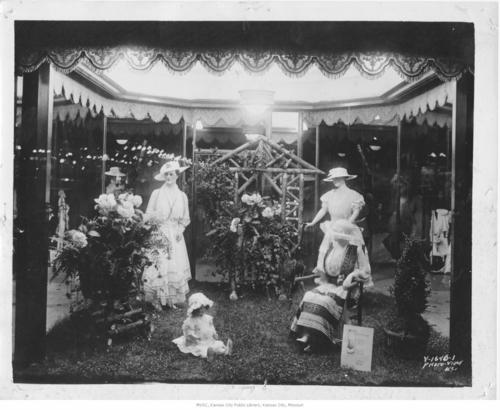
 |
A 1925 window display at Kline's at 11th and Main shows the fashionable
items available along Petticoat Lane.
Courtesy Missouri Valley Special Collections, KCPL |
In the 1920s, the whole family, including Sarah and her
husband, Kenneth lived in the Rector mansion. One of Mama Rose’s chauffeur’s
named Emery Nelson got himself involved in a little scheme when a vendor showed
up just before Christmas in 1924 to make a sale to the Rector ladies.
$2,000 worth of silk underwear “and other silken wearing
apparel” valued at another $500 was stolen from a car outside as the vendor was
showing the ladies his new line of silks, trying to make a sale.
The ladies loved finer clothing, but due to the color of their skin,
they were not allowed to shop alongside white patrons in stores along Petticoat
Lane in downtown Kansas City. Many stores, including Emery, Bird, Thayer &
Co. (EBT) would shut their doors to the public and allow the Rector women to shop freely.
Spending freely at the most fashionable stores was
commonplace for the Rectors in the 1920s. In 1926, Mama Rose must have been a
bit embarrassed when the exclusive Vogue Shop at the Hotel Muehlebach, which
featured “unusual style and exquisite designing” claimed she wrote a bad check
for $388.50.
 |
| Kenneth Campbell and Sarah Rector Campbell appeared in the Kansas City Call shortly after their marriage |
Sarah’s husband, Kenneth Campbell focused on real estate
development and his Hupmobile car dealership at 18th and Vine. Sarah and her
mother, Rose were known for their fancy vehicles they raced around town in. In
fact, both women appeared to have a bit of a lead foot. Several speeding
tickets were issued to both of them- especially to Sarah.
When she was pulled over in her shiny green and black
Cadillac, Sarah would cockily turn to the officer and say, “Don’t you know who
I am?!”
Sarah had three children, Kenneth (b. 1925), Leonard (b.
1926) and Clarence (b. 1929) before her marriage- and her finances- fell apart.
 |
| Sarah getting into her fashionable car, cir. 1950s. |
The history books tell us that the Stock Market Crash in
1929 set the stage for a nationwide Depression that destroyed a myriad number
of millionaires. The Rectors were no different. Extensive landholdings in
Oklahoma, bonds now worth nothing along with depleting oil royalties marked the
end of their overly-lavish spending habits.
It was around this time that the
taxes on the Rector mansion came due. Taxes always seemed to be their downfall.
The home was sold to the Adkins Funeral Home.
Sarah and her older sister, Becky divorced their husbands
and moved to much smaller homes on the east side. In 1930, Sarah was living
with her sister and her maternal grandmother at 2440 Brooklyn. In 1934, Sarah
married William Crawford, the owner of Dick’s Down Home Cook Shop at 1521 E. 18th
St. It was a favorite hangout of the Kansas City Monarchs baseball team.
To be clear, Sarah still had quite a bit of money, but she
didn’t have the ability to throw money around like she had once. Her siblings
all took on jobs- her mother even for a time went back to working as a maid.
Sarah was known for her extravagant parties that are
oftentimes referred to as being in the Rector Mansion on 12th St. where
she entertained musicians such as Count Basie and Duke Ellington. There is no
doubt that some parties would have occurred in this beautiful home, but the
real parties happened, according to her family, when she moved to her home on
Lockridge on the east side of Kansas City.
 |
"Dick's Down Home Cook Shop" at 1521 E. 18th St.
Image courtesy of Tonya Bolden |
She continued to invest in real estate and owned several homes
around 26
th and Lockridge. She owned a sprawling farm in Wyandotte
County where she invited her mother, siblings, nieces and nephews. Fond
memories, although a bit traumatic at the time, included geese chasing
the children all the way up to the door of the farmhouse.
That farm became the
gathering place for the family to remove themselves from the heart of Kansas
City and likely reminded the Rectors of the simpler life once lived in Taft,
Okla. Sarah was quiet and private; her easygoing nature were witnessed by her nieces in those visits to the farm.
Sarah’s nieces spent many-a-summer visiting the farm in Wyandotte
County and visiting family down in Taft. One of Sarah’s dear friends from
childhood nicknamed “Big Momma” would race around the dusty landscape chasing
chickens- chickens running around without heads.
A few hours later, dinner of fried chicken was hot and on
the table. Needless to say, the children would say they weren’t hungry anymore.
 |
| (L-R) Jeannie, Roy's wife, Mama Rose and Rosa |
At the highest point of her millions, Sarah Rector was said
to have had an income larger than that of the President of the United States.
Her oil wells at one time produced $2 per minute- she became a national
headline and her whole family’s lives would never be the same.
The matriarch of the Rector family, Mama Rose, passed away
in 1957 and is buried in Blackjack Cemetery next to her husband and near
generations of freedmen trailblazers that led to the unique story of the Rector
legacy. Just over 10 years later, Sarah passed away from a cerebral hemorrhage
on July 22, 1967. Ironically, her body was brought to C.K. Kerford Funeral Home.
Her last stop in Kansas City was none other than the old Rector Mansion at 2000
E. 12th St. where she and her family had once lived a life of luxury and was then operated as a mortuary.
Her
final resting place in the ground was back where the story began- back in
Taft, Okla. in that little peaceful parcel of land known as Blackjack Cemetery.
Today, there are many rumors that circulate around the
Rectors, and the reason for this began in the headlines that blasted across the
nation and world. The lies began then, and unfortunately, many of those lies
are still circulated as being the truth. Sarah wasn’t deserted by her parents;
she wasn’t left in the care of a white guardian. Her family loved and supported
her when they lived in a small two-room cabin on Mama Rose’s allotment, and
they loved and supported her when she struck it rich.
The family didn’t leave Kansas City, Mo. as some have reported;
five generations of Rector descendants still call this place home. They stayed quiet as the rumors about their family recirculate every so often,
as that false photo of Sarah is placed at the top of newspaper headlines and
social media posts.
They drive by the abandoned Rector Mansion, boarded up and
falling into disrepair, wishing that they could find a way to buy it back and
bring it to its former glory. They cringe when someone says, “That’s the Sarah
Rector mansion!” because the home was for all
of the Rectors and purchased by Mama Rose, the matriarch of the family.
It’s the Rector Mansion.
 |
| A watercolor painting of the Rector Mansion by Pamela Morris (2019) made for the Rector descendants |
“We would like to see the house restored and have it become
a historic landmark and museum,” the Rector descendants told me around the
kitchen table covered with photos, records and family papers. “We have things
we would like to share with everyone.”
 |
| Sarah Rector at her farm with one of her nieces |
The hope in having me write this, they told me, was to dispel
so many of the wrongs that have been written over the past 100 years. They
showed me incorrect articles from the Smithsonian, a video of a man claiming to be a direct Rector descendant who they don't know (who was shamelessly
asking for donations to make a documentary about “his family”), and countless Black
history websites that simply get the story wrong.
This article was meant to rectify the Rectors - to give them
some peace of mind that their family’s story is, in fact, part of the history
of our nation. But if it’s to be told, it must be told in its entirety. This
was meant to tell you about their whole family- not just Sarah – as Sarah’s
story is interlaced with her grandparents, her parents and her five siblings.
Today, it’s kept alive by relentless Rector women set upon making sure their
story from now-on is told right.
I am honored- humbled- that I was the one chosen to right
some of the wrongs placed upon this family’s legacy and share this family’s
powerful place in the pages of history.
The time has finally come to tell the truth.
Photos in this blog were courtesy of the Rector-Brown-Graves family. Please see below for additional family photos!
*If you liked this story, you need to check out my podcast, Kansas City: 2 States, 1 Story- It's FREE! Along with radio personality Bob Fescoe, we discuss local history in a fun, exciting way! To learn more about it, click here! If you enjoyed this story, please considering liking my facebook page, The New Santa Fe Trailer so you can read more of the stories I publish!
Recommended Reading:
Searching Sarah Rector: The Richest Black Girl in America by Tonya Bolden.
Killers of the Flower Moon: The Osage Murders and the Birth of the FBI by David Grann
 |
| Mama Rose (1886-1957) on the farm |
 |
| Becky (1901-1968) and Rosa (1913-1992). Rosa's daughters supplied the information for this writing. |
 |
| Lou (1907-1957) |
 |
| Alfred (1909-1972) |
 |
| Roy (1918-1991) |
 |
| Arthur (1915-1989) |