Previous Posts

Showing posts with label Jackson County. Show all posts

Friday, August 30, 2019

August R. Meyer: Father of the Parks and Boulevard System

Gardens at 13th and The Paseo. Courtesy Missouri Valley Special Collections, KCPL
Kansas City’s extensive park and boulevard system would not have been the same without the vision and the power of a man whose passion involved embracing nature. When August Robert Meyer made his home in Kansas City in 1881, the 30-year-old quickly rose to the upper echelon of society. He used his words and wisdom to later convince the city to make its roadways more than thoroughfares- he wanted to make the city beautiful.

August R. Meyer (1851-1905)
August Robert Meyer was born August 20, 1851 in St. Louis, Mo. to Henrich Peter Meyer (1818-1861) and Margaretha Kraft (1815-1885), both immigrants from Hamburg, Germany. His father was a very successful businessman in St. Louis and upon his death in 1864, he was one of the wealthiest manufacturers in the city. 

After his father’s death, fourteen year old August was sent to Europe to continue his schooling. He first attended school in Zurich, Switzerland, and later when he found mining to be of interest, he transferred to the School of Mines in Freiburg, Germany.  He graduated in 1872. 

After graduation, August spent a few terms continuing his studies in Berlin and later traveled around Europe visiting some of the most prominent mines there. After gaining some of the best education offered in the world, August returned to St. Louis in 1873. Seeking his fortune in the mining business, August moved for a short time to a coal mining operation in Illinois and  landed in Colorado one year later.

He struck gold.

Or I should state he struck silver.
The Healy House in Leadville, CO, was originally built by
 Meyer for his wife, Emma. Courtesy of Healy House Museum

In 1875, August Meyer started an ore-crushing mill in Alma, Co. and struck it rich in the silver industry. He along with “Silver King” Horace Tabor founded Leadville, Co. in 1877. In 1878, he married Emma Hixon of Denver, Co. and built her a beautiful home in the heart of Leadville. This home, known as the Healy House, still stands as a museum and is listed on the National Register of Historic Places. August sold the home in 1888 to Daniel Healy who used it as a boarding house.

Meyer was always attuned to the future, and when he studied the commercial prospects and the advantages of the newly-extended railroads, he saw Kansas City as the heart of industry and growth. In 1881, he moved to Kansas City and established the Kansas City Smelting and Refining Company in the Armourdale area of Kansas City, Ks. At the height of its existence, Meyer employed over 1,000 people at his company.

In 1880, the population of Kansas City was around 55,000. By 1890, the city exploded to a population just shy of 133,000. With this incredible growth in the 1880s came some serious challenges. Population was not an accurate measure of a city’s health, Meyer and others argued. There was more to it than that.  “A city must attract with more than just tax concessions and columns of figures,” Meyer said. 

 Kansas City Smelting and Refining Company in Armourdale area
 Courtesy Missouri Valley Special Collections
An avid outdoorsman and nature lover, August Meyer would oftentimes escape the congestion of Kansas City and his residence in the heart of the elite northeast area to take horseback rides in the rolling hills to the south. These escapes into nature inspired him to push the city to add beauty within the growing commercial, industrial and residential areas being built in record time. August spoke passionately at meetings, promoting his “How to Build a City” paper that outlined what growing cities needed to do in order to include nature.  

Many metropolises were beginning to see the necessity for integrating nature within the cityscape, and August R. Meyer embraced this “City Beautiful Movement.” Along with parks pusher and Kansas City Star publisher William Rockhill Nelson, Meyer begged city officials to add more parks and start planning a boulevard system. “Life in cities. . . has a tendency to stunt physical and moral growth.”

In March 1892, Meyer got his wish when mayor Benjamin Holmes appointed him as the first president of the city’s new Park Board. Holmes and Meyer worked together to hire renowned landscape architect George Kessler so that Meyer’s vision could become a reality. 

The Pergola along The Paseo
The first meeting occurred March 15, 1892 on the second floor of the Livestock Exchange Building inside August Meyer’s office. The first report released in 1893 promoted its central parkway, aptly named The Paseo, as the main artery of the parks and boulevard system. Meyer’s extensive travels were critical to some of the designs implemented; in fact, he personally named “The Paseo” after Paseo de la Reforma in Mexico City and was the designer behind Penn Valley Park. These main features of the parks and boulevard system were laid out under the supervision of August E. Meyer and executed by George Kessler.

In the Kansas City Star in April 1893, Meyer outlined some of the details of the boulevard system. He proclaimed, "The project is a grand one. It will produce something characteristic; something that will go a long way to call attention to the natural beauty of our surroundings, and to the excellence of our climate."

The idea was complex, but the results would be critical in how Kansas City grew. The new parks and boulevards would highlight what was once a major problem in the city- the hills.
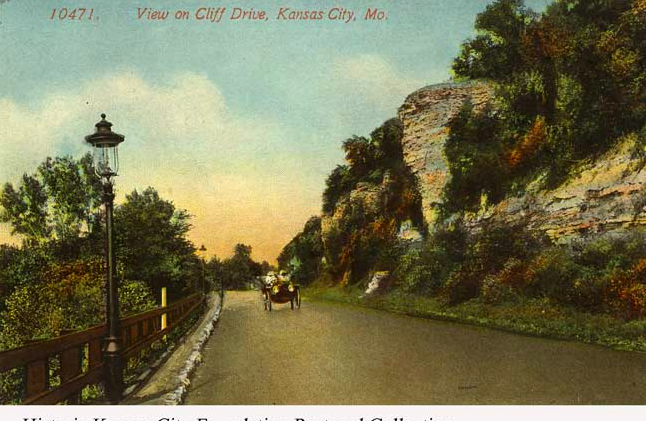
Cliff Drive, a part of North Terrace Park (renamed Kessler
Park in 1971)

Kansas City was built on a grid system, which is why, in my opinion, it's one of the easiest cities to navigate. Numbered streets from the Missouri River increase as the city moves south; named streets, for the most part, are reserved for north-south streets and continue from one end to the other. Even with this easy grid system, the city was congested. There was a need for beauty and for ease of travel.


As I've written before, the boulevards were the main arteries to our system of roads. They were the thoroughfares- our highways- at the turn of the century. And, my goodness, were they made to be beautiful.

When a proposal for a special property tax was discussed in order to fund this large system of parks and roads, people protested the costs associated. However, the power of the Park Board, including the influence of Nelson and Meyer, were able to calm fears and have the tax pass in 1895.

With the help of landscape architect George Kessler, Meyer was able to have plans drawn up to perpetuate the parks and boulevard system. Roads were built with beauty in mind, and they were meant to lead you to something beautiful. The creation of the first three parks, North Terrace (now Kessler Park), South Terrace and Penn Valley Parks gave the city some elegance in midst of the congestion of downtown.
The lake along The Paseo, cir. 1900.

Meyer wrote, "Strangers coming to our city will then have some objective print for their drives and rides, and our own citizens will no longer be compelled to limit their outdoor enjoyments to the mild and dry seasons, for the boulevard will be enjoyable alike to those who ride and drive, or walk, during all seasons of the year."

August R. Meyer got what he wanted. Within the first few years of the development of the boulevards, specifically The Paseo, postcards donned the images of beauty seen. People visiting Kansas City made a point to visit these incredible boulevards and purchase postcards to send home.

Kansas City was turning beautiful under August R. Meyer's leadership.

In 1896, August E. Meyer and his family moved from 2806 Independence Ave., once the richest area of the city, to an eight and a half acre estate designed by the architectural firm Van Brunt and Howe. This stunning, three story, 35-room Queen Anne mansion made of brick and stone featured a grand staircase and entrance hall. His neighbor was none other than his longtime friend, William Rockhill Nelson.
August Meyer's home "Marburg," now the home to the Kansas City Art Institute

This move from the northeast to the Rockhill neighborhood is said to have sparked an exodus of the rich moving west into the edifice of the blossoming parks and boulevard system that was linking the city to beauty while also creating thoroughfares that joined the city together.

His mansion, named “Marburg” at 4415 Warwick stayed in the Meyer family until 1927 when it was sold to Howard Vanderslice. It was then donated to the Kansas City Art Institute. Today, it’s called Vanderslice Hall, serves as the KCAI’s administration building, and is listed on the National Register of Historic Places.

On December 1, 1905, August Meyer died at the age of 54 from “a lingering illness” after developing a severe cold a month prior. He served on the Park Board for eight years and oversaw the development of the complex boulevard system we see today. He negotiated with landowners to get Swope, Penn Valley and North Terrace Park.

In June 1909, a memorial at 10th and The Paseo known as “the square” was erected in honor of August E. Meyer, the first Park Board president. Its placement along The Paseo shows us even today the importance of this boulevard to our area’s history. An 18-foot high bronze marker reads:

Houses and shops are man’s
But grass and trees and flowers
Are God’s own handiwork.
Undaunted this man planned and toiled
That dwellers in this place might ever
Freely taste the sweet delights of nature. 

The August R. Meyer memorial at 10th and Paseo. Courtesy of Kansas City Parks and Recreation
August Meyer knew that boulevards stimulated growth and attracted upscale residences, so it was no surprise when the Parks Board set to honor August Meyer with his own boulevard. In 1910, The Board of Park Commissioners began planning Meyer Blvd. after acquiring land to the south. Meyer Blvd. is the southern link even today of the historical parks and boulevard system -  the western portion links Ward Parkway; the middle section links in The Paseo; and the eastern section picks up the traffic and leads to Swope Pkwy. By 1913, the grading was finished, and in 1920, Meyer Blvd. was completed.

Once standing at 63rd and Meyer Blvd. was an interesting tract of land owned by William L. Rock (1865-1954), Kansas City's most well-known florist. Rock had come to Kansas City and established his first floral shop at the corner of Morton's Confectionary at 1024 Main in 1897. As his popularity developed, so did his land holdings. In 1901, Rock decided that buying flowers from Chicago and New York was quite expensive. In turn, he bought 18 acres between Troost and The Paseo.


Rock Lake on William L. Rock's land.
Courtesy of Missouri Valley Special Collections, KCPL
At the time, the land was two miles to the south of the city limits. He built twenty greenhouses that at one time had 180,000 square feet of glass. He dammed up a small creek and created "Rock's Creek," built a windmill, and added a water tower since city water at the time didn't reach that far. For just shy of 50 years, William L. Rock, "Kansas City's grand man of flowers," opened the Rock Building at 11th and Grand Blvd. where the building stands today. It was known for "windows of fine flora" where the flowers were carefully grown at his tract of land with greenhouses.
The lake and dam were destroyed to make way for Meyer Blvd., but many of the greenhouses stood when J.C. Nichols bought his land in 1946 for $95,000.

At Ward Parkway and Meyer Blvd. stands one of the most iconic fountains in all of Kansas City. In 1922, this circular artery linking Ward Parkway with Meyer Blvd. was named “Meyer Circle.” In 1924, J.C. Nichols offered to donate a fountain in its center and pay for the installation if the city would pay for the landscaping.

The Meyer Circle Sea Horse Fountain in 1930.
Note the landscaping around the fountain.
Courtesy of Missouri Valley Special Collections, KCPL
The city eagerly said yes to the proposition; in turn, Nichols donated a 17th century sea horse sculpture that had stood in a Venetian square for over 300 years that he had purchased a few years earlier. Nichols hired architect Edward Beuhler Delk to create a fountain featuring this incredible sea horse sculpture made of Carrara marble. In 1925, the Sea Horse Fountain at Meyer Circle was turned on, featuring 28 sprays of water in a 100-foot circular park centered on an 80-foot pool where it has remained a central feature of beauty along the boulevard system.

Today, the landscaping around the fountain, much like the landscaping throughout our parks and boulevard system, has disappeared.

A prominent Kansas City businessman and civic leader, Meyer used his experiences in other cities across the nation and the world to transform Kansas City. His visions inspired real estate builders such as J.C. Nichols who continued the objective of adding physical beauty while building and constructing the city’s suburbs. 

Working alongside William Rockhill Nelson and landscape architect George Kessler, these pioneers of city improvement worked to promote the need of a parks and boulevard system. 
August R. Meyer’s planning at the turn of the century has deeply impacted the way in which our city is seen today, and his ideas greatly influenced the residential character of our city for decades to come.

*Please check out my FREE podcast with 610 Sports radio personality Bob Fescoe! Just click here to take a listen. It's a great way to hear me tell these fascinating stories about our history! It's your downloads that keep me going!

** If you haven't already, please search The New Santa Fe Trailer on Facebook and LIKE my page so you don't miss any of my writing!

Thursday, May 30, 2019

Kansas City's Terrifying Tornado in 1886 Claims Dozens of Lives


Courthouse damage from the tornado on May 11, 1886
No one could anticipate the destruction that would rumble within the sky and wreak havoc on blossoming Kansas City. When a population of 132,000 prepared to go to work and school that day, there was only the slightest risk of rain; the clouds had opened up to a pure blue sky with a light wind.

Courthouse at 2nd and Main before the cyclone
On May 11, 1886, there was a change rumbling in the distance- a change most couldn’t have ever predicted. By 10:30 AM, there was cause for concern. It happened quite quickly; the sun had been shining until darkness enveloped the land block-by-block. A curious tinge in the atmosphere colored the sky into a murky green.

Time wore on the sky, changing the coloring from a deep gray to a dense black. Clouds didn’t move in one direction; rather, they scurried one way and the other, a rage mixed into their motives.

First the wind came with distant peals of thunder.

Then, rain and hail covered the downtown streets.

And something was about to permeate the skies and unleash terror. What it was- what we would call this today- could be argued. Regardless, there was no time to prepare and no weather radios, tornado sirens or Doppler radar to track the path of an impending storm.

Citizens learned of weather by looking up into the green sky and identifying the humidity in the air.

People could sense the calamity – citizens began rushing in from the streets and crowded inside stores, homes, and office buildings. As people traveled about their business, something changed. Within minutes, this peaceful spring day was replaced by death and destruction throughout the heart of the city.

Another image of the Courthouse at 2nd and Main
Courtesy Missouri Valley Special Collections
As the sky became densely clouded, the Jackson County Courthouse at the northeast corner of 2nd and Main was business as usual. The building was originally constructed as the Nelson Hotel and was taken over by the Courthouse in 1872. Forming somewhere over the south bank of the Missouri River, the swirling storm quickly transformed into what we would likely call a full-blown tornado. So much water was collected from the river that some at the time called this event “a hurricane.”

Without much warning, the tornado made it onto land and into a direct path toward the courthouse. The Kansas City Star reported, “The force of the wind seemed to be confined to a limited district, and it sought, with almost human intelligence, the weakest buildings for its work of death.”

Because the building was constructed for a completely different business, it was said that many beams and supporting structures were removed to make for larger spaces. The courthouse was no match for the winds that barreled through at 2nd and Main. Within seconds, the top two floors of the courthouse were blown into unrecognizable pieces. Two victims were claimed in its fury almost immediately: deputy sheriff Henry Dougherty and deputy recorder William Hedges.

Dep. Sheriff Henry Dougherty
Courtesy Kansas City Star
Henry Dougherty had been standing in a large area on the first floor as a colleague commented that the storm was indeed a fierce one. Dougherty responded, “Yes, and this is the worst place we could be in.” 

Boy, was he right. At that very moment, the roof gave in and the terror began.

Instead of “duck and cover,” people ran in every direction. Dep. Henry Dougherty was no exception to this; he ran across the street and was quickly buried by falling bricks from the courthouse. When his body was discovered at 4:30 later that afternoon, he was crushed beyond recognition.

Deputy recorder William Hedges was killed as the debris fell within the structure. His little brother, Edward – also a deputy recorder at the courthouse- died four days later from his injuries. His leg had been “snapped like a reed" and thoughts of amputation quickly died as he succumbed to his injuries.

Ironically trapped within the basement were five prisoners held in the courthouse. All escaped the wreckage and all but one returned later that night. Amazed at their survival and honesty, Kansas Citians brought cigars and fruit to them later to congratulate them for their escape. . . and return.

Tornado damage at 4th and Main
Thousands of residents visited the wrecked building to see how bad it was. Much like today, people clamored to get a front-row seat at the sites ravaged on this fateful May day.

The courthouse had $10,000 in “cyclone insurance.” County business would never resume at this location after the path of destruction took those two upper floors. The insurance was used to build their next courthouse at 5th and Oak in 1892.

Smith & Moffatt's, taken cir. 1885
Directly across the street from the courthouse was Smith & Moffatt’s, a tea, coffee and spices wholesale dealer that had been in business since 1884. As the cyclone steamed forward in its southwestern path, it smashed directly into the coffee and spice company owned by Frank O. Smith and Edwin A. Moffatt. The owners were standing in their offices on the first floor as tragedy struck. As the winds ripped through the building, water poured within its structure.

Smith & Moffatt’s was so badly destroyed during the cyclone that the newspaper described it as “overturned.”

Proprietor Frank Smith was killed when a lead pencil drove directly through his heart, thrust there in the power of the gusts. One worker, John Miller, was buried in the rubble for 45 minutes and remarkably escaped without injury. A total of four men weren’t as lucky. One of them, John Kane, employed as a coffee roaster, was crushed to death within the debris.

Edwin Moffatt
William Roome watched from the confines of the courthouse jail as the tornado tore down its southwestern path. 

Mr. Roome had been an employee of Smith & Moffatt’s, tasked with being a debt collector. One year earlier, Roome was charged with embezzlement when he got drunk one night and spent some of the money he had collected for the company. When he was unable to pay it back, Mr. Edwin Moffatt worked to throw the book at him. He was sentenced to six months in jail.

On the day of the tornado, Roome had two months left to serve. As he was able to get free from the rubble, Mr. Roome ran straight for the debris of his former employer and saw men struggling to get free. Without much thought, Roome began digging out men whose cries he could hear. The first man he was able to set free was none other than Mr. Moffatt – the man who had made sure he paid the price in prison.

The following day, Edwin Moffatt went to the jail and asked for William Roome, his embezzler-turned-hero, to be set free. With tears in his eyes, Moffatt was able to return the favor of his life with a shortened prison sentence.

Smith & Moffatt's after the 1886 tornado. Image courtesy of John Dawson
The Old Santa Fe Stage Line building just east of Smith & Moffatt’s spice mills was destroyed completely; it had been a landmark in Kansas City, built in 1858 by Mechanic’s Bank.

Those who experienced the terrors of the tornado tell of “seeing parts of buggies, drays and signs flying through the air like straws . . . carrying death and destruction in their path.”

Advertisement from May 1886 for Smith & Moffatt
Courtesy Kansas City Times
As rain and hail were followed with gusts of wind over 85 miles per hour, the tornado made its way toward the Kansas City Overall Factory at 110 W. 3rd St. Owned by brothers Julien and Joseph Haar, the factory was known to turn out pants and overalls to sell into the marketplace. The three story building housed Graham Paper Co. on the first and second floors while the overall factory occupied the top floor.

Graham Paper Co.’s employees were able to escape, but the “unfortunates in the upper story were borne down in the ruins.”

On any given day, the overall factory employed twenty-five women. Like many of the buildings that booming Kansas City built in haste, this three story structure was not built for durability, even though records report that the walls were at least eighteen inches thick. Forewoman Mrs. Ina Bowes was crushed to death along with four other employees. One man named Will R. Towne was killed as the overall factory’s third floor tumbled to the ground.

Upon examination after the storm of the overall factory, mortar between the brick was deemed “absolutely useless” and “ the bricks might as well have been piled up without mortar.”
Haar Kansas City Overall Factory is just a pile of rubble and a gap
between buildings after the tornado. Courtesy John Dawson
As the storm moved on, the muddy streets of Kansas City turned into small rivers as hail pelted the devastation below. The tornado continued on toward its deadliest path.

This Tuesday morning had been like any other that warm spring day- a day enjoyed by children in schoolyards. It wasn’t until 10:30 AM when a hint of a storm even came. That’s when an “ominous greenish black cloud appeared.”

Fourteen year-old Frank Askew was in charge of ringing the bell at recess for Lathrop School at 8thand May St. The three-story school had been in operation for sixteen years, serving the elite Quality Hill community and the offspring of Kansas City's finest families. Just a few years’ earlier, it had been under examination for not being structurally sound. The school ignored the warnings and classes continued amidst speculation.

Wind howled from the southeast. The storm’s center gathered in the northeast and traveled westward just north of the city.  A mass of green-tinged clouds appeared as two centers joined and “came straight for the city.” Wind changed to the northwest.

Map with overlay showing the locations of the primary
damage of the 1886 tornado
Frank rang the bell for students to come back in from recess, the changing skies foreshadowing what was about to begin. Some students ran home while others sought shelter with their teachers inside the building. When they huddled inside their classrooms around 11:00 AM, it was so dark they couldn’t see across the room.

Miss Fannie McGee, a teacher in the middle school room, could sense the sensitivity of the situation. She asked the principal, Mr. Ripley, twice permission to dismiss school. He thought the rain would overtake the children and they were safer with them inside the school.

Thus, most of the children stayed. Younger children were taken to the first floor classroom of Miss Fanny McGee. As the winds intensified and disaster was looming, Fanny dismissed the frightened children. Under the cloud of whimpers, the littlest of Lathrop School began to scatter in terror.

As the youngest moved in different directions, it was quickly noticed that the bell tower above had begun to sway. Other students followed suit of the younger children and ran from the rooms- a morbid mistake.  On the second floor, Frank Askew and two others were hiding under desks when 6th grade teacher Ella Patterson screamed, “Jump boys, jump!” The ceiling bulged down and the floor buckled under them as Frank jumped into the lower level classroom amidst debris. Children fell into the basement as the middle section of the school caved inward, crashing the bell tower and center roof down upon screaming children that did survive.

On the 50th anniversary of the 1886 tornado, Frank Askew recalled, “I have awful recollection of those children throwing up their hands and starting for the door when that whole mass from the upper room fell through and enveloped them.”

As the announcement of those dead commenced, some were still not identified from the wreckage at Lathrop School, including an “unknown boy, dark hair and eyes, dressed in a black jacket and pants and gray stockings.” Another girl was so mutilated that no one recognized her, and her body laid between L.T. Moore and Robbie Sprague.

Lathrop School after the May 11, 1886 tornado. Courtesy Missouri Valley Special Collections
It was reported that “the tears and cries of mothers of all classes and ranks in life were mingled together” when Kansas City learned of this horrifying tragedy.

"In the Natatorium" where many victims
were brought to be identified.
Courtesy Kansas City Star
Latinas Thomas (L.T.) Moore had been a resident of Kansas City since 1869. He was partner of Bullene, Moore and Emery which would later become known as Emery, Bird, Thayer & Co. (EBT).  L.T. was father to one daughter and two sons and had tragically lost his wife in 1879. His son, Roland died of diphtheria in April 1885 and was placed in a vault at Union Cemetery.

Calamity struck L.T. once more when he received the news that his only surviving son, named L.T., Jr. was crushed when the Lathrop School fell. Devastated, L.T. left three days after the tornado with two caskets to bury “the bodies of his two little sons” next to his wife in Georgetown, Ky.

In true Kansas City fashion, people from all backgrounds emerged from their hiding places and ran to assist firemen, police and doctors as they advanced to Lathrop School to dig out the screaming children.

As the timbers and bricks were pulled away, the sight revealed at Lathrop School was sickening. Little girls lay piled “in straggling heaps, pressed down and crushed by tons of bricks and broken timbers.”

May 11, 1886 drew thousands of onlookers to Lathrop School 
The night before this devastating tornado, two best friends, twelve-year-old Josie Mastin and ten-year-old Bessie Inscho had spent the night together. They were said to be inseparable friends, and when the eleven year-olds were found in the rubble, they were in “a loving embrace.” Because of their connection, the families decided to bury the two little girls in the same grave at Union Cemetery.

After the storm passed, the little brother of tornado victim Mary Lambert went to claim his sister’s books and his own from the destruction. He was so overwhelmed with sadness that when he found his sister’s “broken, battered straw hat” mixed in with the bricks and timbers, he gave his favorite ball to a boy nearby and swore to never play with it again.

Fifteen children were crushed and killed at Lathrop School, a catastrophe striking the hearts of some of Kansas City’s leading families. Over twenty children who survived the tumbling building were trapped under tons of timbers and the belfry that once stood proudly in the center of the school. The bell itself was found twenty yards away from where it had chimed just minutes earlier.

Damage at 14th and Oak. Courtesy John Dawson
The school board denied reports that Lathrop School had been condemned, and they claimed that they made efforts to reinforce the tower. Because of this devastating event, all bell towers at schools across Kansas City were removed.

Just about thirty minutes after it had unleashed its fury on the city, the weather drastically cleared and a light mist fell. Streets had been turned into tiny rivers- and even the deep grading of the roads couldn’t keep flooding out as the sun returned to the sky.

The Hannibal Bridge suffered greatly during this event. 170 feet of the bridge on the Clay Co. side lifted up and was thrown into the Missouri River. Iron bars two and a half inches thick snapped in two. Sixty trains per day used this gateway bridge for travel, and repair on it began almost immediately as to not further disrupt commerce. Telegraph lines were also interrupted as they were broken into pieces throughout the metropolis.

Damage of the Hannibal Bridge. Courtesy Missouri Valley Special Collections
It wasn’t hard to see the damage as one drifted through the heart of the city. Broadway from the riverfront to 10th St. had twisted telephone poles blocking the roadway. Glass fronts of stores on the east side of the street between 9th and 10th were completely shattered. Numerous single family homes were blown to pieces.

Damage of a home at 15th and Wyandotte
Courtesy John Dawson
Two final victims were discovered amidst the wreckage. Twenty year-old John Flaherty had been out in the elements during the heart of the terror at the corner of St. Louis and Santa Fe Street. As the wind howled and ripped apart structures around him, a falling flagstaff off of Long Bros. Wholesale Grocery struck him in the head and killed him as witnesses cowered in fear.

Forty-year-old John McDermott, a stonemason, had sought cover under scaffolding near a quarry at 18th and Woodland. The scaffolding fell on top of him and pinned him as the rain poured from the sky. He drowned amidst the flood waters.

This tornado remains as one of the deadliest tornadoes in the area’s history even though it was far from the most powerful. Just three years earlier, a cyclone swept a large path of damage through the emerging city yet the loss of life was minimal. Kansas City’s oldest residents proclaimed that this weather event was the worst they had ever seen.

Front page headline May 12, 1886
of the Kansas City Times
One business, Parker’s Gallery, decided to make some money off the tragedy. They sold photographs of the ruins of the courthouse, Lathrop School, overall factory and spice factory for 25 cents apiece within days of the destruction.

The Kansas City Star reported that the cyclone “leveled buildings as though they were only eggshells.”

But what exactly unleashed onto Kansas City?

“It was not a cyclone, but a hurricane,” The Kansas City Times reported.

What?!

I’m not sure what this could exactly mean, but a hurricane in the Heart of America seems unlikely.

Straight winds? Maybe.

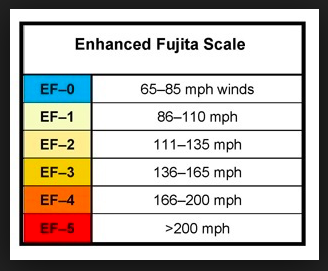
A tornado? Quite possibly. With winds reported at just 80 miles per hour, this cyclone would measure as a EF-0 on the Fujita Scale.

Can you imagine? Thirty people- half of them under the age of 14- died in this deadly disaster.

“It was a tempest, a hurricane, straight and direct, but furious and deadly as a cyclone would have been,” the Kansas City Times announced. Some even described the storm as having no circular movement.

A scientist later claimed it was “a wind storm accompanied by electrical disturbances.”

Resident Dr. J.M. Ford professed that he carefully studied storms. He believed the wind didn’t blow over 80 miles per hour- and buildings should have been built to withstand at least 125 miles per hour. He said, “The storm was merely a high wind, and but for the loss of life would not have attracted much attention.”

Today, it is widely accepted that, although likely weak, this was a tornado.

In 1886, the only warning people had of impending weather was by keeping one eye at the sky. Sirens, advanced warnings and tornado drills in schools were far from creation. The Kansas City Times wrote, “Never in all her history did Kansas City suffer such a disaster as that which the elements hurled upon her.” 

Elmwood Cemetery marker dedicated to ten victims
of the 1886 cyclone buried there
But this horrific event snatched at least thirty lives from the growing population of Kansas City and lived on as a vivid memory for all who were a part of this fateful day.

Today, we are blessed to have the technology and proper procedures in place to give advance warnings to ensure so many lives are never lost again.

***Do you love my writing? Then you need to subscribe to my FREE podcast with 610 Sports radio personality Bob Fescoe! Click here to take a listen to Kansas City: 2 States, 1 Story! 

***Make sure you go to Facebook and search "The New Santa Fe Trailer" and LIKE my page so you don't miss any of these stories of the history of Kansas City!

1886 Tornado Victim’s List*

Courthouse
Henry Dougherty
Edward F. Hedges
William Hedges

Kansas City Overall Factory
Ina Bowles
Nellie Cavenaugh
Mina Crane
Catherine Creeden
Jennie Fitzgerald
William R. Towne

Smith & Moffatt’s
Samuel Black
Henry Jackson
John Kane
Frank O. Smith

Lathrop School
May Bishop
Nellie Ellis
Edna Evans
Bessie Inscho
Ruth Jameson
Martin Jones
Mary Y. Lambert
Josie Mastin
L.T. Moore, Jr.
Mattie Moore
Edith L. Patch
Julia Case Ranney
Robert Sprague
Richard Terry

Streets of the City
John McDermott
John Flaherty


*This list is the closest I could compile through various records, as no formal list of all the victims exists.