Previous Posts

Thursday, January 31, 2019

Civil War History Marked in Stone

In today’s world, the tolerance for monuments to the “Lost Cause” are under attack. Although Kansas City doesn’t have large monuments in public spaces like New Orleans and Charleston, the area was under intense fighting as a severed line between Union and Confederacy.


Confederate monument in Forest Park, St. Louis
Photo courtesy St. Louis Post-Dispatch
There are small memorials to both sides of the fighting in private cemeteries across the area. One memorial erected by a local chapter of the Daughters of the Confederacy remained practically unnoticed in the middle of one of the busier intersections in town until a resident, likely inspired by the very-public removal and scrutiny of Southern statues being removed around the country, called attention to it.


Erected in 1934 and donated to the city, the monument “In Loving Memory to the Loyal Women of the Old South” originally graced parkland on the Plaza. It was moved to 55th and Ward Parkway in 1958 and remained camouflaged as millions of car raced passed it over the years.


It was simply another statue in the center of Ward Parkway surrounded by trees and green spaces.


This cement bench and shaft was in honor to the women who suffered during the strife of the war. Other large monuments- like Robert E. Lee in New Orleans- were met with cheers and tears as they were torn down. A St. Louis monument to the Confederate dead in Forest Park was disassembled and hidden from view in June 2017. The memorial to the women of the South remained untouched and unoffending until all hell broke loose in the media.
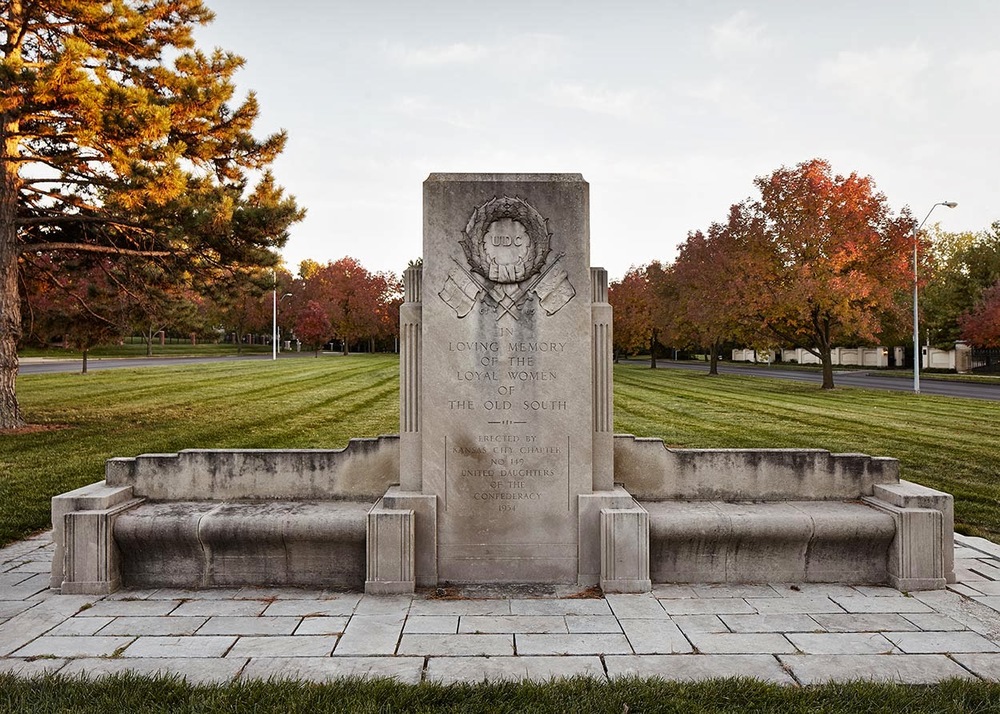

DOC Monument that sat at 55th and Ward Parkway, removed August 2017 to
an undisclosed location
All of these monuments have one thing in common-


They were on public parkland and in public spaces.


In Forest Hill Cemetery, 75 unmarked graves are a part of this area’s Civil War history. This Confederate burial ground wasn’t their first resting place; they were first buried where they fell, then moved to a small burial ground and finally made their way to an area marked with a monument - a monument that remains in a quiet, undisturbed cemetery in the heart of our city.


This is a place that should remain untouched.


Byrum’s Ford to the Gettysburg of the West
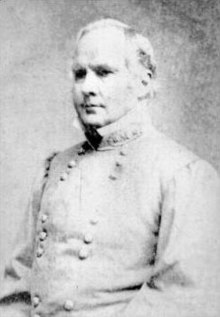

Gen. Sterling Price, CSA
On 63rd St. north of the Kansas City Zoo is parkland dedicated as the Big Blue Battlefield Park. This place, also known as Byram’s Ford, is the gateway to the showdown that happened just south of Brush Creek. At the Battle of Westport, Confederate Gen. Sterling Price, with approximately 8,500 troops- some of which were bushwhackers- launched an attack against 22,000 men led by Union Gen. Samuel R. Curtis on October 22-23, 1864.

The numbers speak to the outcome; this was the end of Price’s Raid on Missouri and the last major Confederate military operation west of the Mississippi.


Gen. Sterling Price’s defeat at the Battle of Westport would have the bushwhackers following him south, thus virtually ending guerrilla warfare along the border. 1,500 soldiers were killed, captured and wounded in what many would coin “The Gettysburg of the West.”


Burial of the Unknown Confederate Casualties


The healing process post-war for those a part of “The Lost Cause” was to memorialize their memories in speeches and in stone. During Reconstruction, no one had the money to invest in the proper burial of so many that fell on the battlefields.


Around 1866, a local man named George W. Briant told some of his friends that if they would remove the bones of these Confederate soldiers from the trenches, he would give them a proper burial place.


Briant deeded a small fraction of his land to the Byram’s Ford Internment Association so that men hastily buried along the battleground could be placed in a proper cemetery. The cemetery was on the southeast corner of current-day Troost Ave. and Self Ave. (now Gregory), and they started removing unknown soldiers to this location. The cemetery became known as both the Confederate Soldier’s Cemetery and the Self Cemetery.
Overlay map on an 1877 atlas showing the location of the Confederate Cemetery. The area is marked with a cross and "Confed"


Even though today we mark the location of the Battle of Westport at Loose Park, the battle was much, much larger than this and included thousands of acres of farmland. The Battlefield Trust places the core battle area as just north of the Plaza, extends to Forest Hill Cemetery to the south, from State Line to the west and east to where Research Hospital is today. Just south of the Ward house (now 55th and Ward Parkway), over a dozen soldiers with no names or ranks known were buried in the trenches. Judge A.M. Allen of Westport commented, “I saw those Confederate buried the day they were killed.”
Col. Upton Hays 


Those unknown soldiers were moved to this location.
On May 20, 1871, thousands gathered at the little burial ground to honor five bodies that had been removed from local farms that were part of the Battle of Westport. They had been interred without known names or ranks.


Joining these unknown soldiers at the Confederate cemetery was one colonel idolized for his service. Col. Upton Hays, a 30-year-old local man-turned-militant, had fallen in Newtonia, Mo. in 1862 with a bullet through the head. Earlier in the summer before his death, Upton Hays and Dick Yeager, one of Quantrill’s lieutenants, had arrived in Westport with six others. They went to the home of Dr. Boggs and “demanded a large Union flag known to be in his charge, which of course he was compelled to deliver over.”


According to Deryl P. Sellmeyer in Jo Shelby’s Iron Brigade, “[Hays] had used the flag as the lining for his overcoat, and it formed part of the shroud in which he was buried.”


It was at his family’s wishing that Col. Upton Hays be re-interred at the only Confederate cemetery in Jackson Co. Those present when he fell were able to identify the grave outside of Newtonia, dig him up and carry him back to Jackson Co.


Civil War soldiers at Battle of Westport reenactment
Courtesy battleofwestport.org
As the crowd gathered, words of honor were bestowed upon the fallen Confederate colonel. “Col. Upton Hays was a Missourian. He was a man that never knew an hour of fear. . . He was brave, generous, true, devoted, noble- a patriot.”


Present also on this monumental day was James Barnes Yager (1809-1883), a man who served two terms at the state legislature and five terms as a judge in Jackson Co. His son, Richard Francis “Dick” Yeager, was a “notorious Missouri guerrilla” who served under Quantrill as one of his trusted lieutenants.


During the Border Wars, Yeager’s name graced headlines across the country as being a tyrant torturing Kansas towns. He sacked Shawneetown, Blackjack and was present at the Lawrence Massacre. At just 25 years old, Dick had developed quite the reputation.


As early as June 1864, it was reported by Union soldiers that Dick Yeager had been killed near the Jackson/Lafayette Co. border. News spread like wildfire, so when newspapers reported in early August 1864 of his death in Arrow Rock, the headlines read “Dick Yeager Killed Again.”


From the Wyandotte Commercial-Gazette, Aug. 6, 1864
The accepted death of Dick Yeager is that of the encounter in August 1864. As guerrillas robbed safes and stores in Arrow Rock, it was said that Yeager was shot through the top of the head. Two doctors in Arrow Rock examined the wounds and “thought they were of such character he could not recover, his brains exuding from two places.”


The guerrillas, with Dick in tow, we were said to have headed back to Jackson Co.


So when the little Confederate cemetery at the corner of Self Ave. and Troost was dedicated, it was only proper that Dick Yeager be re-interred there as well. Due to the complications of his death date, the stone today simply reads “1864.”


Shelby's Last Stand marker inside
Forest Hill Cemetery
Confederate Cemetery in Danger


By 1890, as roads were being widened, the cemetery that had simple rocks marking those buried there was being threatened. It was proposed in the Kansas City Star that they “may move bodies to Forest Hill and erect an appropriate monument.” Forest Hill Cemetery, started in 1888 and built upon the land of David Self (namesake of the Confederate cemetery), was just across the street from the infringed-upon cemetery and held 320 acres of land between Troost Ave. and Prospect Ave.

By this point, at least 70 unidentified bodies had been moved to the little space. Many of these soldiers were said to have served under Gen. Jo Shelby.


Rather fittingly, Forest Hill sat on the site of Gen. Jo Shelby’s last battle against the Union troops. Today, there is a marker inside the cemetery commemorating “Shelby’s Last Stand.” It was stated that the Confederate cemetery held the remains “among the best and bravest in Shelby’s command.”
Clipping from Elsmore Enterprise, Feb. 19, 1897


Between 1893 and 1894, the seventy-something bodies of Confederate soldiers along with Col. Hays were moved for a third and final time to lots donated by Forest Hill Cemetery.

Today, the location of what was once Jackson County's only Confederate cemetery is a car lot surrounded by large chain link fence and barb wire.


When Gen. Jo Shelby, then a 67 year old U.S. Marshal of the Western District, fell ill with pneumonia in February 1897, the discussion began as to where was a fitting place to bury the Confederate hero. The Ex-Confederate Veteran’s Association owned many lots near where the 70-something graves had been moved from the Self Cemetery, so it was determined they would make space for Shelby and his whole family.


Gen. Jo Shelby
Stephen Regan, a prominent Kansas Citian and Confederate veteran, was part of the Ex-Confederate Association’s committee that helped to move the remains from the old cemetery to Forest Hill. He had called on Jo Shelby weeks before his death and said that the old General had told him, “Captain, have you any room for me in that burying ground out at Forest Hill for me? When I die, I want to be buried there among my old soldiers.”


When Gen. Jo Shelby passed away peacefully in his home in Adrian, Mo. on Feb. 13th, the family decided “to bury General Shelby beside his comrades of the Confederacy in Forest Hill cemetery, Kansas City.”


The Movement for a Monument


The bodies had been moved together inside Forest Hill, but there still was no monument to mark them. At the turn of the century, the Daughters of the Confederacy moved to change this. They hosted balls, concerts and lectures to raise the $5,000 needed.


Dr. Jeremy Neely, Civil War and military history professor at Missouri State University, understands the influx of the movement for monuments during this time period. “I think that Confederate memorials say as much, and perhaps more, about the people who raised them and the period in which they were erected than the people of the Civil War generation,” Neely commented.
The monument "In Memory of Confederate Dead" was erected in
1902 by United Daughters of the Confederacy 


Memorial Day 1902, thousands gathered, including several hundred ex-Confederate soldiers, near the southeast corner of Forest Hill to see the monument “In Memory of Our Confederate Dead” unveiled. The project was backed by some of the most prominent men of the city.


They had talked of placing the monument on The Paseo or another spot on the battlefield; however, many men, including former mayor of Kansas City Turner Gill, believed Forest Hill was the most appropriate place because “that is where the bodies lie of the men whose memory it is proposed to perpetuate.”


Today, we should be glad the monument made it inside private gates.


The Monument Today


It’s hard to miss the monument inside Forest Hill Cemetery, yet so many don’t know it is there. Perched upon the top of a granite shaft high above the air is a Confederate soldier facing north. Inscribed on the monument reads: Erected by the Kansas City Chapter, 149 UDC, to the memory of 75 Confederate soldiers representing the states of Virginia, Texas, Arkansas, Missouri and Illinois who fell at the Battle of Westport, October 23, 1864.


Dr. Neely believes that monuments are a part of our history. “Situated in highly public places, such as parks and cemeteries, monuments weren't just history, a remembering of what had happened in a particular place, but a conscious celebration of one person, event, or part of the past that civic leaders decided were worthy of honor.”


Today, we know that only one side of history- the history of the Lost Cause- is represented on this monument erected in the shadows of the Jim Crow era. “One of the most glaring problems with these Jim Crow era monuments was that they reflected the values and nostalgia of only one part of the body politic--white former Confederates,” Neely said.


Unlike the monument removed in 2017 public land at 55th and Ward Parkway, this monument amongst fallen soldiers rests on private property and many men that fought for the Lost Cause are buried all around it. It’s not the only remaining marker to Confederate soldiers in the area, but it holds importance in the fight to save those unmarked graves of fallen men left in the trenches of the battlefield.

** If you enjoyed this piece, please consider searching "The New Santa Fe Trailer" on Facebook and LIKING my page so you don't miss any of these fun stories about our history!


Monday, December 24, 2018

Imagining the Christmases of the Past Through Food and Community

In 1843, the first printed Christmas card was commissioned by Henry Cole in England and featured a group of people surrounding a dinner table. A simple message of “A Merry Christmas and a Happy New Year” was painted on the bottom of the tablecloth.

The early pioneer traditions of Christmas, especially surrounding gift-giving and sharing food, show us how much the menu and the presents have changed over the years. On the western border of Missouri, starting as early as the 1840s, these customs seem unfamiliar today to our palate and our strained pocketbooks.


Isaac McCoy's homestead
While most people today embrace the message “Merry Christmas” when addressing people during the holiday season, early pioneer settlers on the Missouri-Kansas border, most with southern roots, would cheerfully rush toward neighbors and friends with a different message.

John C. McCoy’s daughter, Nelly McCoy Harris (1840-1926) was hailed as the first “white girl” born in Kansas City and known as one of the city’s first historians. Her grandfather was Rev. Isaac McCoy, Indian missionary whose home (known as "Locust Hill") stood where St. Luke's on the Plaza stands today.

In her manuscript, “Reminiscences of the Pioneer Days,” she describes Christmas traditions that she fondly remembered as a child. “We said ‘Christmas gift’ when meeting friends on [Christmas]. Now they say ‘Merry Christmas.’ I do not exactly understand the last expression.”


Nellie McCoy Harris (1840-1926)
As early as the 1840s, people hailing from the southern states would address people on Christmas day by exclaiming, “Christmas gift!” Even slaves would express this to their masters, expecting to receive a small gift in return. The first one to say it claimed the gift, usually a small present of a fruit, sweet treat or nuts would be given.

Christmas was usually a given free day for slaves, thus, according to Nelly, “All were happy except the mistress of the mansion, who had to continue all sorts of ways to get along without the usual quota of house servants.”

Boo-hoo.

Although Kansas City was slowly growing before the Civil War, the area was quite isolated as compared to the northeastern cities. Spending Christmas with loved ones far away was usually not possible, so it was usual for neighbors to gather together to celebrate the holiday. In these simpler times, pioneers looked forward with joy to the festivities of the Christmas season.

“We went to frolics early and stayed late,” Nelly wrote, “especially if the entertainments were at the homes of the McGee families . . . where they were so hospitable.”

I have a personal fondness for the great-grandchildren of A.B.H. McGee. They are my friends that I have fortunately met through my research and writing. Nelly, over 100 years ago, gushed over her personal relationships with them, stating, “The hearts of these McGees seemed to be overflowing with good will to all.”
The McGee family cir. 1880 in front of the first brick home in all of Kansas City. Photo courtesy of the McGee family


Nelly had a way with words. I couldn’t have said it better myself as it pertains to my personal feelings about the McGees of Kansas City.


A candlelit tree at Wornall House
These early pioneer families would spend the holiday together in their homes lit only by the fireplaces' glow or the soft flicker of candles placed around the room.

Invitations to celebrate sometimes were verbal and others were written (yet never requiring an RSVP). In this area, some guests traveled by horse up to 20 miles away to attend parties. When festivities went all night long, “pallets were spread about the floor by good-natured colored servants” so makeshift beds could be utilized.


Tables were placed in larger residences wherever there was room, and in the center of each table was placed a large stack of pyramid cake, likely similar to what we see today at weddings. “No one was afraid of eating all they wanted for fear the cake would give out,” Nelly wrote, “The bottom section of the pyramid was generally a tin pan iced over, but that was no loss to anybody, for guests never got down to that [layer].” The next day, children would gather around those tin pans still iced over with frosting and eat the sugary substance until the pan was revealed underneath.

What was served on Christmas day generally depended on whether you lived in the city or the country. In the small town of Kansas City, menus would have been heavy in fruits and root vegetables.


Henrietta Harris
Nuts and spices roasted on an open fire would have created a familiar scent of the season in small homes. Sugar at the time would have been quite expensive, so sweet treats were not as common as dried fruits. Because of this and other ancient traditions, the fruitcake became a popular staple at the holiday table. Those of more comfortable means would have been more likely to have more sugary options for guests and family.

Foods such as turkey, hams, chickens, roast pig, saddle of mutton, and sometimes venison and buffalo were served to guests. Oysters in tins were expensive but popular additions to the menu.

In 1918, the great niece of Henrietta Harris (1804-1881), the wife of the famous proprietor of Harris House Hotel in Westport, shared her recipe for chess cakes, copied as it was written “nearly a hundred years ago.” Henrietta was well-known in the Westport area for her delicious chess cakes.


Helen Miller demonstrates cooking over an open fire
at the Wornall House Christmas candlelight tour
The recipe simply reads: One cup butter, two cups brown sugar (English golden); yolks of eight eggs. Flavor with nutmeg and vanilla or a little sherry wine. Work the butter and sugar until very creamy; add the well-beaten yolks of the eggs, and lastly the flavorings. Bake in small patty pans, in paste. Bake in a very slow oven.”

Confused? So am I.

Another early recipe printed in 1847 in The Carolina Housewife by Sarah Rutledge reads:

Bake the walls of thick standing crust, to any size you like, and ornamented as fancy directs. Lay at the bottom of the pie a beef steak. Bone a turkey, goose, fowl, duck, partridge, and place one over the other, so that, when cut, the white and brown meat may appear alternately. Put a large tongue by its side, and fill the vacancies with forcemeat balls and hard eggs, and add savory jelly. This last is better for being kept in a mould, and only taken out as required. Bacon, chopped or beat up with the forecemeat, is preferable to suet, as it is nicer when cold, and keeps better.

Boy, am I glad that our taste buds aren’t suffering anymore.

Today, piecing together the steps of these old recipes is quite difficult; setting your electric oven to a temperature and baking for a certain amount of time are vital parts of successful baking. But before the electric oven, women cooked on an open fire or on a cast iron stove.
Stirring Up History is available on Amazon.com

Modern cooking that we all do, including Christmas dinner, is usually based off a written recipe with clear directions. Cookbooks as we know them today were not commonplace in the 19th century. However, some women began featuring their favorite recipes in church cookbooks, usually arranged as a fundraiser for their community.

Cheryl McCann, author of Stirring up History: The Meals, Memoirs and Memories of Our Ladies of Clay County, has spent years reading old recipes and decoding them. The book is the recreation of the 1880 and then the 1903 Presbyterian ladies of Liberty Missouri’s Economy Cook Books. McCann was interested in trying to figure out more about the women behind the recipes as well as interpreting the recipes into today’s measurements and baking times.

“Cooking and cookbooks could be surprisingly liberating and bring women of different backgrounds together,” McCann explained.

As she researched the women who in the early additions were listed by only the name of their husband, she also had to learn how women in the 19th century cooked. “I started trying to find out who these ladies were, and many of them had remarkable stories of their own to tell.”  Therefore, Stirring up History, available on Amazon, includes the old recipes as they were typed, updated recipes in today’s measurements, and biographies about the women who supplied them.
Kansas City Times, 1895

Some recipes called for ingredients such as glycerin, glucose, ammonia, tartaric acid and carbolic acid that we wouldn’t dare ingest today. Directions such as “butter the size of an egg” needed to be given in acceptable measurements to ensure the best results. A “cold oven” in these old recipes actually means 325 degrees, showing us how many strides have been made over the years on the subject of accurate recipes.

“I think we can all be inspired from the lives of other people, past and present, but to know how these strong women from a variety of backgrounds came together to create this cookbook shows a sense of community,” McCann commented.

In a way, Stirring Up History brings the past alive through our current taste buds and opens our eyes to the lives these women led. “I also find that the biographies show great character traits such as endurance, faith, kindness, injunity, and the bravery. These ladies lived in a time before the vote, and some lived through the Civil War. They took on the challenges that were presented to them,” McCann said.
Cream puffs 

Sometimes tasting these foods made from the old recipes can be a bit different than what we are used to, as I have personally tried some of McCann’s own creations from these recipes. I’m a personal fan of the cream puffs. :)

We have advanced in our cooking and in our technology. We can now order food from our phones and have it hand-delivered to our doors. In some ways, the simplicity of the holidays have been lost to the rush of last-minute shopping and packing our Amazon shopping carts full of Christmas gifts.

I kind of wish we could return to these old times where the holiday was lit by fireplaces and candlelight- where a modest celebration didn’t overshadow the specialness of the season.

Today, we don’t shout “Christmas gift” at friends and generally don’t celebrate the holiday with neighbors. We are mobile; we have the ability to travel far distances to share with our families. But the pioneers of this area created their own versions of Christmas that best suited them. We can learn so much about how we celebrate from the foods that decorated the tables of the past and the labor of love that was exercised in order to execute delicious meals for the special occasion of Christmas day.

Merry Christmas Gift, Kansas City!

** Please consider searching "The New Santa Fe Trailer" on Facebook and LIKE my page so you don't miss any of my writing! :)

Upcoming presentation on January 11th! If you're interested in seeing me talk about south KC history (all proceeds going to charity), CLICK HERE! Be sure to get your tickets ahead of time!

Monday, November 19, 2018

The Curious Case of the Thanksgiving Date

Pilgrims with flat-topped hats adorned with fashionable gold buckles - Native Americans half-dressed and ready to shake hands with these newly-arrived white men- both groups sitting down at a perfectly dressed outdoor table to break bread. Those are the images that most people have of the beginnings of a holiday that now focuses on family and giving thanks for what fortunes we have.

This was only further enforced when we school children traced our little hands and fashioned the outline into turkeys. We then whipped out the Elmer’s glue and colorful construction paper to make headbands with limp “feathers” attached.

Oh, we all did it.

This isn’t very PC today, but we all wore those proud crowns topped with unfortunate stereotypes.


History tells us that the first Thanksgiving, an autumn harvest festival, occurred in the fall of 1621 among about 50 Pilgrims and around 90 Wampanoag Indians. But our history books in high school- and our teachers in grade school- really got the whole thing wrong. The real origin of Thanksgiving is up for interpretation.

Yes, what we credit with the first Thanksgiving was originally a three-day celebration attended by men. No, not families. Men. We think of Plymouth (correctly spelled “Plimoth”) and Pilgrims. We think of them inviting a Native American tribe to dine with them. And of course, we think of turkey, stuffing, gravy, and cranberries.

And pie. Lots of pie.

Truth be told, feasts of thanks celebrating the autumn harvest had been celebrated for centuries. There is even record that the Spaniards in North America held a small autumn feast well before these Pilgrims in Plimoth. That’s why Virginia, Texas, Florida and Maine affirm they are the birthplace of the “first” Thanksgiving.

"First Thanksgiving at Plymouth" by Jennie Augusta Brownscombe (1914)

Confusing, right?

What we do know is that these fresh-off-the-boat men in 1621 did dine with the Wampanoag Indians; the tribe even brought four deer to the celebration. We also do know that cranberries, native to New England, were served. But there is no evidence that turkey made it to the table.

No pie, guys. There was no pie. Pumpkin and squash were in the diet, but a traditional pumpkin pie wasn’t prepared nor had it really been created yet.

Unlike other holidays, the date of Thanksgiving moves on the calendar every year. And have you ever thought it odd that a nationally-declared holiday is on a Thursday? Just like the controversial birth of our Thanksgiving, the significance of the holiday and the date it is celebrated has morphed over the years.

The first “official” Thanksgiving holiday proclamation was declared by George Washington. He called for a “day of public thanksgiving and prayer” to be observed Thursday, Nov. 26, 1789. But the meaning of this date wasn’t attached to Pilgrims at all. Washington was simply wishing for Americans to pay homage to a fledgling nation after the Revolutionary War was won. And, at the time, Thanksgiving was more of a religious holiday than a turkey and gravy one.


It would take 75 years exactly for another national declaration of Thanksgiving to be added to the calendar. During this period of time, individual states and territories would decide when to designate a day of thanks. Sometimes this day of thanks didn’t even fall in November. For example, in 1857, Missouri’s governor Robert Stewart “fixed upon Thursday, the 31st day of December, as a day of Thanksgiving throughout the State of Missouri.”

Abraham Lincoln, Oct. 1863

To no surprise, the next time there was a national declaration of giving thanks on a specific date didn’t happen until our nation was at war again. After the victory at Gettysburg, President Abraham Lincoln proclaimed Oct. 3, 1863 that we “set apart and observe the last Thursday of November next as a day of thanksgiving.”  

The country was severed in half during the Civil War. Locally in the Kansas City area, the state line was a battleground between the North and South. Another battle less critical was brewing. In 1864, president of the Confederacy, Jefferson Davis threw a curveball and appointed Wednesday, Nov. 16th as the day of “rebel thanksgiving.”

Jefferson Davis invited people of the Confederate states “to assemble on the day aforesaid, in their place of public worship . . . [and] that He restore peace to our beloved country, healing its bleeding wounds and securing to us the continued right of self-government and independence.” This put the Confederate turkey day the day before the date suggested by President Lincoln.

Liberty Tribune, Nov. 11, 1864
Somehow, this doesn’t surprise me at all.

Northern newspapers responded to the announcement of a rebel Thanksgiving with a stiff opinion of the makeshift holiday for the South. The Cleveland Daily Leader wrote, “We fear that Mr. Jefferson Davis has mistaken the inspiration of the devil for that from above, and mistakes the amount of strength and inspiration which yet animate the people of the South.”

Roosevelt on Thanksgiving
Courtesy of Library of Congress
It went on to suggest that the South “can then give thanks for the reelection of Abraham Lincoln.”

Dannnnnggguuh.

More confusion on the official date of Thanksgiving occurred in 1939. The Depression era had depleted the nation’s economy, and just like today, the sales during the holiday season was a make-or-break for many merchants.

Traditionally, the fourth Thursday in November was the default date across the country as appointed annually by the president since 1863; however, the fourth Thursday would land Thanksgiving Nov. 30, 1939.

The concern was that losing extra shopping days between turkey day and Christmas would be harmful to the economy. In response, President Theodore Roosevelt was pressured to issue a proclamation declaring the third Thursday the “official” Thanksgiving, moving the date to Nov. 23rd.

Kansas City Star, Oct. 31, 1893
The response nationwide was one of havoc and confusion. In addition, it threw a bombshell on football schedules set a year in advance. Locally, one tradition was in danger of being lost and had Missouri and Kansas up in arms- again.

Traditionally at the time, the University of Missouri and the University of Kansas played their rival football game on Thanksgiving day each year- the most celebrated rivalry west of the Mississippi.

The Border Wars were far from over, and some would argue that they've never really ended.

And to add more insults to the stereotypes, the winner of this "Turkey Day Battle" was rewarded with an "Indian War drum traveling trophy." Starting in 1937, MU's Kansas City Alumni Association with the help of Kansas University Letterman's Association presented an authentic Indian drum each Thanksgiving to the winner.
Top photo: 1893 KU football team
Bottom photo: 1893 MU football team
Courtesy of KU/MU Archives

They wanted to keep it "real," so they commissioned the Osage Indian tribe to make it... since they were the original "landowners" in Missouri and Kansas.

How appropriate.

On a side note, the trophy allegedly disappeared only to resurface in the 1980s in a Columbia, Mo. basement, tucked away forgotten in midst storage boxes.

The first matchup between football teams happened October 31, 1891 in Kansas City at Exposition Park at 15th and Montgall. According to the Kansas City Star, “Society was represented by many of its best known devotees.”  The beginning of the modern-day “border wars,” the Jayhawks were able to secure a 22-10 win over the Tigers.

The Thanksgiving date was used for the Border Wars game starting on November 30, 1893 at Exposition Park in Kansas City, Mo. The Kansas City Star reported, "Out at Exposition Park this afternoon there will be a wondrous blending of college colors and college yells. . . The pretty girls and the girls not so pretty will be there in force."

Wow.
Kansas City Journal, Nov. 24, 1898 

To add insult to injury, the article continues, "To be sure [the women] don't understand the game, but there will be plenty of men on hand to instruct them in foot ball ethics and tell them when to applaud."

Well, it was a different era. Let's just be glad we have made strides in the past 125 years - I know plenty of women that know more about football than most!

3,000 people packed the small stadium, a record crowd for the day, and Mizzou was able to secure a 12-4 win over the Jayhawks.

A weird score, right? Well, touchdowns at the time were worth four points and the extra point was worth two.

Border War football games continued to be played in Kansas City (once in St. Joe) until 1910 where each team took turns hosting the other on turkey day.

Leavenworth Standard, Dec. 1, 1893
In 1939, it was KU’s turn to host the Tigers in Lawrence, but the confusion over the date had things on hold.

Because President Roosevelt’s proclamation truly only affected the the District of Columbia and territories belonging to the United States, it was up to the governors of each state to decide when to celebrate the day.

The MU-KU game was scheduled to be held on Nov. 30 on the date everyone assumed would be Thanksgiving.

This had the governors of each state deciding whether to follow President Roosevelt or hold to the generally-accepted fourth Thursday in November. And just like the Border Wars, Missouri and Kansas chose two different sides.

Governor Payne H. Ratner of Kansas declared, “The Thanksgiving day of November 30, 1939, which is fixed in the calendar and upon which so many people have made definite plans will be retained in Kansas.”

The cover of Time Magazine in 1939
Missouri governor Lloyd C. Stark signed his declaration in August and announced, “We will have only one Thanksgiving day in Missouri. That will be the date set by the President of the United States.”  

This created a pretty serious headache for the two states’s largest universities. If the Thanksgiving Border Wars game between MU and KU was played on Nov. 23, KU would have to change its class schedules. If Mizzou had to play the Thursday after their holiday vacation, they would miss class and attendance at the game would be affected.

A solution was reached; the game, traditionally held on Thanksgiving day, was moved to Sat., Nov. 25 “because of the two conflicting turkey dates in the two states.”

Mizzou won 20-0.

The Tigers and the Jayhawks continued their matchup on Thanksgiving day until the early 1950s.

Due to the chaos leading up to the 1939 Thanksgiving, President Roosevelt gave advanced notice when he designated Thurs., Nov. 21st (the third Thursday in Nov.) the official Thanksgiving for 1940. He declared the date in October 1939.

Congress passed a law Dec. 26, 1941 giving us a “unified Thanksgiving the fourth Thursday of November.” Thankfully since then, there has been no confusion as to when we gather to give our thanks across the nation.


This piece is dedicated to my friends, Mizzou Tiger Cristin Blunt and Kansas Jayhawk Tim Reidy :)

If you enjoyed this piece, please consider searching "The New Santa Fe Trailer" on Facebook and LIKING my page so you don't miss any of these fun stories about our history!
Time Magazine 1893 comic shows the nation's new love of Thanksgiving day football