Previous Posts

Showing posts with label Quantrill. Show all posts

Wednesday, November 29, 2017

Log Cabin in Cass County Uncovers a Promising Link to the Civil War and Order No. 11

Nightfall had overcome the prairie the sweltering evening of August 21st, 1863; few sounds echoed in the darkness in the middle of the night. They had avoided the manhunt by taking high prairies and divides between Bull Creek and the Marias des Cygnes River. They had turned into the timber, and in the darkness, had escaped into the night. Quantrill and his men continued to creep with solidarity southbound.

They needed to get back into safer territory. They needed to cross into Missouri.

Senator James H. Lane, a notorious Jayhawker and Union general, emerged after narrowly escaping the attack in Lawrence. Through the burning cinders and ashes of the town of 2,000, Lane looked for reinforcements in order to chase the murderers. Knowing very well that he was one of Quantrill’s targets, the unpredictable senator rallied farmers to grab fresh horses and follow the guerrillas.  Lane had no intention of letting Quantrill get away this time.

The Lawrence Massacre, August 21st, 1863
Meanwhile, in Leavenworth, Ks., Gen. Thomas Ewing, Jr., the man in charge of the District of the Border, was oblivious to the goings-on just southwest in Lawrence. Ewing was absent from his headquarters at the Pacific House Hotel in Kansas City when two couriers were sent to alert him of the Lawrence Massacre. But it wasn’t long before the dreadful news crossed in front of him. By 1:00 in the afternoon, Gen. Ewing left Leavenworth and headed south to seek out the slayers.

Gen. Ewing did not have fate on his side. He was delayed at the Kansas River at De Soto, Ks. because they couldn’t find boats to cross the waters. Hours crept by as Ewing was left restless and exhausted. As he was caught in wait on the river, Quantrill quietly continued on his route to safety.

Sen. James H. Lane (1814-1866)
Hunger and thirst overcame Quantrill’s men as their horses struggled to keep moving forward. The high from the morning’s successful attack of Lawrence had soon worn off as federal troops trailed the men as they fled Lawrence south. They, too, were exhausted from the chase of just shy of 50 miles. As men were alerted along the way, some stationed themselves on the state line in hopes of catching the guerrillas before they could sneak across the invisible line.

Some were, in fact, captured and killed. But the big fish was still out there.

The raiders, after killing close to 200 men and boys in what would be coined the Lawrence Massacre, slipped somewhat silently into Missouri in Cass Co. and closely watched at a fork of the Grand River as federal troops continued their manhunt.

By daylight the next day, the famished guerrillas halted to take a quick meal in small prairie surrounded by trees. Before they could feast, a warning came that troops were nearby. There was no choice; Quantrill and his men had to proceed. A small skirmish with troops ensued, yet, as always seemed to be true, Quantrill and most of his men fled through the forest to freedom.

Gen. Ewing, dangerously affected by the delay in De Soto, didn’t arrive to the Missouri border where Quantrill crossed until after dark on the 22nd- hours and hours after Quantrill hopped into his familiar territory where friends were aplenty.

Sen. Lane lost his search of Quantrill, yet his rage was not adrift. He had plenty of time, fatigue the enemy, to fester over the intense hatred he had for these guerrillas. Gen. Ewing and Sen. Lane met near the place where Quantrill and his men were known to stop four miles east of the Missouri-Kansas border. Lane, an incredible extemporaneous speaker, spat his frustrations at Gen. Ewing and demanded something drastic be done.

If Ewing wasn’t going to do anything, Lane and his Jayhawkers certainly would.


********************************************************************************************************

William Quantrill (1837-1865)
When Don Peters, former executive director of Cass Co. Historical Society received a phone call in December 2014 that a log cabin was hidden underneath an abandoned house north of Freeman, Mo., he jumped at the chance to save it. And now, just shy of three years later, Peters is convinced this cabin is much more than just a lovely piece of pioneer history. He believes that it could be where two central infamous figures in the Kansas-Missouri Civil War conflict stayed and discussed Quantrill’s Raid on Lawrence and one of the most controversial orders during the Civil War.

And if he’s right, this little log cabin would be a significant rediscovered piece of Civil War history for the ages.

A man had recently bought 80 acres of land north of Freeman, Mo. Before the new owner was to bulldoze the structures on it, he knew it was best to contact the experts about what he believed was underneath the abandoned house on the land.

A log cabin enthusiast, Peters was perfect for this new project. He had already successfully saved three other cabins in Missouri, but a cabin surviving the Border Wars and Civil War was an anomaly. As any good historian would do, he dug deep into the records to learn more about the history of the land and the family attached to it. 

Alfred G. Sloan's first land patent from 1845
And Mr. Peters has a very interesting case.

“Albert Sloan cleared the land and built this log cabin,” Peters explained. From its construction, Peters believes the cabin to be built in the late 1830s or early 1840s.

The first landowner was Alfred G. Sloan, born around 1805 in Barron Co., Ky. He married his first wife, Elizabeth Standiford in Indiana, and by the 1830s, Sloan and at least one of his brothers settled in what is now Cass Co. (then called VanBuren Co.).

Accounts from the Sloan descendants are recorded in the history of Cass Co. Family lore indicates that when Alfred rode into Pleasant Hill on a black pony with his wife, he met a Native American. Alfred wished to find land with plenty of water sources, and the old Indian led them to land north of Freeman, Mo. where the South Grand River's forks spidered on the land. In thanks, Alfred turned over his black pony to the old Indian.

He patented 240 acres of prime real estate in 1845. As with many early settlers of the western portion of Missouri, it is likely that Alfred Sloan was a “squatter,” meaning he had settled on the land well before he had purchased it from the government. The 1840 census shows that Alfred had already moved to Cass. Co. earlier, showing that the construction of the cabin was, in fact, by the late 1830s.

After all, a family of eight had to have a place to sleep.

Alfred’s brother-in-law, Hiram Boone Standiford, founder of Stanton, Ks., was a member of the Territorial Legislature before Kansas was a state. In E.W. Robinson’s History of Miami County, he wrote of Standiford: “He was a leader to be trusted, a friend warm and steadfast. . . In public life, he was an uncompromising Free-state man. . . He had been an anti-slavery member of the Missouri Legislature.”

Alfred G. Sloan and Serepta White. Courtesy
of the Sloan-Tribby descendants.
On December 7th, 1855, H.B. Standiford left his farm in Miami Co. and traveled to Lecompton to attend a special session of the legislature. On January 2nd, 1858, the 38-year-old passed away and his body was brought to Stanton for burial.

This connection to the very beginnings of the fight for abolishment of slavery is significant. Alfred G. Sloan seems to have sided with his in-law’s family.

Earlier in 1845, the same year Alfred patented his acreage in Cass Co., his wife passed away. He then married Serepta White and had nine more children, bringing his offspring total to 15. By this time, tensions in the area ran high due to frequent raids by Kansas free staters and the Missouri bushwhackers.

The nearest town was Morristown, now erased from the landscape and was one mile northwest of current-day Freeman, Mo. By the 1850s, Morristown had a general store and later a flour mill.

In September 1861, a skirmish, known as the Battle of Morristown, occurred on the streets of the small town. Morristown was overtaken by Union forces. They used this town for a winter camp and would search for supplies from neighbors.

The troops had no problem taking from the neighbors- especially from secessionists that were allies of Quantrill and the bushwhackers.

The town, by 1862, had been ransacked and only five buildings stood. Nearby Harrisonville had been taken and occupied by the Union.
Part of Plate 161 from the Military Atlas of the Civil War. The red star marks the location of Morristown.

This type of tyranny on the border was all-too-common. Families, such as the Sloan’s, stayed put for a time in hopes that the warfare would calm down. The nearest town- what they had most likely considered their hometown- had been nearly ruined.

The house before the removal began. 
To be clear, Alfred Sloan’s loyalties were not popular, even as Cass Co.’s towns were occupied by the Union. With the border towns under continuous fire and overtaken by Confederate sympathizers in the area, it is likely that Alfred Sloan, a staunch Unionist, decided it was time to abandon his farm and his log cabin. Records clearly indicate that he sought refuge in Miami Co., Ks.

Don Peters’ excitement mounted as he kept uncovering substantial evidence on this preserved piece of Missouri history. He surveyed the site and began to gingerly tear away the more modern frame house. With every board that was torn carefully away from the yellow paneling that covered it, a perfectly in-tact log cabin emerged.

Cabin hidden under that more modern structure begins to be revealed.
Courtesy of Lonnie Peters
The two story, 18x20 two room cabin showed no modifications. Although the floor and roof were gone, Don was able to piece together a pretty good idea of what the original, simple structure looked in the days of the Border Wars. The door and window frames remained along with the original rafters hewed from cottonwood.

“Whatever wood they had available is what they would have used,” Don explained.

As he examined the structure, he noted some interesting anomalies. “There were no bullet holes in it, and I could find no evidence of fire damage,” Peters noted.
 The side of the cabin.
Courtesy of Lonnie Peters

During this time in Missouri-Kansas Border War history, it is quite uncommon to find a structure this old completely unharmed by warfare. Tom Rafiner, historian and author of two books, Cinders and Silence and Caught Between Three Fires, explained, "A number of cabins that survived in the area during the Civil War were used by Union companies as stations. The houses that did survive outside of the Pleasant Hill or Harrisonville military posts were used by counting parties or patrols sent out. They grabbed a hold of a cabin to use."

Union soldiers cooking in camp. 
Courtesy of the Library of Congress
In a book published on the history of Cass Co., it notes an important event that may have led to Alfred and his family moving to Miami Co. for the remainder of the war. It reads, “During the Civil War the ‘Kansas Bushwhackers’ came over the border burning and stealing. They came to the Sloan place, but the family hid in the small basement of the log cabin and they did not find them.”

Well, most cabins from this era didn’t have basements. When Don neared the foundation of the old home, his eyes widened and a smile followed as the base of the structure saw light for the first time in over a century. There it was. A small, 10 to 11-foot cellar with a small opening- with walls almost six inches thick.

There’s nothing like physical corroboration of paper records found.

Oh, but those records had a lot more to show that this cabin could possibly have served as a significant piece of Civil War history after Alfred and his family fled to Miami Co.

Capt. J.A. Pike
William Clarke Quantrill and his men were after revenge. The collapse of Union Prison, killing women and children, was the final straw. His men crept into Kansas through the southeast corner of Johnson County and escaped back into Missouri after the massacre less than a mile away from where he had entered. According to an account by Captain Joshua A. Pike, 9th Kansas Calvary, “Quantrill passed out of Kansas, after sacking Lawrence by passing down another fork of Grand River.  This branch flows east through section twenty-two (22), townships fifteen (15), range twenty-five (25).  It crosses the State line in the northeast quarter (N. E. 1/4) of said section less than half a mile south of line between Johnson and Miami counties. . . He came in through the southeast section of land in Johnson County and went out through the northeast section in Miami county--and on the adjoining quarters of those sections.”

This is no more than five miles northeast of Alfred Sloan’s cabin and implies that Quantrill entered Missouri just west of where Cleveland, Mo. is today.

Exhausted and famished, the bushwhackers then stopped to get something to eat after dawn on August 22, 1863, less than 24 hours after sacking Lawrence. In Quantrill and the Border Wars by William E. Connelley, published in 1910, the author states, “The main body of the guerillas was then four miles from the state line in Missouri, at the head of a branch of the Grand River.”


When Don discovered this information, his heart raced at the possibilities. As the history books indicate, the federal troops were hot on their tails, thus they abandoned their resting point and disappeared into the brush.

“How many log cabins could have been close to this location? They were few and far between, especially after the Border Wars and the fighting during the Civil War,” Don declared.

To put this into perspective, only 1,312 people lived in all of Dolan Township in Cass Co., Mo. in 1860. Many had fled at the outbreak of war- including the Sloan family- so this number is likely high. Tensions locally were further ignited by constant invasions of border ruffians.

Sen. Lane’s stewed in his fury as he crossed into Missouri. He recognized that personally catching up to Quantrill’s raiders was out of the cards, yet his hope remained that troops would be able to corner them in the brush.

Sen. James H. Lane
Gen. Thomas Ewing also had chased Quantrill’s route down into Cass Co. and arrived after his delay of boats in De Soto on the evening of the 22nd of August. Quantrill had last been seen at “a head of the branch at the Grand River” earlier that morning.

As troops gathered behind Gen. Ewing, Sen. Lane and his small group approached. In Quantrill and the Border Wars, it reads, “General Ewing and Senator James H. Lane met at the point where Quantrill had stopped first after crossing back into Missouri.”

This information certainly peaked Don Peters’ interest. When he looked at the maps and compared the location of where Quantrill had stopped and where the Sloan-Tribby cabin stood- perfectly unharmed- he wondered.

Further documentation in Forty-Six Years in the Army by Maj. James M. Schofield shows that at this fiery meeting, “General Ewing and General James H. Lane met at Morristown and spent the night together.”

Dr. Jeremy Neely, professor of history at Missouri State University and author of The Border Between Them: Violence and Reconciliation on the Kansas-Missouri Border stated, “After the Lawrence massacre, Lane and other furious Kansans, many of whom blamed Ewing for failing to stop Quantrill's raid, threatened a retaliatory raid across the state line.  Ewing, meanwhile, had supported increasingly forceful policies against the households whom he suspected of aiding pro-Confederate guerrillas.”

And it is suggested in several credible, documented sources that these two men spent the night together in a cabin.

Brig. Gen. Thomas Ewing, Jr. (1829-1896)
Is it possible this cabin is the place where two central figures of the fight along the border met?

Sen. Lane was famously known for his persuasive speeches and outspokenness. Gen. Ewing, more cautious and reserved, had been stewing over how to squash out the bushwhackers along the border. Sen. Lane, in this meeting in a cabin near Morristown, insisted that if something was not done soon, he would go to Washington and have him removed from his position.

In Connelley’s book, he described this meeting of Ewing and Lane. His information came from Col. Elijah F. Rogers, a member of the Missouri militia who had heard it from Lt. William Mowdry. He wrote, “Lane agreed to make no complaint if Ewing would issue the order, which had been under consideration for some time, depopulating portions of some of the border counties of Missouri. Ewing agreed to do it, and they went to a cabin near-by.”

Let’s just consider that there weren’t subdivisions of cabins in 1863. There were very few buildings left standing after the Border Wars and during the Civil War. And as Don pointed out, this cabin was left with no damage. And it’s near Morristown- within a mile. It’s not far from the branch of the Grand River four miles from the state line.

In fact, when I drew a circle and analyzed the maps myself, Don proved to be right. This cabin would meet the description perfectly. When you further consider that Alfred Sloan’s brother-in-law was involved in the Territorial Legislature and the cabin was unharmed, the preponderance of the evidence shows that this is cabin could be where Ewing and Lane met.

This map from 1877 showcases the cabin. It sat just over four miles east of the Kansas-Missouri border.
I asked Tom Rafiner, one of the most well-known writers and historians of the early history of Cass Co., about this possibility. "Don makes a compelling case. Ewing and Lane's meeting place is definitely in that area. There is a reasonable chance that this is the place."

The prospect of this perfectly in-tact log cabin being where Ewing and Lane met has historians talking. Is there a smoking gun that could prove or disprove this theory?

“How many log cabins could possibly have been standing at this point? This cabin- the Sloan-Tribby cabin- was. That, we certainly know,” Peters persisted.

The order in which Gen. Ewing and Sen. Lane discussed on the 22nd of August came to fruition when Ewing rode north to Kansas City and sat down at the Pacific House Hotel. Three days later, he signed Gen. Order No. 11, one of the most controversial orders placed on civilians during the Civil War.

In part, the order states:

All persons living in Jackson, Cass, and Bates counties, Missouri, and in that part of Vernon included in this district, except those living within one mile of the limits of Independence, Hickman's Mills, Pleasant Hill, and Harrisonville, and except those in that part of Kaw Township, Jackson County, north of Brush Creek and west of Big Blue, are hereby ordered to remove from their present places of residence within fifteen days from the date hereof.

George Caleb Bingham's "Order No. 11" painting, completed at his studio in Independence, Mo. in 1865-1870
After the order was enforced, the area became known as “The Burnt District” due to the fact that it was a no-man’s land after the evacuation. Houses were burned to the ground after they were looted for their goods. There are very few surviving structures pre-Civil War in the Kansas City metropolitan area due to Ewing’s decision to depopulate the area after the Lawrence Massacre.

Lane kept to his word; he rode back into Kansas and defended Gen. Ewing.

The resounding effects of Order No. 11 can be read in full by clicking here: Everything Ablaze on the Western Border: Ewing's Order No. 11.

The Sloan-Tribby house in early 1900s. Courtesy of the
Sloan-Tribby descendants
As the history books tell us, the Civil War ended in 1865. Alfred Sloan moved back to Cass Co. after the dust settled. Imagine his surprise when he found his cabin safe, especially when most of his neighbors returned to nothing but ashes. Alfred built an addition with a sloped roof on the west side of the house and a room was added to the east side.

For whatever the reason, Alfred and his wife decided to return to Kansas where he died in Paola in 1893. His second wife, Serepta, died in 1909 in Oregon. His daughter from his second marriage, Katie Tribby (1860-1952), took over his beloved farmstead with her husband, Mark, where it remained in the family for many years. Around 1900, the Tribby’s added a second floor to the western addition. A wrap-around porch in the Victorian gingerbread style completed this updated look and completely masked the plain log cabin.

One of the carefully numbered logs 
It stayed that way until December 2014, and plans to allow thousands of visitors to see and explore the Sloan-Tribby cabin are well underway. The cabin was donated to Belton Parks and Recreation in 2017 and will proudly be featured.

Shane DeWald, Parks Director for Belton Parks jumped at the chance to have the Sloan-Tribby cabin as a part of their facilities. “We took it to the Park Board, and everyone rallied around it,” DeWald stated.

A few presentations are in the works to further raise money and awareness of this incredible piece of Missouri history. Hopes are to have the cabin up and ready for visitors by June 2018.

Today, the cabin sits protected in a warehouse, each board carefully numbered and waiting for reconstruction at Belton’s Memorial Park.


A 1900s croquet match outside the Sloan-Tribby house.
Courtesy of the Sloan-Tribby descendants.


They will need around $70,000 and donated materials in order to restore this cabin. DeWald is working now to get the foundation underway at Belton Memorial Park, where the cabin will be raised near the arboretum. The Chamber of Commerce is working on fundraising efforts.

Historians still are waiting for the “smoking gun” in order to definitively state whether this cabin is, in fact, where Ewing and Lane had their meeting after the Lawrence Massacre.  
 
 "To be able to definitively say it's the cabin where they met, we need to find a letter or further documentation possibly mentioning the family that lived in the cabin and its connection... Someone will have to devote time and effort to uncovering more that may still be out there," historian Tom Rafiner stated.

Even if it’s “just” a log cabin, it holds importance because it was one of the very few on the western border that survived the Border Wars and the Civil War.

Don Peters is waiting for someone to prove him wrong about his assumptions of the significance of this cabin. Don proclaimed with excitement and a twinkle in his eye, “If this is what I think it is- and all my research shows true -this cabin is the Appomattox of the West.”
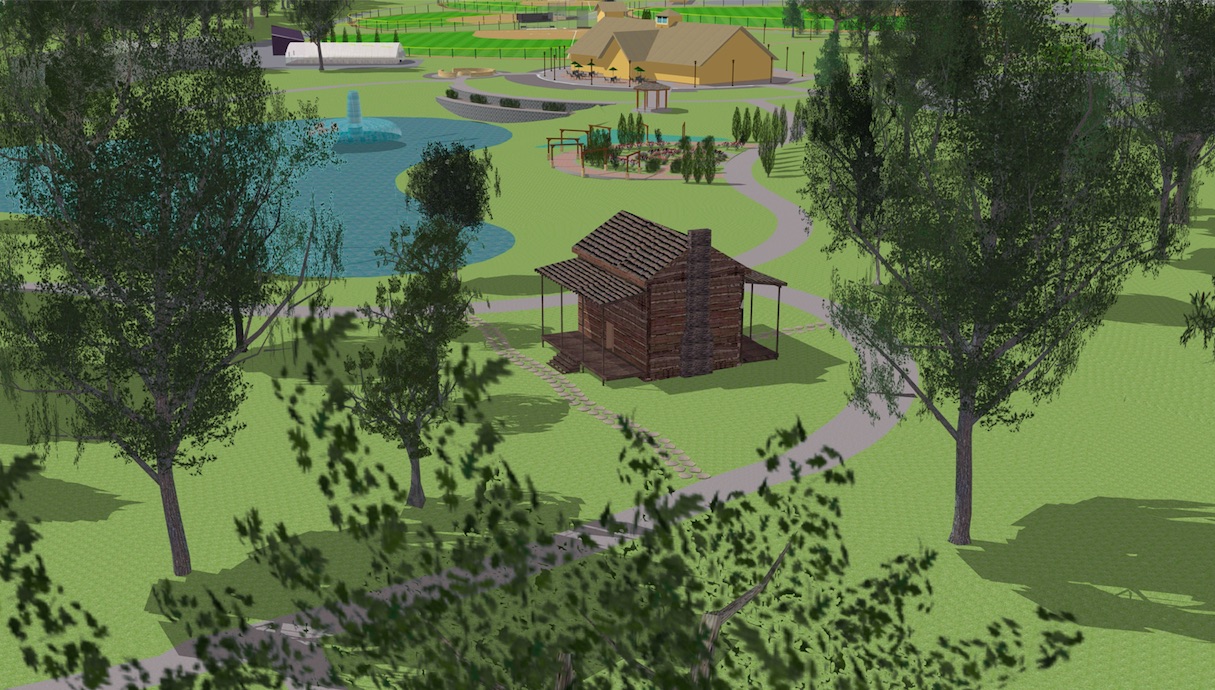
The plans at Belton Memorial Park includes featuring the Sloan-Tribby reconstructed cabin.
Courtesy of Shane DeWald, Belton Parks and Recreation
Maybe the evidence is in an attic, tucked away in a journal of a Civil War soldier. Perhaps the piece to connect this cabin is still out there to be found.

Belton Parks and Recreation is looking for donations, including lighting/electrical, stonework, cabin assembly, heavy equipment, walkway stones, landscaping, surveillance cameras, fencing, roofing, windows, doors, and various other pieces to bring this piece of history back to life. If you are or know someone who could help, please contact Belton Parks at https://www.beltonparks.org or email Diane Euston (the writer) at thefamilygenies@gmail.com.

**Please consider LIKING my Facebook page as well! Search "The New Santa Fe Trailer" so you don't miss any of my writing from the blog and the Martin City Telegraph! :) 

Thursday, August 24, 2017

Everything Ablaze on the Western Missouri Border: Ewing's General Order No. 11

“For miles and miles, we saw nothing but lone chimneys to mark the spot where a happy home
 stood only five years before. .. It seemed like a vast cemetery- not a living thing to break the silence.” 

- Rev. George Miller


A stroll through the rolling hills of Jackson, Cass, and Bates Counties in the mid 19th century would have been quite the sight to see; cabins hewn from trees near the rivers, brick homes and barns dotting the cultivated landscape- stone fences caging in acreage belonging mostly to Tennessee, Virginia and Kentuckians newly transplanted from their southern loyalties.

But that stunning scenery was far from what appeared in the summer of 1863 on the western border counties in Missouri.

Brig. General Thomas Ewing (1829-1896)
154 years ago on August 25th, civilians living on the border were banished from their homes, barred from returning by the government. Within a short amount of time, the order that ostracized these elderly men, women and children from their lands turned these counties into a vast wilderness- not a home, barn or valuable left upon their return. The only thing to mark that a civilization had once been present were the skeletons of brick and stone chimneys left standing, the smoke and flames engulfing these once happy homes.

General Order Number 11 issued by Brigadier General Thomas Ewing, Jr. is listed in history as one of the harshest orders ever penned by the government, displacing approximately 25,000 civilians at the height of the Civil War. Author Arthur E. Castel wrote, “In considering the harsh treatment of civilians in American history, [Order 11] ranks second only to the internment of Japanese Americans during World War II.”  

Before we examine this horrific event on American citizens, we need to examine what led up to it.

Ewing (1829-1896), an Ohioan-turned-Kansan, was appointed in charge of the District of the Border in June 1863. The district included Kansas and western Jackson, Cass, Bates and the northern part of Vernon County.  With little to no experience as a soldier, Ewing knew this assignment was going to be certainly challenging.

This area had been at war well before the cannons were fired at Fort Sumter. And the citizens living in the western border counties of Missouri had been ransacked by outraged Kansans, oftentimes known as Jayhawkers or “Red Legs” due to the red stockings they wore.

To be fair, neither side was completely innocent here.

Map showing the Kansas-Nebraska Act and Missouri's unique position
on the map. Courtesy of American Experience
The Kansas-Nebraska Act of 1854 determined whether Kansas was admitted as a free state. This ignited the Southern-born residents along the border. Some owned small holdings of slaves- most didn’t. The notion that just across the horizon was being overtaken by Northern-born families, many hell-bent "free-staters," was too much to take.
  
Radical abolitionists, including men led by Jim Lane and John Brown, crossed into Missouri and created mass chaos. Pro-slavery “border ruffians” formed in small communities, and guerilla bands of bushwhackers stormed into Kansas and evoked the same pain on them.

1861 Harper's Weekly drawing of federal soldiers searching
the home of rebellious Southern women for incriminating.
Since Missouri was “neutral” during the Civil War and it never formally ceded from the Union, there was an ironic divide within the state. And as we know, especially from recent history, great disagreements lead to even greater violence. As Confederate General Sterling Price recruited soldiers in Missouri, men reluctant to join the cause- and those with more radical tendencies- stayed away from organized service.

Charles R. Jennison’s raids on western Missouri in 1861 had enraged even neutral men. Missouri artist and Unionist George Caleb Bingham commented, “If Jennison were hung, General Sterling Price would lose the best recruiting agent he ever had.”

As the violence escalated on the border and these local groups of guerillas increased in size, infamous William Clarke Quantrill linked them together. Men and boys as young as 14 joined the guerilla bands to protect their countryside and their wives, mothers and children. 

. . .And to raid Kansas. 
Recruitment poster for Jennison's Jayhawkers, 1861
 In order to be successful, these guerillas needed aid and shelter in western Missouri.

The Southern women and older men living in these counties were really left no choice; disagreeing with Quantrill or one of his men meant a quick burning of your home or possibly worse. Thus, the farms left in charge of women were refuge for these men living in hiding from Union forces- and it really didn't matter if they sided with the South or not.

Brig. Gen. Thomas Ewing felt this was the case; he knew quite well that women were aiding the enemy, oftentimes denying that they were at any fault. Most swore loyalty to the Union. Many had kin - including husbands, brothers and fathers – that were deeply involved in the Southern cause.

Women were second-class citizens. They had no choice but to follow along with sealed lips and heads down.

By the summer of 1863, the situation was clearly out of control. Ewing, stationed at Pacific House (still standing as a landmark in Kansas City) at 4th and Delaware, wrote to his commander, John M. Schofield, that the bushwhacker allies on the border were “actively and heartily engaging in feeding, clothing and sustaining them.” He believed that up to 2/3 of the people that lived within his military control were actively aiding the bushwhackers.

Honestly, he was probably right.
Pacific House Hotel, where Ewing's Union headquarters were
during the summer and fall 1863

The result was General Order No. 10 on August 18th, 1863. In part, the order states:

The wives and the children of known guerrillas, and also women who are heads of families and are willfully engaged in aiding guerrillas, will be notified by such officers to move out of this district and out of the State of Missouri forthwith. They will be permitted to take unmolested, their stock, provisions and household goods. If they fail to remove promptly they will be sent by such officers under escort to Kansas City for shipment South, with their cloths and such necessary household furniture as may be worth removing.

This was a mistake…

William "Bloody Bill" Anderson
(1840-1864)
Young women with bushwhacker ties were found with gunpowder up their skirts and suspicious amounts of cash. They were arrested and held with no bail with the intention of removing them to St. Louis, Mo. where they were to be put on trial. Makeshift prisons around Kansas City had to be erected to hold them. The three-story building at 1409 Grand was chosen to hold about twenty women prisoners.

The prisoners were held on upper floors, including the third floor that once was George Caleb Bingham’s art studio and was added by the artist himself. Guards were stationed on the main floor and in the cellar. To make extra space available, it was said that the Union removed some support beams of the brick structure.

Around dinnertime on August 13th, the building cracked and crumbled to the ground with 17 women, one boy and one guard inside. Four women were killed from being crushed by the collapse and another died days later from her injuries.

One prisoner, the 10-year-old youngest sister of William “Bloody Bill” Anderson, had been chained to a bed for being disobedient. She suffered a crippling back injury, a cut-up face and two broken legs. Another sister, Mary Ellen, was crippled for the rest of her life. Charity Kerr, sister of John McCorkle (one of Quantrill’s men), was killed. Susan Vandever and Armenia Whitsett Selvey, cousins of Cole Younger (another member of Quantrill’s men and later a member of the James-Younger gang), were also among the victims. To add insult to injury, another of Bloody Bill Anderson’s sister’s, 15-year-old Josephine, was crushed to death on this fateful day.

John McCorkle, who lost his sister in the collapse, wrote, “We could stand no more. . . innocent and beautiful girls had been murdered in a most foul, brutal, savage and damnable manner. We were determined to have our revenge.”

Quantrill and his men were enraged when they heard the news of the death of their allies and family. Taking refuge at farmhouses nearby, Quantrill and his men plotted their revenge. Lawrence, Ks., a Union town with strong ties to the Jayhawkers who had consistently attacked farms in western Missouri, was a perfect target.

The raid on Lawrence is depicted here in a painting by Lauretta Fisk
Quantrill and his men considered any crime against women- especially Southern, “God-fearing” women- to be a severe, punishable act. Women, frankly, were off-limits. Quantrill and the guerrillas meticulously mapped their route and headed into Kansas just eight days after the prison collapse. Arriving at dawn with about 400 Confederate guerrillas (including McCorkle, Cole Younger, “Bloody Bill” Anderson and George M. Todd, whose father had built the original Red Bridge), they rode into Lawrence with payback on their minds.

As the men stormed into Lawrence on August 21st, 1863, Quantrill yelled his last order to his men. “Kill every man big enough to carry a gun,” he shouted as he secured four revolvers on his belt.

The first victim, Rev. Snyder was ambushed near his home as he harmlessly milked his cow. The attack was well-organized; every man had an assignment to carry out. They screamed and shouted as the 400 men swooped through the streets, setting fire to over a quarter of the buildings, homes and barns.
Harper's Weekly's depiction "The Ruins of Lawrence"

Rev. Hugh D. Fisher, a Methodist minister who escaped the Lawrence Massacre by concealing himself under a rug, transcribed his eyewitness account in “Gun and the Gospel.” He wrote of numerous events he saw that day, including the murder of John Carpenter. Carpenter, in ill health, had tried to run from his home to escape the guerrillas. He was chased by the armed men, and his wife knew he was certainly going to be caught. She fell on top of Carpenter and sheltered him in her skirt.

Rev. Fisher wrote, “She fell with him and again they tore her partially from him and finished their crime by repeatedly turning their revolvers upon him while still she clung to him and begged for mercy and his life.”

This repulsive, unrelenting raid became known as one of the most significant and bloody events against civilians during the Civil War. Called “Quantrill’s Raid” or the “Lawrence Massacre,” around 160 to 190 men and boys were murdered. Corpses littered the dusty streets of Lawrence, then a town of about 3,000. Their mission was complete in less than four hours.
 
Tensions and vengeance had finally spilled over into unforgivable violence. Ewing was in Leavenworth when Quantrill took to Lawrence. He met with Kansas Senator and Jayhawker Jim Lane (1814-1866) near Morristown, Mo. later that evening, possibly looking to relieve some of the tensions this tumultuous, radical abolitionist would have after the Lawrence Massacre.
A monument in Oak Hill Cemetery in Lawrence, Ks.
honors the victims of the Lawrence Massacre 
Leander M. Dehoney stood outside of his home looking toward Blue Springs on the night of August 24, 1863 and could count 24 houses burning in the distance. The retaliation of Lawrence had already begun.

Ewing returned to the Pacific Hotel in Kansas City on August 25th and took pen to paper four days after the Lawrence Massacre to issue General Order No. 11. Little did he know the lasting influence this would have on families. . . and on his own career.

In part, the order read: 

All persons living in Jackson, Cass, and Bates counties, Missouri, and in that part of Vernon included in this district, except those living within one mile of the limits of Independence, Hickman's Mills, Pleasant Hill, and Harrisonville, and except those in that part of Kaw Township, Jackson County, north of Brush Creek and west of Big Blue, are hereby ordered to remove from their present places of residence within fifteen days from the date hereof.

Just fifteen days to vacate.

We know how the weather can be in August in Missouri. The temperature during this fifteen day period hovered between 90 and 100 degrees. . . and it hadn't rained in weeks.

This original Oath of Allegiance dated Sept, 7, 1863 for George W. Kemper shows that he was able to answer questions to the Union's liking and could stay within the Hickman's Mill military post.
Document courtesy of Harvey Kemper
Depriving the bushwhackers of the comforts offered in many western border counties was essential, in Ewing’s mind, to controlling the havoc. Gen. Order No. 11 went on to allow people to report to one of the military posts, which included Hickman’s Mill, Pleasant Hill, Harrisonville, and Kansas City and swear their oath of allegiance to the Union. They would be put under intense questioning, and if their answers were deemed true by soldiers at the post, they would be allowed to stay at the military station.

This map demonstrates the "Burnt District"
outlined in red. The stars represent military posts.
The northwest corner of the map carved out
was the exception of Order No. 11 evacuation.
These people were not allowed, under any circumstances, to return home. They couldn’t jump over the state line to Kansas and settle on the eastern border counties. All of their possessions were left behind-  they were left to carry what they could. Many families buried priceless treasures in hopes they could one day return and reclaim them. All their crops were automatically forfeited to the government.

It’s essential to keep in mind that these families that remained on their farms were absent of young men to help with moving; most of the men over the age of 15 were serving on the two sides of the war. Elderly men, women and children were the only ones remaining. Wagons to haul valuables away had been pillaged and stolen in previous raids from both sides- horses had been taken from their stables.

Ewing instructed his soldiers to not pillage the deserted homes left behind, but he was in no position to control what happened. Many of the Union soldiers in charge of these displaced Missourians in the camps were enraged Kansans looking for an opportunity to punish them. And pillaging and burning of homes started the minute word of the Lawrence Massacre traveled like the wind.

The civilians of these counties, estimated to be over 25,000 people, were given 15 days to clear out – most traveling on foot- of an area of just shy of 3,000 square miles. The families that had rummaged up their possessions were oftentimes attacked on the road and robbed of what they did have left. Each person, loyal or disloyal to the Union, was forever affected by Gen. Order No. 11.

News of the order traveled quickly, but those in more rural areas, far away from military stations and the bustling towns of Kansas City and Westport, had no idea such an order had been enacted. Carol Bohl, executive director of the Cass County Historical Society, stated, “Many in reality didn’t receive that message until 15 minutes before they were told to gather their things and leave. So the culmination, of course, was that most of the population of the border area left, not by their own choice. They were forced out by the federal troops.”

Rev. George Miller (1835-1900)
Historian and expert on Gen. Order No. 11, Tom Rafiner, stated in Topeka’s KTWU’s “Sunflower Journeys” series, “In many instances, as soon as families had packed their belongings that they had to carry out of the county, their homes and barns were set fire to. There are numerous instances of families standing in their front yards watching as troops set fire to their homes and their property. Those three counties that were vacated later became known as the Burnt District.”

Union militiamen, many from Kansas, traveled through the counties and set fire to most all of the abandoned homes. They carried the remaining possessions of these displaced citizens into Kansas to use for their own purposes. Stories from the survivors of the order wrote of hardships and terror as many of them watched men shot down as they were trying to obey the order.

Rev. George Miller, who lived in Kansas City at the time, wrote, “The enforcement of such an order. . . right at the beginning of winter, would avail nothing, and would inflict untold suffering on thousands of helpless women and children, already bearing crushing burdens, and would bury its author in eternal ignominy.”

The home of George Caleb Bingham when he painted "Order
No. 11," located in Independence, Mo.
George Caleb Bingham, a Unionist, completely disagreed with Ewing’s order. He famously warned in a letter to Ewing, “If you execute this order, I will make you infamous with pen and brush.”

James Lane
And boy, did he ever! In 1868, Bingham sat in his art studio in Independence, Mo. and painted one of the most famous of his works. Civil War: as realized in the Desolation of Border Counties of Missouri during the operation of “General Order No. 11,” issued by Brigadier General Ewing, from his Head Quarters, Kansas City, August 25, 1863 was the name given to his famous painting. Commonly referred to as Order No. 11, this work of art demonstrates how many on both sides of the cause felt about Ewing’s decision to inflict pain on civilians living on the border.


Kansas senator Jim Lane, known for his powerful political speeches, threatened in the Daily Missouri Democrat on September 1, 1863, “I will tell you what I want to see. I want to see every foot of ground in Jackson, Cass, and Bates counties burned over everything laid waste. Then we shall have no further trouble. The bushwhackers cannot remain in the country, for they will have nobody to feed them nobody to harbor them nobody to provide them with transportation no place to sleep in.”

Lane got his wish.

The Columbia Statesman reported of the refugees traveling through the community that same month. “For several day’s past families with all their movables have been passing through, en route for a new home, having left the border in consequence of the late order of Gen. Ewing. Many of them looked ragged and forlorn, bearing evident signs of poverty.”

It was said that anyone left behind after September 9th still residing in these counties was shot on the spot by Union troops.

The Union commander at Lexington, Mo., Bazel F. Lazear, wrote to his wife, “There is hundreds of people leaving their homes from this country, and God knows what is to become of them. . . . It is heart sickening to see what I have seen. . .A desolate country and women & children some of them almost naked. Some on foot and some in old wagons. Oh God what a sight to see in this once happy and peaceable country.”

George Caleb Bingham's "Order No. 11" painting, completed at his
studio in Independence, Mo. in 1865-1870
25 year-old Laura Harris Flanery Bridges wrote of her experiences during Order No. 11. Her account was published in Tears and Turmoil: Order No. 11. Her husband had served in the Missouri State Guard as she stayed home at their farm near present-day Lees Summit with her young son. Her house had been burned in 1861 by the Jayhawkers along with 26 other houses- and her church.

When Order 11 was issued, she remembered, “All of the women were panic stricken. We had lived sheltered lives, busy in our own households, directing our Negro servants and, naturally, all important decisions were made by the men of the family.”

With no place to go, Laura gathered the small possessions she had left and traveled with 23 families, whose husbands, fathers, brothers and sons were away in the rebel army. Two men were with their group- an 84 year-old man and his 56 year-old blind son. The rest of the party contained 61 women and children.

As they headed south, they were robbed in Clinton, Mo. of everything but one team of horses and oxen. They couldn’t drive the oxen, so their feet were they only thing left to guide them all the way to Sherman, Tx.

Yes, they walked all the way from Missouri to Texas.

Laura recalled, “That was a long walk. We were only able to walk four or five miles a day.”

President Abraham Lincoln could envision the problems that could amass due to Order No. 11. He informed General Schofield in a letter Oct 1st, 1863:

"With the matter of removing the inhabitants of certain counties en masse, and of removing certain individuals from time to time, who are supposed to be mischievous, I am not now interfering, but am leaving to your own discretion.. . So far as practicable, you will, by means of your military force expel guerrillas, marauders and murderers, and all who are known to harbor, aid or abet them. But in like manner you will repress assumptions of unauthorized individuals to perform the same service, because under pretense of doing this they become marauders and murderers themselves."

And so it happened.

George Caleb Bingham
Courtesy of the State Historical Society of MO
A displaced loyal Southern woman recalled that the road from Independence to Lexington was crowded with women and children. Women walked with babies in their arms while children followed. They cried for bread and others cried to be taken back home.

In November 1863, Gen. Ewing eased up on his order and allowed people to return to their homes as long as they swore loyalty the Union. But the damage was already done. 

These shells of homes- these brick and stone chimney structures- charred from the fires and torches lit by Union men and Jayhawkers along the border, became known as “Jennison’s tombstones," and the area was accurately called "The Burnt District." In Cass County, Mo. alone, 5,000 citizens were displaced due to Order No. 11, and only 35% returned after the war to their farms. In truth, there was nothing to return to. Bates Co. didn’t have a military post nearby, thus the county was completely abandoned and all of their records in the courthouse were burned. Nothing remained.

This Order, considered to be one of the largest atrocities of the Civil War, haunted Ewing for the rest of his career. George Caleb Bingham, who had promised to show the country the atrocities of Order 11, traveled throughout to market his painting. He tried to keep Ewing out of public office, yet Ewing was able to serve two terms in the House of Representatives. As Bingham publicly denounced Ewing, Ewing stayed perfectly quiet and said not one bad word about Bingham. Bingham died in 1879, cast away due to his pubic rants and outspoken hatred toward Ewing.

Brig. Gen. Ewing was interviewed in the Kansas City Daily Times in 1879. When asked about Order No. 11, he said, “It hardly needs explanation. It was a necessity of war, and necessary to save the lives of the family and friends of the guerrillas, who were almost the only persons affected by it.”

ALMOST?

Nice try, Ewing.

Everyone, no matter the loyalty, was affected by Order No. 11.

Around 40,000 people lived in the three counties prior to Order No. 11. By the end of the Order, only about 5,000 remained. According to historian Tom Rafiner, one out of five people returned after the war.

When Ewing ran for governor of Ohio in 1880, he lost by a small margin. The events on the Missouri-Kansas border, specifically Gen. Order No. 11, is said by some historians to be the reason for his defeat. In the end, possibly George Caleb Bingham did get his way.

In 2009, a memorial, called the “Burnt District Monument” was erected 2501 W. Wall St. in Harrisonville, Mo. to pay homage to the thousands of people displaced after Gen. Order No. 11 and to remember all of their homes that were burned to the ground. A stone chimney stands at the site, a simple yet powerful reminder of the atrocities of Gen. Order No. 11.
 
The Civil War on the border was a unique and prolific time in this area’s history. People on both sides lost everything and were left behind in the smoke and flames. The anniversary on August 25th is a staunch reminder of the suffering of civilians in the hands of chaos of the region and how elderly men, women and children were victims- and survivors – of a horrific event against civilians in wartime.


THE EXILES LAMENT*
By Martin Rice (1804-1903)

Alone I've returned to the home whence expelled
By "Order Eleven" from Kansas,
And here in this home, by my feelings impelled,
I sigh as I'm penning these stanzas.

In the home which I builded I sit alone quite,
Or walk through its rooms in sad silence,
And I think of the time when my skies were all bright,
Ere the land had been covered with violence.
 
I look on my hearthstone, so cheerless and cold,
And my eyes as I look become tearful,
As I think of the past, and the happy household
Who once met around it so cheerful.

In vain I may look for that household to-day,
In vain search the orchard or wildwood ;
My motherless children are now far away
From the scenes of their earliest childhood.

I look on the landscape so changed and defaced,
And the farms all to ruin fast hasting ;
The fruits of my labors, abandoned in haste,
I find are now wasted or wasting.

I look through my windows on farms lying waste,
The homes of my once happy neighbors,
Whose houses and orchards are torn and defaced,
And spoiled are the fruits of their labors.

But some of those neighbors I'll see here no more,
I laid them in beds dark and gory,
But when I have quitted this blood-crimsoned shore,
I hope I shall meet them in glory.

Hard, hard is the fate of an exile from home,
And hard is our lot among strangers ;
Wherever we wander, wherever we roam,
We're looked on as Quantrell's bush-rangers.

What though we have suffered at bushwhackers' hands,
Or bled in the cause of the Union,
Because from the haunt of bushwhacking bands
We're counted as if in communion.

But I must away now and leave here with pain,
This wreck of my earthly Elysian,
And when I have left it perhaps ne'er again
Will this home greet my organs of vision.

*Martin Rice was born in 1804 in Tennessee and published two volumes of poetry in his lifetime. He was the only person to vote for Abraham Lincoln in all of Cass County, Mo.
This poem was written in the latter part of 1863 and published in The Lexington Union


The Rice Homestead

**If you haven't already, be sure to go onto Facebook and search "The New Santa Fe Trailer!" Please like my page so you don't miss any of my writing! **

Suggested readings: 

* Bleeding Kansas, Bleeding Missouri: The Long Civil War on the Border by Jonathan Earle and Diane Mutti Burke 
*Caught Between Three Fires: Cass County, Mo., Chaos & Order No. 11 by Tom Rafiner
*George Caleb Bingham: Missouri's Famed Painter and Forgotten Politician by Paul C. Nagel
* Kansas City Public Library's "Civil War on the Western Border" website- http://www.civilwaronthewesternborder.org

*Scattered to the Four Winds: General Order No. 11 and Martial Law in Jackson County, Missouri, 1863 by Ralph A. Monaco II

*Tears and Turmoil: Order No. 11 by Joan Chiles Eakin