Previous Posts

Sunday, December 17, 2017

Christmas Firsts in Kansas City


The First Lighted Tree

He was a craftsman; he had been trained in Prussia to carve beautiful creations from the simplest of things. Like many of the freshly-arrived immigrants to the States, Oswald Karl Lux wished to immerse himself in new customs while still holding onto some of those from his homeland.

He was on a mission.

Oswald left his little workshop at the back of his home on Archibald Street in Westport content to follow through with a promise he had made himself. As he scratched his beard, he wrapped his trench coat closer to his body in hopes to shield the bitter cold wind as it gusted straight through his small frame. The cold wasn’t going to stop him – he must continue.

1885 view of Westport Road and Pennsylvania
Missouri Valley Special Collections
The merchants in Westport didn’t have what he was looking for. Two days before Christmas, he had walked the streets, store-by-store, searching and describing what he wanted to purchase. But alas, the stockpiles of items weren’t what he had envisioned. He wanted to bring an authentic German Christmas to his family, especially for the little ones that left Leobschutz before they could recall the town in its seasonal splendor. Oswald knew that for this Christmas, the second they were to celebrate together, had to be special. His family had sacrificed so much, and this Christmas was going to be extraordinary.

He had resolved to mount his horse and tie up his wagon so he could travel three miles north to bustling Kansas City. Perhaps what he was looking for could be found in one of the many stores that had advertised the ability to supply Christmas goods. As he traveled up and down the hills on the main road, he imagined six-year-old Hattie waking up on Christmas morning and rushing to the front of their home to see what Santa Claus had brought her. Oh, and Olga. . . Olga would grab her big sister’s hand and run with her full speed in wonderment to what awaited.

It reminded him of a harsher time in July 1880- just over two years earlier- when three-year-old Hattie had clasped his hand as they boarded the ship from Hamburg to New York alone. It was a decision that most could not even fathom, leaving his pregnant Agnes and seven month old Olga behind in Prussia as he and little Hattie set up a new home in Missouri. That first Christmas in this new country was coated in sadness, because their growing family was an ocean apart. Christmas 1883 was going to be different; now that Richard was born healthy and they were finally together, the Lux family was going to have a proper Christmas together. Their first was much less extravagant- they had no money to spend with so many mouths to feed.

The German immigrants in Kansas City had to have what he was looking for at their shops. Time was running short, but he knew he had to try. Oswald arrived at 15th and Grand and peered up at the sign above the shop. Warneke Baker Company would be his first shot in the city. Their bakery was renowned for their confectionary, dried fruits and trinkets for Christmas trimming. As he peered through the frosted window and spotted several Christmas adornments, including beautifully frosted cakes, he smiled in hope. This place could have what he so desperately craved.

Main St. at 11th cir. 1880
Image supplied by John Dawson
He opened the wooden door and a bell jingled to announce his entrance. Standing behind the counter was a young man dressed in a white apron. The clerk’s eyes brightened as 37-year-old Oswald removed his gloves and his hat from his head.

“Good morning, sir! How may I help you?” the clerk inquired with a growing smile on his face.

Oswald’s heart raced a little quicker when he immediately noticed the clerk had no accent. He tried to form his words, uncomfortable and shy in his demeanor. He had practiced his words so many times before as he had combed all the stores in Westport the day before. Oswald grew a little taller and looked in the young clerk’s direction. “I look for tree. Christmas tree,” Oswald announced in a thick German accent.

The clerk’s eyes widened as he listened to the man’s request. With only a second of hesitation, the clerk threw his pointer finger up into the air excitedly. “Yes! Yes. A tree! I think I have what you’re looking for!”

Oswald grew a little more uncomfortable as he recognized that this young man wouldn’t be able to speak to him in German. However, his animated actions made it easier for Oswald to understand him. The clerk waved Oswald over to the other side of the small store. Reluctantly, Oswald began to walk on the checkered floor and toward where the clerk now stood. He raised his eyes and placed his gloves on the glass counter. Behind it, the clerk proudly stood next to a miniature Christmas tree no taller than eighteen inches. Its delicate branches drooped in sadness. They were weighted down by a few pieces of dried oranges tied with red ribbon on the few sprigs of greenery.

Oswald looked curiously at this small tree. His brow furrowed as he made eye contact with the proud, young clerk looking for another commission before Christmas. His hands rested on his hips as he beamed back at Oswald. Yes, this clerk thought he had this sale in the bag.
A drawing in the Kansas City Star
showcasing Oswald Lux's search
for a tree

“No, no, no…” Oswald shook his head back and forth, “I look for… for… for big tree.”

The clerk crooked his head to the side as he realized that this sale wasn’t going to be as easy as he had thought. “How big are you thinking, sir?” he asked as he sprung his hand up and down at his waist indicate the size.

Oswald threw his arm above his head and proudly responded, “Dis big!”

He had struck out again. As Oswald slowly opened the door to leave Warneke’s, the clerk hollered, “I wish you luck, sir. But I don’t think you’re going to find anything that big here in the city.”

Oswald turned, tipped his hat and nodded to the young clerk as he shut the door behind him. The cold rushed his body as he buried his face closer to his jacket collar and headed toward his horse and wagon. He had to rethink what he was going to do next.

He did try other stores, and reluctantly, he had to admit the clerk was right. There were no tall evergreen trees available in Kansas City for purchase. As he headed south back home to Westport, he was lost in thoughts and defeat. He just couldn’t imagine letting the little ones down on Christmas morning. He had already told them tall tales of Christmases long ago in Prussia- the beauty of a perfectly trimmed evergreen tree brightening up the coldest of winter days. An eighteen-inch tree or smaller was literally all these merchants had, and that wasn’t even close to what he had promised to deliver.

Union Cemetery showing the large evergreens
Courtesy of unionhill.com
As he headed up the hill on the main road back toward home, his eyes shifted to the west at the barren winter landscape. In the distance, he spotted the small grey stones of Union Cemetery. His horse trekked along, and Oswald’s gaze watched as the dots of stones disappeared as enormous evergreen trees hid their sight. They stood out in the distance, the only color in wintertime. He just wished he had a tree like those. . . those branches would hold the weight of wrapped presents and dried fruits.

Those branches. . . Wait. Those branches!

He slapped the reins on the horse’s flank and turned toward the west. As he drew closer to Union Cemetery, he stopped at one of the towering evergreens and took out his pocket knife from his coat. He breathed in deeply and closed his eyes; the familiar smell of fresh evergreen enraptured him. Yes, this would work. He can make this work.

Oswald quietly crooked his head toward the large tree and gingerly cut branches off of it. His gloves became sticky from the sap, so he removed them to quicken his task. He gathered the healthiest branches in his reach, bundled them and placed them in his wagon. Excitement overtook him.

He knew now that his skills as a cabinetmaker would soon be at work. He had the greenery, but he needed sturdy branches that would hold up to the weight of all he had envisioned in his mind. As he turned into the town of Westport, he was overcome with another brilliant idea to pull off this massive undertaking. He stopped and purchased a broom and asked the owner of a saloon if he could have one of the empty barrels chucked at the back of his business. He loaded the contents into his wagon and turned toward Archibald Street to his cozy home.

For the next two nights, Oswald worked by candlelight to transform these objects into something beautiful. He removed the head, hoops and rivets to free the curved wooden staves from the barrel. The scent of Kentucky bourbon drifted to his nose and throughout the small shop behind his home. Oswald fastened the staves to the broomstick handle one-by-one, the longest, about fifteen inches, being at the bottom. He used shorter sticks to fashion the top of the tree. Recycling colored tissue, he concealed the wooden staves and carefully covered over the tissue with the sprigs of evergreen acquired near Union Cemetery.

Oswald cautiously walked backward, his eyes concentrating on the project at hand. He put his hand to his mouth and thought about what else he needed to make this makeshift tree something special.

Oswald Karl Lux (1846-1937)
Courtesy of the Lux descendants 
He looked about the small room and spotted the candles that lit his workshop. Of course! The tree needed candlelight to illuminate it. This would be just like what they had at home in Prussia and exactly what he had described to his small children.

Oswald drove nails through the ends of his “tree” and then placed short, fat candles on each nail. He smiled in satisfaction.

After the children were put to bed on Christmas Eve, Mr. Lux quietly carried his creation into his home and mounted it in the front window. Oswald and Agnes silently tied toys, dolls, sweets and apples on each branch. Before the signs of daylight, Oswald quickly lit each of the candles on the tree and impatiently waited for the children to awake from their slumber.

As daylight barely crept through the windows, the children awoke in the instant excitement that comes from anticipation on Christmas morning. The oldest children, Hattie and Olga, jumped out of bed and raced to the doorway into the front room. Standing before them was the most beautiful creation they had ever seen. Glowing even in the early morning, the lighted Christmas tree, standing just three feet tall, was a delight. Their cries of enthusiasm were replaced with awe at the lighted tree.

Before breakfast was finished, the marvel of the tree had drawn small neighborhood children to the streets. Through the frosty front window of the Lux home on Archibald Street in Westport, the children saw the glowing beauty of the largest tree they had ever seen. One-by-one, they called on the Lux family so they could get a closer look at the finest tree they had ever seen.
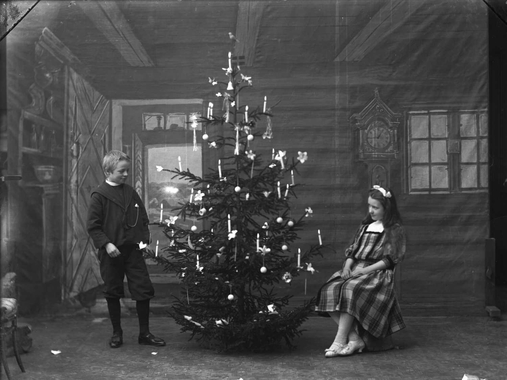
For over a week after Christmas, the Lux home was the site of continuous activity. The tree’s popularity triggered Oswald to remove it from the front window and onto the street so everyone could stop and see it. Boxes and boxes of candles were used to keep the tree lit, and children returned every day to stare at its splendor.

Two years later, Oswald’s want of purchasing a large tree for his family was no longer an issue. Evergreen trees imported from Michigan became available in Kansas City in 1885.

Yet the first lighted tree in all of Kansas City and Westport would forever be attributed to Oswald Karl Lux, a German immigrant who wished to light up the faces of his small children on that Christmas day in 1883.


The First Electric Christmas Tree Lights

Thirty-two year-old Edwin R. Weeks traveled from his offices at 807 Santa Fe in Kansas City to his residence at 1409 Cherry. With Christmas upon him, he couldn’t wait to arrive home to show his infant daughter, Ruth and his wife, Mary what he had just received by parcel from his friends, Thomas Edison and Edward Johnson.

They had sent him something special to try out in Kansas City.

Edwin Ruthven Weeks (1855-1938)
Five years earlier in 1882, Johnson had put 80 hand-wired red, white and blue bulbs together and decorated his very own tree with them. They had been working for years to perfect this design with hopes of replacing dangerous candles that were used to illuminate trees at the time.

Edwin R. Weeks became close to these pioneers of electricity after circumstances in 1881 led him to be the manager of Kawsmouth Electric Light Company. After working at the Kansas City Journal as a newspaper man and a short stint with the railroads, Weeks’ innovations and natural ability in physics had him pioneering electricity in the city. He had supervised over the first plant in the world to use the Thompson-Houston system (now General Electric).

As the city grew in size, Edwin had been breaking ground on spreading electricity. Before long, he had just shy of four miles of poles carrying electrical currents to the West Bottoms, the Union Avenue business section and Quality Hill. In 1883, he had incorporated the Kansas City Electrical Company, the precursor to Kansas City Power and Light.

The first electric dynamos appeared in a 1917 article
in the Kansas City Star
Oh, the growth of electrical wonders that Edwin had seen! A system built by Thomas Edison himself first lit his office – and another unit was sent to him to light his home at 1409 Cherry.

Weeks tightly tucked the wooden box under his arm as he rushed inside his brick home to greet his wife and daughter. In the front room, his Christmas tree stood, lit by numerous candles. He shouted for Mary and told her to come into the room.

“Wait until you see what has been sent to us!” Edwin exclaimed as he carefully placed the box on a table in the room.

With Ruth in her arms, Mary smiled and played along. “Why, what is this?”

Edwin smiled widely as he turned his attention to prying the lid off the box. He tore through the protective papers and peered inside.

There they were- colored lightbulbs and wiring.

Edison Christmas tree lights (1903-1904)
“This is electrical lighting for a Christmas tree,” Edwin explained as held up one of the bulbs in his hands for his wife to see.

She looked back and forth from the candles on the tree already displayed in their front window to the lightbulb in her husband’s hand. “Are they safe?” she quietly asked.

“Of course they are safe! They have to be safer than these candles!” he beamed.

Without much of an argument in her, Mary watched in silence from the settee as Edwin gingerly screwed each bulb into the wiring. After removing each candle from the tree and cautiously draping the single strand of electric lights on its branches, Edwin leaned down to test this new innovation.

Mary gasped as the room was soon replaced from candlelight into a room of magical color. Edwin turned the lights off around the house and they raced outside to catch a glimpse of the glory from the street.

An early 1900s advertisement for Christmas lights
There it was, beautifully lit in an unbelievable scene of splendor. In that square bay window at 1409 Cherry, the first electrically lit Christmas tree stood proudly for all of Kansas City to see.

The mistrust of electricity throughout the United States continued for years. In 1895, President Grover Cleveland assisted in building confidence in electric tree lighting when the family Christmas tree in the White House was coated in hundreds of electric lightbulbs.

Therefore, the evolution of electric lighting of trees became more and more popular in the 20th Century.

Charles S. Pitrat (1895-1970)
The First Plaza Lights

He had been there when Jesse Clyde Nichols staked out a location in the low creek bottoms to build the first outdoor shopping center in all of America. Nichols’ innovations and creativity had him imagining a nostalgic location that would include architecture that matched the beauty of Seville, Spain. At that time in 1922, Charles S. Pitrat was only a 27-year-old eager to find a place within J.C. Nichols' growing empire.

Within just a few short years, Pitrat had positioned himself as a vital part of the development of the Country Club Plaza. He counted his blessings that Christmas season in 1925 when he stood in the second story entrance of the Suydam Building on Mill Creek Parkway (now J.C. Nichols Parkway). This very building was the first to be finished on the Plaza, and he had helped lease the first tenant. The Suydam Decorating Company on the second floor was the original namesake of this important place.

He had seen the Country Club Plaza emerge from a vision inside of Clyde Nichols’ head and change into a physical location that was slowly building into a significant place. His office in the Tower Building guaranteed he could be nearby if anyone needed anything through development.

The site today of the very first Christmas
lights strung by Pitrat
In those early years, Charles had gone door-to-door and asked merchants to park outside on the streets in front of the two parking garages to help make the area look busy. Business wasn’t booming, and he needed to help find a way to revolutionize it further.

“Merry Christmas,” he shouted as one of the tenants locked up for the night and headed out the door of the Suydam Building. He held onto the small strand of lights in his hand and glanced upward to the cornices of the building.

Yes, this will do just fine, he thought to himself as he climbed a small ladder and got to work.

His father, too, had been a revolutionary in Kansas City when he had opened Kansas City’s first bookstore, Osborne & Pitrat. Maybe that same spark of firsts followed Charles on this very day. But when he climbed that ladder and strung the small strand of lights, he was simply looking to spread some holiday cheer.

The Plaza Lights, 1940
Missouri Valley Special Collections
Yet just three years later after the Plaza Theater had been constructed, the Country Club Plaza would flip the switch on a strand of lights along 47th Street. And by 1929, every single beautifully built and planned building on the Plaza was covered in beautiful, colorful Christmas lights.

Charles S. Pitrat’s simple strand of lights in 1925 on what is now known as the Mill Creek Building transformed the Plaza’s place in history, and each year became grander and grander than the last.

To read another great story about Christmas in Kansas City, check out last year's post here: Christmas History, Cultures and Traditions of Kansas City Settlers

***Merry Christmas from the Santa Fe Trailer! Don't forget to LIKE my Facebook page (search The Santa Fe Trailer) so you don't miss any of these incredible stories. As always, thank you for reading and inspiring me to keep writing about the history of this incredible area. 

*Main image of the Plaza Lights was published at www.theodysseyonline.com 

*Some fictional details were added to bring these stories alive, yet thorough research was conducted (as always!)

Wednesday, November 29, 2017

Log Cabin in Cass County Uncovers a Promising Link to the Civil War and Order No. 11

Nightfall had overcome the prairie the sweltering evening of August 21st, 1863; few sounds echoed in the darkness in the middle of the night. They had avoided the manhunt by taking high prairies and divides between Bull Creek and the Marias des Cygnes River. They had turned into the timber, and in the darkness, had escaped into the night. Quantrill and his men continued to creep with solidarity southbound.

They needed to get back into safer territory. They needed to cross into Missouri.

Senator James H. Lane, a notorious Jayhawker and Union general, emerged after narrowly escaping the attack in Lawrence. Through the burning cinders and ashes of the town of 2,000, Lane looked for reinforcements in order to chase the murderers. Knowing very well that he was one of Quantrill’s targets, the unpredictable senator rallied farmers to grab fresh horses and follow the guerrillas.  Lane had no intention of letting Quantrill get away this time.

The Lawrence Massacre, August 21st, 1863
Meanwhile, in Leavenworth, Ks., Gen. Thomas Ewing, Jr., the man in charge of the District of the Border, was oblivious to the goings-on just southwest in Lawrence. Ewing was absent from his headquarters at the Pacific House Hotel in Kansas City when two couriers were sent to alert him of the Lawrence Massacre. But it wasn’t long before the dreadful news crossed in front of him. By 1:00 in the afternoon, Gen. Ewing left Leavenworth and headed south to seek out the slayers.

Gen. Ewing did not have fate on his side. He was delayed at the Kansas River at De Soto, Ks. because they couldn’t find boats to cross the waters. Hours crept by as Ewing was left restless and exhausted. As he was caught in wait on the river, Quantrill quietly continued on his route to safety.

Sen. James H. Lane (1814-1866)
Hunger and thirst overcame Quantrill’s men as their horses struggled to keep moving forward. The high from the morning’s successful attack of Lawrence had soon worn off as federal troops trailed the men as they fled Lawrence south. They, too, were exhausted from the chase of just shy of 50 miles. As men were alerted along the way, some stationed themselves on the state line in hopes of catching the guerrillas before they could sneak across the invisible line.

Some were, in fact, captured and killed. But the big fish was still out there.

The raiders, after killing close to 200 men and boys in what would be coined the Lawrence Massacre, slipped somewhat silently into Missouri in Cass Co. and closely watched at a fork of the Grand River as federal troops continued their manhunt.

By daylight the next day, the famished guerrillas halted to take a quick meal in small prairie surrounded by trees. Before they could feast, a warning came that troops were nearby. There was no choice; Quantrill and his men had to proceed. A small skirmish with troops ensued, yet, as always seemed to be true, Quantrill and most of his men fled through the forest to freedom.

Gen. Ewing, dangerously affected by the delay in De Soto, didn’t arrive to the Missouri border where Quantrill crossed until after dark on the 22nd- hours and hours after Quantrill hopped into his familiar territory where friends were aplenty.

Sen. Lane lost his search of Quantrill, yet his rage was not adrift. He had plenty of time, fatigue the enemy, to fester over the intense hatred he had for these guerrillas. Gen. Ewing and Sen. Lane met near the place where Quantrill and his men were known to stop four miles east of the Missouri-Kansas border. Lane, an incredible extemporaneous speaker, spat his frustrations at Gen. Ewing and demanded something drastic be done.

If Ewing wasn’t going to do anything, Lane and his Jayhawkers certainly would.


********************************************************************************************************

William Quantrill (1837-1865)
When Don Peters, former executive director of Cass Co. Historical Society received a phone call in December 2014 that a log cabin was hidden underneath an abandoned house north of Freeman, Mo., he jumped at the chance to save it. And now, just shy of three years later, Peters is convinced this cabin is much more than just a lovely piece of pioneer history. He believes that it could be where two central infamous figures in the Kansas-Missouri Civil War conflict stayed and discussed Quantrill’s Raid on Lawrence and one of the most controversial orders during the Civil War.

And if he’s right, this little log cabin would be a significant rediscovered piece of Civil War history for the ages.

A man had recently bought 80 acres of land north of Freeman, Mo. Before the new owner was to bulldoze the structures on it, he knew it was best to contact the experts about what he believed was underneath the abandoned house on the land.

A log cabin enthusiast, Peters was perfect for this new project. He had already successfully saved three other cabins in Missouri, but a cabin surviving the Border Wars and Civil War was an anomaly. As any good historian would do, he dug deep into the records to learn more about the history of the land and the family attached to it. 

Alfred G. Sloan's first land patent from 1845
And Mr. Peters has a very interesting case.

“Albert Sloan cleared the land and built this log cabin,” Peters explained. From its construction, Peters believes the cabin to be built in the late 1830s or early 1840s.

The first landowner was Alfred G. Sloan, born around 1805 in Barron Co., Ky. He married his first wife, Elizabeth Standiford in Indiana, and by the 1830s, Sloan and at least one of his brothers settled in what is now Cass Co. (then called VanBuren Co.).

Accounts from the Sloan descendants are recorded in the history of Cass Co. Family lore indicates that when Alfred rode into Pleasant Hill on a black pony with his wife, he met a Native American. Alfred wished to find land with plenty of water sources, and the old Indian led them to land north of Freeman, Mo. where the South Grand River's forks spidered on the land. In thanks, Alfred turned over his black pony to the old Indian.

He patented 240 acres of prime real estate in 1845. As with many early settlers of the western portion of Missouri, it is likely that Alfred Sloan was a “squatter,” meaning he had settled on the land well before he had purchased it from the government. The 1840 census shows that Alfred had already moved to Cass. Co. earlier, showing that the construction of the cabin was, in fact, by the late 1830s.

After all, a family of eight had to have a place to sleep.

Alfred’s brother-in-law, Hiram Boone Standiford, founder of Stanton, Ks., was a member of the Territorial Legislature before Kansas was a state. In E.W. Robinson’s History of Miami County, he wrote of Standiford: “He was a leader to be trusted, a friend warm and steadfast. . . In public life, he was an uncompromising Free-state man. . . He had been an anti-slavery member of the Missouri Legislature.”

Alfred G. Sloan and Serepta White. Courtesy
of the Sloan-Tribby descendants.
On December 7th, 1855, H.B. Standiford left his farm in Miami Co. and traveled to Lecompton to attend a special session of the legislature. On January 2nd, 1858, the 38-year-old passed away and his body was brought to Stanton for burial.

This connection to the very beginnings of the fight for abolishment of slavery is significant. Alfred G. Sloan seems to have sided with his in-law’s family.

Earlier in 1845, the same year Alfred patented his acreage in Cass Co., his wife passed away. He then married Serepta White and had nine more children, bringing his offspring total to 15. By this time, tensions in the area ran high due to frequent raids by Kansas free staters and the Missouri bushwhackers.

The nearest town was Morristown, now erased from the landscape and was one mile northwest of current-day Freeman, Mo. By the 1850s, Morristown had a general store and later a flour mill.

In September 1861, a skirmish, known as the Battle of Morristown, occurred on the streets of the small town. Morristown was overtaken by Union forces. They used this town for a winter camp and would search for supplies from neighbors.

The troops had no problem taking from the neighbors- especially from secessionists that were allies of Quantrill and the bushwhackers.

The town, by 1862, had been ransacked and only five buildings stood. Nearby Harrisonville had been taken and occupied by the Union.
Part of Plate 161 from the Military Atlas of the Civil War. The red star marks the location of Morristown.

This type of tyranny on the border was all-too-common. Families, such as the Sloan’s, stayed put for a time in hopes that the warfare would calm down. The nearest town- what they had most likely considered their hometown- had been nearly ruined.

The house before the removal began. 
To be clear, Alfred Sloan’s loyalties were not popular, even as Cass Co.’s towns were occupied by the Union. With the border towns under continuous fire and overtaken by Confederate sympathizers in the area, it is likely that Alfred Sloan, a staunch Unionist, decided it was time to abandon his farm and his log cabin. Records clearly indicate that he sought refuge in Miami Co., Ks.

Don Peters’ excitement mounted as he kept uncovering substantial evidence on this preserved piece of Missouri history. He surveyed the site and began to gingerly tear away the more modern frame house. With every board that was torn carefully away from the yellow paneling that covered it, a perfectly in-tact log cabin emerged.

Cabin hidden under that more modern structure begins to be revealed.
Courtesy of Lonnie Peters
The two story, 18x20 two room cabin showed no modifications. Although the floor and roof were gone, Don was able to piece together a pretty good idea of what the original, simple structure looked in the days of the Border Wars. The door and window frames remained along with the original rafters hewed from cottonwood.

“Whatever wood they had available is what they would have used,” Don explained.

As he examined the structure, he noted some interesting anomalies. “There were no bullet holes in it, and I could find no evidence of fire damage,” Peters noted.
 The side of the cabin.
Courtesy of Lonnie Peters

During this time in Missouri-Kansas Border War history, it is quite uncommon to find a structure this old completely unharmed by warfare. Tom Rafiner, historian and author of two books, Cinders and Silence and Caught Between Three Fires, explained, "A number of cabins that survived in the area during the Civil War were used by Union companies as stations. The houses that did survive outside of the Pleasant Hill or Harrisonville military posts were used by counting parties or patrols sent out. They grabbed a hold of a cabin to use."

Union soldiers cooking in camp. 
Courtesy of the Library of Congress
In a book published on the history of Cass Co., it notes an important event that may have led to Alfred and his family moving to Miami Co. for the remainder of the war. It reads, “During the Civil War the ‘Kansas Bushwhackers’ came over the border burning and stealing. They came to the Sloan place, but the family hid in the small basement of the log cabin and they did not find them.”

Well, most cabins from this era didn’t have basements. When Don neared the foundation of the old home, his eyes widened and a smile followed as the base of the structure saw light for the first time in over a century. There it was. A small, 10 to 11-foot cellar with a small opening- with walls almost six inches thick.

There’s nothing like physical corroboration of paper records found.

Oh, but those records had a lot more to show that this cabin could possibly have served as a significant piece of Civil War history after Alfred and his family fled to Miami Co.

Capt. J.A. Pike
William Clarke Quantrill and his men were after revenge. The collapse of Union Prison, killing women and children, was the final straw. His men crept into Kansas through the southeast corner of Johnson County and escaped back into Missouri after the massacre less than a mile away from where he had entered. According to an account by Captain Joshua A. Pike, 9th Kansas Calvary, “Quantrill passed out of Kansas, after sacking Lawrence by passing down another fork of Grand River.  This branch flows east through section twenty-two (22), townships fifteen (15), range twenty-five (25).  It crosses the State line in the northeast quarter (N. E. 1/4) of said section less than half a mile south of line between Johnson and Miami counties. . . He came in through the southeast section of land in Johnson County and went out through the northeast section in Miami county--and on the adjoining quarters of those sections.”

This is no more than five miles northeast of Alfred Sloan’s cabin and implies that Quantrill entered Missouri just west of where Cleveland, Mo. is today.

Exhausted and famished, the bushwhackers then stopped to get something to eat after dawn on August 22, 1863, less than 24 hours after sacking Lawrence. In Quantrill and the Border Wars by William E. Connelley, published in 1910, the author states, “The main body of the guerillas was then four miles from the state line in Missouri, at the head of a branch of the Grand River.”


When Don discovered this information, his heart raced at the possibilities. As the history books indicate, the federal troops were hot on their tails, thus they abandoned their resting point and disappeared into the brush.

“How many log cabins could have been close to this location? They were few and far between, especially after the Border Wars and the fighting during the Civil War,” Don declared.

To put this into perspective, only 1,312 people lived in all of Dolan Township in Cass Co., Mo. in 1860. Many had fled at the outbreak of war- including the Sloan family- so this number is likely high. Tensions locally were further ignited by constant invasions of border ruffians.

Sen. Lane’s stewed in his fury as he crossed into Missouri. He recognized that personally catching up to Quantrill’s raiders was out of the cards, yet his hope remained that troops would be able to corner them in the brush.

Sen. James H. Lane
Gen. Thomas Ewing also had chased Quantrill’s route down into Cass Co. and arrived after his delay of boats in De Soto on the evening of the 22nd of August. Quantrill had last been seen at “a head of the branch at the Grand River” earlier that morning.

As troops gathered behind Gen. Ewing, Sen. Lane and his small group approached. In Quantrill and the Border Wars, it reads, “General Ewing and Senator James H. Lane met at the point where Quantrill had stopped first after crossing back into Missouri.”

This information certainly peaked Don Peters’ interest. When he looked at the maps and compared the location of where Quantrill had stopped and where the Sloan-Tribby cabin stood- perfectly unharmed- he wondered.

Further documentation in Forty-Six Years in the Army by Maj. James M. Schofield shows that at this fiery meeting, “General Ewing and General James H. Lane met at Morristown and spent the night together.”

Dr. Jeremy Neely, professor of history at Missouri State University and author of The Border Between Them: Violence and Reconciliation on the Kansas-Missouri Border stated, “After the Lawrence massacre, Lane and other furious Kansans, many of whom blamed Ewing for failing to stop Quantrill's raid, threatened a retaliatory raid across the state line.  Ewing, meanwhile, had supported increasingly forceful policies against the households whom he suspected of aiding pro-Confederate guerrillas.”

And it is suggested in several credible, documented sources that these two men spent the night together in a cabin.

Brig. Gen. Thomas Ewing, Jr. (1829-1896)
Is it possible this cabin is the place where two central figures of the fight along the border met?

Sen. Lane was famously known for his persuasive speeches and outspokenness. Gen. Ewing, more cautious and reserved, had been stewing over how to squash out the bushwhackers along the border. Sen. Lane, in this meeting in a cabin near Morristown, insisted that if something was not done soon, he would go to Washington and have him removed from his position.

In Connelley’s book, he described this meeting of Ewing and Lane. His information came from Col. Elijah F. Rogers, a member of the Missouri militia who had heard it from Lt. William Mowdry. He wrote, “Lane agreed to make no complaint if Ewing would issue the order, which had been under consideration for some time, depopulating portions of some of the border counties of Missouri. Ewing agreed to do it, and they went to a cabin near-by.”

Let’s just consider that there weren’t subdivisions of cabins in 1863. There were very few buildings left standing after the Border Wars and during the Civil War. And as Don pointed out, this cabin was left with no damage. And it’s near Morristown- within a mile. It’s not far from the branch of the Grand River four miles from the state line.

In fact, when I drew a circle and analyzed the maps myself, Don proved to be right. This cabin would meet the description perfectly. When you further consider that Alfred Sloan’s brother-in-law was involved in the Territorial Legislature and the cabin was unharmed, the preponderance of the evidence shows that this is cabin could be where Ewing and Lane met.

This map from 1877 showcases the cabin. It sat just over four miles east of the Kansas-Missouri border.
I asked Tom Rafiner, one of the most well-known writers and historians of the early history of Cass Co., about this possibility. "Don makes a compelling case. Ewing and Lane's meeting place is definitely in that area. There is a reasonable chance that this is the place."

The prospect of this perfectly in-tact log cabin being where Ewing and Lane met has historians talking. Is there a smoking gun that could prove or disprove this theory?

“How many log cabins could possibly have been standing at this point? This cabin- the Sloan-Tribby cabin- was. That, we certainly know,” Peters persisted.

The order in which Gen. Ewing and Sen. Lane discussed on the 22nd of August came to fruition when Ewing rode north to Kansas City and sat down at the Pacific House Hotel. Three days later, he signed Gen. Order No. 11, one of the most controversial orders placed on civilians during the Civil War.

In part, the order states:

All persons living in Jackson, Cass, and Bates counties, Missouri, and in that part of Vernon included in this district, except those living within one mile of the limits of Independence, Hickman's Mills, Pleasant Hill, and Harrisonville, and except those in that part of Kaw Township, Jackson County, north of Brush Creek and west of Big Blue, are hereby ordered to remove from their present places of residence within fifteen days from the date hereof.

George Caleb Bingham's "Order No. 11" painting, completed at his studio in Independence, Mo. in 1865-1870
After the order was enforced, the area became known as “The Burnt District” due to the fact that it was a no-man’s land after the evacuation. Houses were burned to the ground after they were looted for their goods. There are very few surviving structures pre-Civil War in the Kansas City metropolitan area due to Ewing’s decision to depopulate the area after the Lawrence Massacre.

Lane kept to his word; he rode back into Kansas and defended Gen. Ewing.

The resounding effects of Order No. 11 can be read in full by clicking here: Everything Ablaze on the Western Border: Ewing's Order No. 11.

The Sloan-Tribby house in early 1900s. Courtesy of the
Sloan-Tribby descendants
As the history books tell us, the Civil War ended in 1865. Alfred Sloan moved back to Cass Co. after the dust settled. Imagine his surprise when he found his cabin safe, especially when most of his neighbors returned to nothing but ashes. Alfred built an addition with a sloped roof on the west side of the house and a room was added to the east side.

For whatever the reason, Alfred and his wife decided to return to Kansas where he died in Paola in 1893. His second wife, Serepta, died in 1909 in Oregon. His daughter from his second marriage, Katie Tribby (1860-1952), took over his beloved farmstead with her husband, Mark, where it remained in the family for many years. Around 1900, the Tribby’s added a second floor to the western addition. A wrap-around porch in the Victorian gingerbread style completed this updated look and completely masked the plain log cabin.

One of the carefully numbered logs 
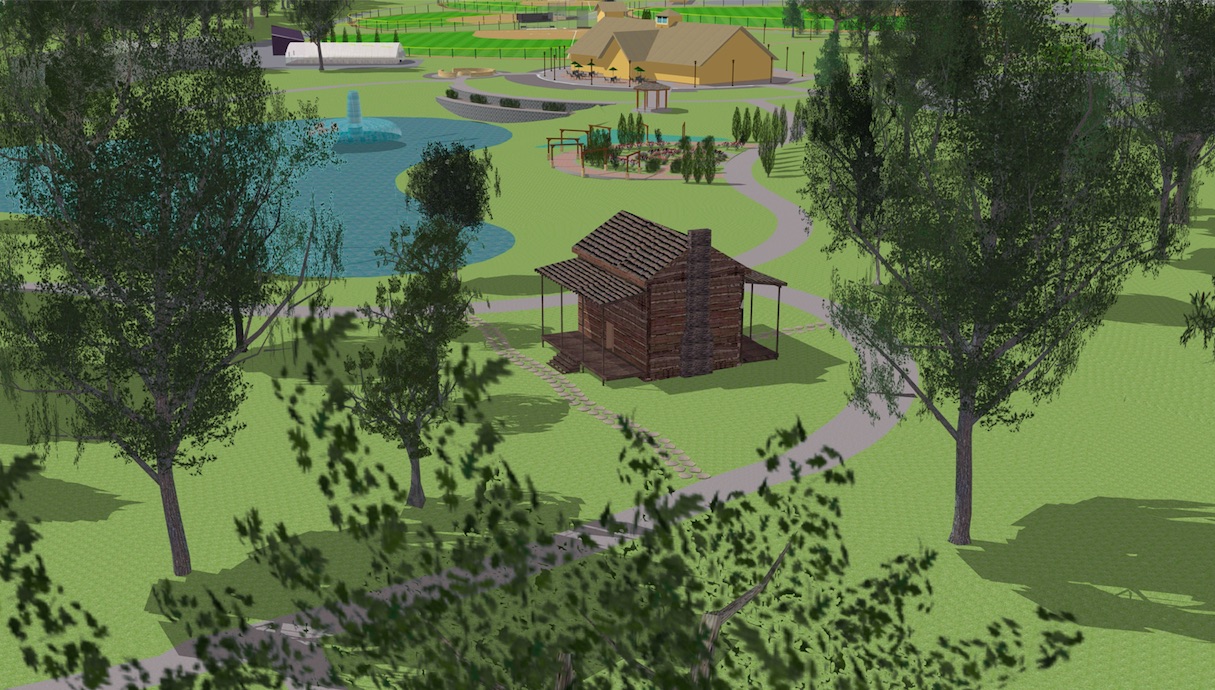
It stayed that way until December 2014, and plans to allow thousands of visitors to see and explore the Sloan-Tribby cabin are well underway. The cabin was donated to Belton Parks and Recreation in 2017 and will proudly be featured.

Shane DeWald, Parks Director for Belton Parks jumped at the chance to have the Sloan-Tribby cabin as a part of their facilities. “We took it to the Park Board, and everyone rallied around it,” DeWald stated.

A few presentations are in the works to further raise money and awareness of this incredible piece of Missouri history. Hopes are to have the cabin up and ready for visitors by June 2018.

Today, the cabin sits protected in a warehouse, each board carefully numbered and waiting for reconstruction at Belton’s Memorial Park.


A 1900s croquet match outside the Sloan-Tribby house.
Courtesy of the Sloan-Tribby descendants.


They will need around $70,000 and donated materials in order to restore this cabin. DeWald is working now to get the foundation underway at Belton Memorial Park, where the cabin will be raised near the arboretum. The Chamber of Commerce is working on fundraising efforts.

Historians still are waiting for the “smoking gun” in order to definitively state whether this cabin is, in fact, where Ewing and Lane had their meeting after the Lawrence Massacre.  
 
 "To be able to definitively say it's the cabin where they met, we need to find a letter or further documentation possibly mentioning the family that lived in the cabin and its connection... Someone will have to devote time and effort to uncovering more that may still be out there," historian Tom Rafiner stated.

Even if it’s “just” a log cabin, it holds importance because it was one of the very few on the western border that survived the Border Wars and the Civil War.

Don Peters is waiting for someone to prove him wrong about his assumptions of the significance of this cabin. Don proclaimed with excitement and a twinkle in his eye, “If this is what I think it is- and all my research shows true -this cabin is the Appomattox of the West.”

The plans at Belton Memorial Park includes featuring the Sloan-Tribby reconstructed cabin.
Courtesy of Shane DeWald, Belton Parks and Recreation
Maybe the evidence is in an attic, tucked away in a journal of a Civil War soldier. Perhaps the piece to connect this cabin is still out there to be found.

Belton Parks and Recreation is looking for donations, including lighting/electrical, stonework, cabin assembly, heavy equipment, walkway stones, landscaping, surveillance cameras, fencing, roofing, windows, doors, and various other pieces to bring this piece of history back to life. If you are or know someone who could help, please contact Belton Parks at https://www.beltonparks.org or email Diane Euston (the writer) at thefamilygenies@gmail.com.

**Please consider LIKING my Facebook page as well! Search "The New Santa Fe Trailer" so you don't miss any of my writing from the blog and the Martin City Telegraph! :)