Previous Posts

Thursday, May 31, 2018

Twelve Stories of the History of the Kansas City Metro: Year Two in Review!


It’s hard to even fathom that it has been two years since I started this journey of telling the stories of Jackson County pioneers. The stories never run dry; one search inevitably leads to another. I try my best to be extremely thorough in my research while also not losing the human interest of these incredible events, people and places.


In April 2017, I wrote,  “I want to use my words to make people feel like they are a part of this amazing growth of Jackson Co. when it was just farmlands and trails to the West.” This continues to be my mission one word, one post and one article at a time. In the past two years, my blog has been viewed over 200,000 times! As I continue to write, some of the posts become buried and harder to locate. I know that many of you could be new to my writing, so I want to take the chance to do another “Year in Review” so that you can easily access and share some of the cool stories written in the past year. Just click on the link to be able to get to each post!

This story truly changed my direction of writing and hit me especially hard. I joked with my friends and family that this was going to be difficult for me to write- I am used to writing about people that are long gone- not writing about an event that people living in the area remember as if it happened yesterday.

I am extremely proud of this story. I spent hours interviewing people, collecting never-before-seen photos of the damage and pieced together the events of the evening of May 20, 1957 from the start of the tornado to its end. I was able to put together the most accurate list of casualties – correcting spelling errors of many names- from the first victim to the last. But more importantly, this story captures the true fury and power of what many current and former residents of Kansas City remember like it was yesterday. To read more about the Ruskin Heights Tornado, click here!
I waited years to finally get the green light to write about the house that inspired me to take this path into historical research and writing. This house, known to many as the Watson Place Inn, was reportedly a stop for travelers on the Santa Fe Trail in the town of New Santa Fe. It also happens to be directly across the street buried behind brush and trees from where I grew up- and where my mother still lives. The land, which originally included Timber Trace subdivision and Blue Hills, was owned by some of the most colorful characters of early Jackson County History. Although the house is no longer for sale, learning the history about it- starting with the oldest section in the middle of the home- shows us the importance of preserving the very few historic landmarks left in Kansas City. To read more about the Watson Place Inn, click here!
 
What we refer to today as Watts Mill, thanks in part to the shopping center named in its honor, was of major importance in the early history of the area. By the 1830s, there was a mill operating at current-day 103rd and State Line that ground corn and flour for thousands of pioneers. After Anthony B. Watts bought the mill and passed it along to his son, Stubbens, the “Fiddling Miller of Dallas” continued to entertain local pioneers. Today, some evidence remains of what once was an important stop near the Santa Fe Trail. To read more about Fitzhugh-Watts Mill, click here!


One swift move by a frustrated Brigadier General changed the way the metropolitan area developed. Gen. Number No. 11, issued August 25th, 1863, virtually destroyed the families barely hanging on in midst the Civil War. The people in the area had been under constant attack well before the cannons fired at Fort Sumter; the area had suffered so much due to the Border Wars. When Brig. Gen. Thomas Ewing felt the pressure from one Kansas senator named Jim Lane and the Lawrence Massacre left people demanding action be taken against the bushwhackers and their sympathizers, Gen. Order No. 11 was the result. This order forced elderly men, women and children to flee their homes in Jackson, Cass, Bates and part of Vernon Counties. To understand the Civil War and the history of the Kansas City metro, one must read and comprehend what this order against U.S. citizens did. To read about Gen. Order No. 11, click here!


To understand my mission behind the creation of this blog, you need to understand how much this pioneer church destroyed in 1971 impacted my own personal journey. Because of the Santa Fe Christian Church, I began to research the people behind its inception. The piles of notes and copies from the archives had me scratching my head. What do I do with all this information? The result was The New Santa Fe Trailer. This church, founded in 1869 and partially ravaged by fire in 1969, was at the heart of me truly understanding what history looked like in my small Southern Jackson County neighborhood. This gave me access to people- to stories. My involvement with the Little Blue River Chapter, NSDAR in erecting a marker at the site of where this church stood became invaluable to me. In fact, this same Chapter presented an award to me – a national award! – in April of this year for “excellence in historic preservation” for all the work I have done through my blog. But the real story behind my love of these people and stories starts with the Christian Church at New Santa Fe. Please take a few to learn about its inception and unfortunate demise. Click here!

When I read a newspaper account about the quadruple homicide of a mother, son and two farm hands at the heart of current-day Leawood, Ks., I had to know more about it. Further research showed that another double murder led the Johnson Co. Sheriff to a Cass Co. native named Bert Dudley. And boy, does he have an interesting story to tell. To read more about this complicated and captivating early 20th century homicide case, click here!

I was intrigued when my uncle, who lives in Peculiar, Mo., contacted me and explained he had read a small piece about the discovery of an old log cabin hidden underneath a more modern structure. When I read more and found out that this cabin could be linked to one of the most controversial orders in American History, Order No. 11, I had to write about it. Don Peters, a historian and log cabin enthusiast, walked me through how he came to know about the cabin and its incredible history. Could it be where Gen. Ewing met with Sen. Jim Lane to discuss the Lawrence Massacre and enacting a harsh order on thousands of citizens? The cabin is set to be reassembled late summer at Belton Memorial Park. To learn more about this cabin, click here!


When did people start having full-sized Christmas trees? When did people string lights on their homes and trees? And how did the Plaza lights even become a “thing?” These were questions associated with the KC metro that I sought out to answer. Learning about the first Christmas tree assembled in Westport, the first electric lights strung from a tree – when electric lights were considered unsafe- and learning about how one strand of lights changed the way the skyline of the Plaza looks from Thanksgiving night until early January was incredibly interesting. To learn more about these three unique Christmas stories, click here!

We don’t think much about paved roads unless we travel off the beaten path in rural areas. But the history of the road system in South Kansas City involves political influence, the sectioning out of land, and the development of small towns in between. The earliest of the roads of the area is linked to the Santa Fe Trail, yet later roads depended on the building of bridges such as the Red Bridge. The development of the railroad was yet another reason our roads look the way that they do. To read more about the interesting early history of the road system, click here!


Inspired by local history buff John Dawson, I had to know more about a street in current-day downtown Kansas City that seemed to have just been erased from the records. There just wasn’t much about Pearl Street (1st Street) to even begin to find. When you travel to downtown Kansas City or even look at a map, have you ever wondered why the roads running north and south start at 2nd St.? At one time, the millionaires- the founders of the Town of Kansas – lived on Pearl Street Hill. To learn more about this incredible street now cut away from our view, click here!
After a visit to the Shawnee Indian Mission with my students, I was inspired to really investigate the namesake of Johnson Co., Ks., Rev. Thomas Johnson. When I learned he owned slaves in Kansas territory, was elected on the pro-slavery ticket to the Territory Legislature, switched sides during the Civil War, and was murdered I had to know more. He is one controversial man that historians have a hard time piecing together. To read more about Rev. Thomas Johnson, click here! 

I had my eye on this cemetery for years but just didn’t even know where to start. Mount Pleasant Cemetery is a hidden gem inside current Timber Hill Estates subdivision just east of 125th and Wornall Rd. Even though it was one acre surrounded by beautiful homes, it was desecrated and forgotten even by those living around it. The cemetery dates back to even before legal settlement of this area of Jackson Co. (1840!) and is an important piece of our early history. The ground sinks in spots where a body rests without a headstone. Read about how we helped save this historic cemetery and how the effort continues– click here!]

This concludes one more year and twelve more incredible stories!

When I first started this journey with the Santa Fe Trailer, I didn’t know where it would go or who would even take the time to read what I had discovered. I certainly knew it was important to continue to fight to save our history before it is lost and forgotten. Two years later, I still am inspired by the families I meet, the readers I encounter and the stories I continue to find on these lost and forgotten pieces of our incredible city. If you read one of my stories and now look at the area just a little bit differently- or you share some tidbit of information you learned from an article I’ve written as you casually drive down the road with a friend- then I’ve done by due diligence.

This has been about finding a way to share the history of what was once on top of the land we now own, travel through or admire from a distance. We all should know our unique history, and I’m so happy to have been able to share it with you all.

*This piece is dedicated to the late Nancy Henning, one of my loyal readers and a local lover of history and her husband, Jack who were taken too soon.

If you haven’t yet, be sure to search the New Santa Fe Trailer on Facebook so you don’t miss any of my writing!


Monday, April 30, 2018

The Struggle to Save Historic Mount Pleasant Cemetery in South Kansas City


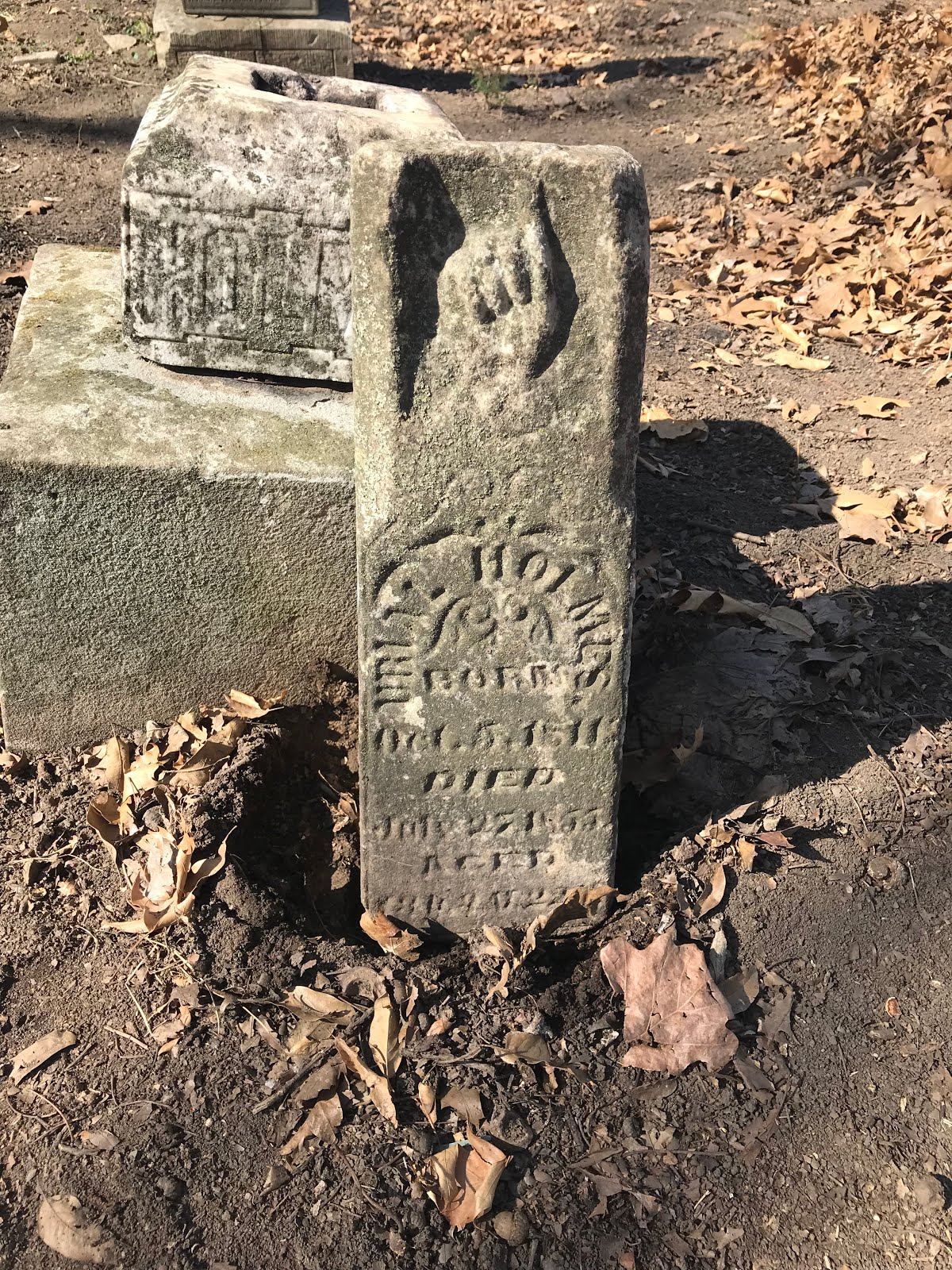
Harvey Holmes Kemper III, known as Kurt to friends and family, moved leaves aside as he searched for his great-great-grandfather, Urial Holmes’ final resting place. “It’s got to be here somewhere,” he commented as he clutched a 2012 photo of the gravestone.

Hiding underneath a carpet of leaves are hundreds of stories of survival, triumphs and the tragedies of pioneer life. In one historic cemetery in South Kansas City, an effort to revitalize and preserve what is left is underway.

Boy Scouts and volunteers work to bag leaves and brush on April 14th
When I started this journey several years ago, my first love, New Santa Fe Cemetery, was my inspiration. As a little girl, I fought the colonies of mosquitos in the summer and raced around the graves just up the street from my home. That cemetery was my catalyst even at seven years old, and I watched as the modest cemetery grew through preservation efforts, an added fence, and a little grass seed into one of the most beautiful pioneer cemeteries in all of Jackson County.

Mount Pleasant Cemetery hasn’t had its chance to shine- yet.

Sandwiched in between houses in Timber Hill Estates off 125th Pl. and Wornall Rd. is Mount Pleasant Cemetery, also referred to in records as the King Burying Ground.  As early as 1840, before settlement was even legal, pioneers began using this land atop one of the rolling hills of Jackson Co. First, William King settled on the land and after his death and burial in 1857, the land passed to his children. In 1878, what was once known as King Burial Ground was renamed “Mount Pleasant Cemetery,” most likely due to the name of the country school only a few hundred yards away. By 1885, the land was sold to Joshua Self, son of John Self who is also buried at this sacred location. Today, the cemetery stands in a shadow of its former glory.

Avila University Day of Service volunteers 
A group of about 25 dedicated volunteers spent Saturday, April 14th armed with rakes, chainsaws and hundreds of leaf bags in order to spruce up the burial ground that has fallen into disrepair. A team of Avila University’s “Dear Neighbor Day” volunteers, Boy Scout Troop 531, and passionate history buffs came to assist the effort to clean up six years’ worth of leaves, broken branches, and fallen headstones lying on their side.

Kurt Kemper's son is part of the Boy Scouts who volunteered to help the family find the resting place of their relative. Kurt's own father, Harvey stood in the shadows, overwhelmed that even as the leaves were removed, the headstone of his own great grandfather appeared to be missing. “This just isn’t right,” he commented as he shook his head side-to-side with a few tears welling in his eyes.

And there I stood, unable to give him a resolution.  It appeared to be gone.

A photo from 1999 showing Mount Pleasant Cemetery's condition
Urial Holmes (1811-1855), a Tennessee native who came to Jackson Co. in 1853 and settled near the Red Bridge, passed away at 43 years old in 1855. He, like many of the pioneers of southern Jackson Co., was buried at Mount Pleasant Cemetery. His own son, also named Urial, relayed to the DAR that this gravesite was used for burials many years prior to even the deaths documented then.

In the 1934 survey of Mount Pleasant Cemetery, 43 graves still remained surrounded by private farmland held onto by the Self family. Descendants owned the land for many, many years until a developer bought the land and platted out Timber Hills Estates in 2003.

Headstones remain on their sides, and in
some cases, upside down at the cemetery
Because the cemetery was separated from land records (including one acre and ten feet square on the northeast corner), the developer never could morph the cemetery into a manicured lot to sell. So, the developer built right up to it. Somehow, the clause including the ten feet square in the northeast corner was… left out of the records of sale and only the one acre remained. The ten feet square described in 1960 as a “burial ground” is now part of a driveway.

Former residents of the subdivision informed me that the developer, in order to build near the cemetery, had to enclose the one acre with a fence. The developer complied, and a wrought iron fence borders three of the four sides.

To be clear, the cemetery was a mess for nine years, minus a few Boy Scout projects, as people bought lots and began construction on their homes. Building material was tossed into the dilapidated,  overgrown graveyard as Timber Hills Estates germinated into suburbia. We found building material scattered along the fenceline at the cleanup.

John Humphrey, a local lawyer with a taste for local history, discovered Mount Pleasant Cemetery when his parents began construction on a home in the subdivision in 2006.

He vividly recalls how incredibly peaceful this spot was in South Kansas City, tucked away and forgotten amidst the forest on top of the hill. The south side of the cemetery came to a downward slope. As John squirmed through the brush, trees and leaning headstones, he could hear running water below. A small creek peacefully passed through the natural landscape.

John Self (1803-1889)
“I can still see and feel vividly standing at that edge, basking in the warmest glow of the golden sun on my face, feeling incredulous that there was still this hidden heavenly wilderness in the middle of the part of town in which I'd grown up,” John fondly recalled.

This place was special, and he could sense the spirituality left behind by pioneers. “As I basked, I felt whatever it is one might feel when they are deeply touched by the lives and spirits of those who trod the same patch of earth before them,” John remembered.

It’s this moment that led John to ongoing efforts to help save what was left of the cemetery. And boy, how I am grateful to have him by my side.

In 2007, a cleanup led by Doug Vaughn of Fresno, Ca., descendant of John Self who is buried in the cemetery, reset headstones upright, removed many trees and placed two markers at the entrance of the cemetery.

John Self (1803-1889) was a true pioneer of Kansas City. He made the clapboards for the Chouteau warehouse and, according to his obituary, “helped to clear up the woods on the hills where Kansas City now stands.”

His grave is one of the few remaining, yet I find it quite ironic he is now overtaken by trees.

Ground Penetrating Radar report from 2012. Courtesy of Construction Solutions, Paola, Ks.
Ground Penetrating Radar was completed in 2012 at another cleanup initiated by Boy Scouts. Through this technology, one can see what anomalies or disturbed earth which lies below the surface. 76 grave sites were noted on the report and 35 headstones were found- four of which were buried underground.

2012 photo showing the overgrowth after just a few years of neglect
76 pioneers.

=35 headstones remained in 2012, and I counted 19 just the other day.

Even after the cleanup in 2012 relieved a majority of the chaos inside the fence line, the one acre tract continued to transform more into more of a vacant lot than a peaceful, historic cemetery. And, in my opinion, it is still exposed to vandals today. How else can we explain how graves seem to be missing in just six years?

When the first burials of Mount Pleasant Cemetery were interred, this section of Jackson Co. was not even open to legal settlement. Some families, such as John Shelton (1788-1854), took a gamble and moved from Virginia and squatted on land illegally just south of current-day Grandview, Mo. His five year-old son passed away in 1840 and was the oldest burial on record at the cemetery.

His stone has vanished after years of neglect and vandalism, as did the rest of the Shelton family's graves.

The remains of William M. See's above-ground vault
that was in exquisite condition in 1934
A photo from 1999 reveals that at least one of the Sharp family's headstone was completely in-tact. Tilman B. Sharp (1805-1889) was left standing then. But there is absolutely no sign of his grave now.

Another section of the cemetery showcases the remains of where an above-ground vault once stood atop the hills and was built for someone traveling on the Santa Fe Trail. According to the DAR Vital Records book published in 1934, this vault was built for William M. See who died at 21 years old in 1849 “while enroute west with his parents” and “after 84 years, the marble head stone and vault, above ground, are in excellent condition.”

 Only fragments of this vault remain, thus virtually erasing this burial from the site.

A small piece of headstone with the words "Nellie" was
discovered during the cleanup
John Humphrey jumped at the chance to help at the cleanup in 2012 and documented the discoveries on his camera.

He returned April 14th and 28th of this year (2018) to assist yet again. He was surprised to see how much had changed in the years since the first cleanup. “It’s very disappointing to me that in so few years there are far fewer tombstones and grave markers than there were then.”

Adonna Thompson, Archivist at Avila University and leader of the team from the school, gingerly cleared off a small remnant of a headstone revealed as the leaves were hauled away. “It says ‘Nellie,’” she smiled as she brushed away the debris.

Only one “Nellie” is in the 1934 survey of the cemetery, and this 1890 grave of a one-year-old is still upright.

Adonna discovered a new grave – or, at least a piece of one- that has remained buried under brush for over 100 years.
Impressions in the earth show the locations of unmarked graves

“Avila was inspired to give back to our local community by helping to restore this cemetery,” Adonna explained. “Saving these culturally significant places is meaningful to Avila University and to me.”

As leaves were carefully removed by Boy Scouts, Avila University volunteers, and history buffs that answered my plea for help, large indentions in the ground were exposed.

These pits are indicators of graves. When burial vaults are not utilized, the coffins decompose and the ground sinks. These craters have become markers of graves by themselves. No headstone is needed to know someone lies beneath.

Urial Holmes (1811-1855)
Kurt Kemper walked the dirt floor of the cemetery one last time at the end of the cleanup April 14th to see if he could spot his great-great-grandfather’s grave. He was hoping to show it to his son who was there with his Boy Scout troop. Unfortunately, he was met with disappointment as the last leaf bags were carried to the curb. “We would like to find out where his tombstone has run off to since it has rested there peacefully for the last 160 years until recently it went missing,” Kemper explained.

The work wasn’t completed, and as I bundled up in the 39 degree weather, I, too, had to walk away for the day. After four hours of labor at the first cleanup on April 14th, we removed 297 bags of leaves and debris from the one acre landscape of Mount Pleasant Cemetery. Piles of leaves and sticks remained, but I’m a pit bull. I wasn’t about to stop.

The following week, I returned to survey the cemetery, combing each section as carefully as I could. My eyes darted from my clipboard to the stones in front of me. I took photos of everything that I thought we may have missed.

As the sunlight peeked through and glittered the ground around me, I glanced to my right. There, standing before me, the headstone resting on its base, was Urial Holmes’ grave.

I fumbled for my phone, emotional and eager to pass along the good news to the Kemper family who had desperately searched under leaves for the remains of Urial. In all caps, I sent a simple text to Kurt: I FOUND URIAL!

Harvey Kemper gazes at his great-grandfather's grave
for the first time in decades with his grandson
Less than two hours later, the family gathered at the resting place of their descendant, overwhelmed and relieved that Urial Holmes had escaped vandalism.

So many others that chose Mount Pleasant as their final resting place weren’t so lucky.

Two weeks after the initial cleanup, a small group gathered again to finish what we had started. Broken branches and twigs were drug to the curb for removal by Grade A Tree Care. With the invaluable help from Cameron Fiser and his team at Monarch Lawn & Landscape, the remaining leaves (which I can only guess would have been another 300 bags’ worth!) were blown into a concentrated area to be mulched by their mower.

Within a few hours, one acre of land, deserted and desecrated, looked once again like a peaceful pioneer cemetery.

Overwhelmed and emotional, I sat back with my camera and the other volunteers and just… Looked. Gazed. Sighed. We did it.

Mount Pleasant Cemetery will survive.

With the help of the Timber Hills Estate HOA, trees will be trimmed and some will be removed. A chainsaw will take care of the newer volunteer trees that, if they remained, would further destroy the earth surrounding the sacred graves that have miraculously survived.

A cemetery now is exposed at the second cleanup April 24th
John Jackson of Integrity Stone, a company that specializes in the restoration of existing stone, answered my call for help. He has volunteered his services to reset the stones that do still remain.

It occurred to me throughout this process that the little community around Martin City really banded together to help save something that has been on my radar for years. We have resurrected the integrity of a sacred space that existed well before Martin City and the influx of suburban development.

It is our duty to preserve what has been left behind. The subject of preservation was an ongoing topic at the cleanup. Efforts must continue.  “Everyone buried here deserves at least that from us,” Kurt Kemper commented as we hauled brush to the curb.

The history of southern Jackson Co. can be found in the many stories left behind of these pioneers that chose Mount Pleasant Cemetery as their final resting place. Further restoration of this small burial ground will connect the future with the past as well as ensure that their sacrifices, lives and legacy are never forgotten. 

*More photos below!!
A special thanks to all of the volunteers who helped with this worthy cause:

Adonna Thompson and Avila University's "Dear Neighbor Day" Volunteers
Boy Scout Troop 531
Burr and John McGee, relatives of the Baxter family buried at Mount Pleasant
Cameron Fiser, Monarch Lawn & Landscape
Chris Wilson, relative of the McPherson and Watson families, buried at Mount Pleasant
Don and Lonnie Peters
Euston Hardware
Grade A Tree Care
Helen Van Hecke
Jackson County Advocate
John Humphrey
The Kemper Family, Urial Holmes' Descendants
Kolette Knittel, relative of John E. Watson, buried at Mount Pleasant
Larry and Clara Van Draska
Margo Aldridge
Martin City Telegraph
Laurie Duffey
Sharon Mickelson
Steve Hodgden
Steve Taylor
Timber Hills Estates HOA

To locate the cemetery: From 435, go south on Wornall to 125th Terr and take a left (east). Follow the road around until you see the cemetery on the left.

Don't forget that you can search "The New Santa Fe Trailer" on Facebook and LIKE my page so you don't miss any of my writing!