| |
It was given an incorrect name that stuck. It seemed to come from nowhere, and doctors at the time had little treatment for it. It was unclear how it even was transmitted, as the theory about germs was in its infancy. Public officials tried to balance the line between protecting the population without scaring them and reporting the straight-up facts.
|
 |
| Camp Syracuse in New York, taken October 1918. Courtesy U.S. Army |
We do tend to forget the past.
The lessons learned from what came to be labeled the Spanish Flu should have laid the course for what and what not to do during a pandemic. Kansas City in particular suffered harder than most large cities due to divided politics, mixed messages, and a raging World War.
The story, many now believe, begins in a county just shy of of 400 miles southwest of Kansas City.
The story, many now believe, begins in a county just shy of of 400 miles southwest of Kansas City.
 |
| King Alfonzo VIII of Spain (1886-1931) |
"La Grippe" or "the Grip" was a common term for influenza at the time.
Shortly after, several young men kissed their mothers goodbye and headed to Camp Funston at Fort Riley, Ks. to be trained in the Army to fight overseas in World War I. They didn’t just take their luggage with them- they were likely carrying with them a deadly strain of influenza.
By the beginning of March,1100 soldiers came down with this mysterious flu at Camp Funston. Because of the war effort, these soldiers carried the virus to other Army camps. Before getting their ticket to the battlefields in Europe, influenza infected at least 24 of the large Army camps in the states and spread to nearby communities.
By the beginning of March,1100 soldiers came down with this mysterious flu at Camp Funston. Because of the war effort, these soldiers carried the virus to other Army camps. Before getting their ticket to the battlefields in Europe, influenza infected at least 24 of the large Army camps in the states and spread to nearby communities.
The United States stayed quiet as the virus virtually spread like wildfire – no one wanted the enemy to know that soldiers could have been weakened by sickness. By the time it reached Europe and crossed the invisible borders into Spain, millions of people had been infected.... including their king, Alfonzo VIII.
Spain was neutral during World War I, so they openly reported the outbreak while most everyone else downplayed the problem. In turn, this new, deadly strain of influenza got a new name- the Spanish Flu.
The name has stuck for over a century.
 | |
|
The name has stuck for over a century.
By 1918, Kansas City’s population was around 225,000. Because of rapid population growth, the city was congested. Many boarding houses crammed tenants into them, and modern plumbing was a luxury. The absence of sufficient bathing houses, running water and lack of personal hygiene was the perfect breeding ground for a deadly virus.
The people making political decisions were a part of the “Democratic Machine.” Joe Shannon and Tom Pendergast had at one time been at odds for control of democratic politics but had agreed to work together to elect “their people” into office.
Mayor James Cowgill was one of these people, and after put into office, Pendergast and Shannon split appointment of government offices in half so each boss could have equal control over the police and fire departments, the City Council and even the Health Board.
Mayor James Cowgill was one of these people, and after put into office, Pendergast and Shannon split appointment of government offices in half so each boss could have equal control over the police and fire departments, the City Council and even the Health Board.
 |
| Old City Hospital (General Hospital No. 2), the first black hospital in Kansas City, operated from 1908-1957 |
The president of the Health Board was W.P. Motley, and most everyone on the Board were people who “worked” for the Democratic Bosses. The political setup in Kansas City would directly affect the way these men would respond to a public health crisis in 1918.
And of course, we were in the heart of the Jim Crow era, so equality in Kansas City was certainly lacking. Hospitals were segregated. In 1908 when General Hospital built a new and nicer building across the street from their first location, African Americans in Kansas City finally got their own hospital -their only one at the time- called "General Hospital #2," commonly referred to as the Old City Hospital or the Negro Hospital.
 |
| Dr. William J. Thompkins (1884-1944) |
The Old City Hospital was set up to cater to black and Latino people and was run by Dr. William J. Thompkins starting in 1914. He worked to set up a school at the hospital to train African-American nurses.
Although influenza had attacked the Army and other communities in March and April, Kansas City seemed to have avoided any direct threat to the virus. As the second wave of this strain of flu emerged in late September, it swept through Kansas City and created mass chaos.
Ironically, a second hospital for blacks called Wheatley-Provident Hospital opened at 1826 Forest Ave. on September 29, 1918- two days after the first case of the flu crept into Kansas City. 12,000 people gathered on their opening day to witness the dedication. Founded by Dr. J. Edward Perry, the facility was designed to run as a hospital and training school for nurses.
There were two black hospitals for 25,000 people in 1918. Today, over a century has passed and racial disparity is still alive and well in Kansas City.
 |
| 12,000 people gathered on September 29, 1918 outside of Wheatley-Provident Hospital to celebrate its dedication. Photo courtesy Missouri Valley Special Collections, KCPL |
On the other side of the segregated city, the first case of flu likely started with the Army in town. Starting in the city’s two Army motor corps schools, the first cases of the disease were immediately put into quarantine but the damage had already been done. The soldiers had been in contact with some young ladies, and shortly thereafter, they came down with the illness. According to the University of Michigan, “By October 1st, twenty percent of the city’s army training schools [in Kansas City] had contracted influenza. Forty-three civilian cases had appeared, with 33 of them under isolation.”
 |
| Mayor James Cowgill (1848-1922), Kansas City's mayor from 1918 until his death |
It sure was an inopportune time to be battling a deadly virus, especially since doctors didn't even agree at the time what caused the spread of it.
In the 19th century, no degree was required to enter medical school and there were various theories of disease transmission. When this flu broke out, it didn’t get diagnosed correctly at first because the symptoms were so unique.
Instead of infecting the young and old, it seemed to have targeted the population who should have been the strongest. This strain was killing young, healthy men and women at their prime. Patients experienced a quick onset of a high fever, a wet cough that brought up blood, and their faces would turn blue. Within 24 to 48 hours, many would succumb to the illness.
Treatment at the time was varied. Young doctors better trained in medicine had enlisted in the war, leaving a shortage of them throughout the nation. The Army saw quarantine as the best way to fight the disease. Susan Debra Sykes Berry, who wrote a thesis on the pandemic in Kansas City, explained, “Quarantine was one of the best public health measures, and most Army doctors were aware that a 21-day period was the ideal.”
 |
| A Naval hospital in California in November 1918 takes care of influenza patients |
Well, these are certainly interesting theories...
In truth, the best remedy for influenza was nurse care which included drinking fluids, keeping warm and trying to lower the patient’s temperature. Many doctors recommended aspirin or quinine and ordered patients to stay home.
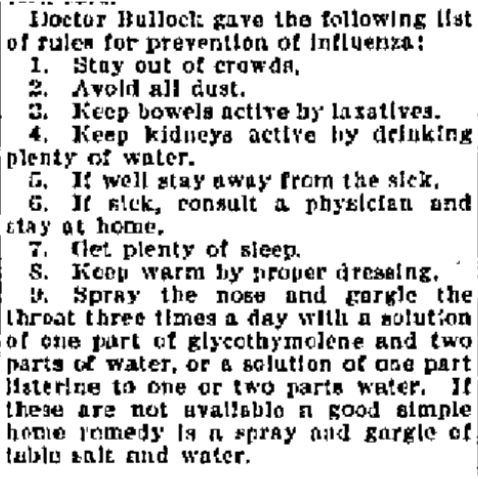 |
| List of recommended remedies for the flu published in the Kansas City Star October 6, 1918 |
Since the Health Board in Kansas City wasn’t leading, an unexpected group stood up and demanded action. The Chamber of Commerce led by Bernard Parsons asked for a meeting with the mayor and Health Board. Closing businesses to the public would directly hurt the Chamber, but they argued that the lives of Kansas Citians were more important.
Businessman R.A. Long said, “I’d feel like a criminal, personally, if I were a businessman and insisted on keeping open in a time like this. If the epidemic grips your own household you will then commence to know what human life means as compared to money.”
Businessman R.A. Long said, “I’d feel like a criminal, personally, if I were a businessman and insisted on keeping open in a time like this. If the epidemic grips your own household you will then commence to know what human life means as compared to money.”
 |
| Headline in the Kansas City Star from October 7, 1918 |
Sound familiar?
On the Kansas side of the state line, the mayor took swifter action and closed schools, churches, and theaters. All public gatherings of all kinds were prohibited until “after the danger from the disease has passed.” For the most part, Kansas never lifted their quarantine.
The minute that there was a decrease in cases in a 24-hour period, Kansas City resumed talks to lift the ban. To no surprise, saloons were still open and quite crowded. Because the Democratic Machine was directly involved in saloons and also controlled the police, they went about business as usual knowing that no action would be taken against them. Many even boasted signs at the back of bars claiming the flu could be fought with quinine and whiskey, but the Kansas City Star noted, “The saloons continued to work extra bartenders to accommodate crowds- not for advised quinine- but for tall steins of ‘suds.’”
It is true that whiskey was seen to be a remedy to the flu. Many people claimed that people who regularly drank whiskey could avoid getting sick.
That's the polar opposite advice I would give to any twenty-something today. Like, if you want to get sick, drink a ton of whiskey at a party.
Local companies like mail-order whiskey house J. Rieger & Co. followed the trend and advertised their product was a "good thing for the grip." The resurrected J. Rieger & Co. in the East Bottoms has wisely dropped the company's prior claim of using whiskey as medicine and has used 21st century technology to make hand sanitizer during the Covid-19 pandemic.
Now that is "very good for the grip" - and germs in general.
In any case, just one week after placing a ban on crowds (which was not enforced) on October 7th, 1918, the Health Board and the mayor lifted it despite the glaring evidence that most physicians didn’t agree with the decision. Major Dell D. Dutton with the Red Cross stated, “I consider it very unwise to lift the ban. The history of other epidemics shows this to be the critical time. To lift the ban now is to invite the return of the epidemic.”
Ahhh.... the parallels....
It is true that whiskey was seen to be a remedy to the flu. Many people claimed that people who regularly drank whiskey could avoid getting sick.
That's the polar opposite advice I would give to any twenty-something today. Like, if you want to get sick, drink a ton of whiskey at a party.
 |
| 1899 advertisement of Kansas City's J.Rieger & Co. whiskey claiming it was a "good thing for the grip." Courtesy KC Journal |
Now that is "very good for the grip" - and germs in general.
In any case, just one week after placing a ban on crowds (which was not enforced) on October 7th, 1918, the Health Board and the mayor lifted it despite the glaring evidence that most physicians didn’t agree with the decision. Major Dell D. Dutton with the Red Cross stated, “I consider it very unwise to lift the ban. The history of other epidemics shows this to be the critical time. To lift the ban now is to invite the return of the epidemic.”
Ahhh.... the parallels....
Health Board president W.P. Motley responded that if lifting the ban was a mistake, “we can rectify it later on” while another man present warned, “A dead man cannot accept apologies.”
113 cases of the flu were reported the next day.
Schools in Kansas City, Mo. decided to remain closed for a week longer despite the lift on the ban October 7th.
Two days later, Missouri's governor Frederick D. Gardner issued a Proclamation
"appealing to the people of the State to take every possible precaution against the spread of influenza."
On a side note... just over two weeks later, he issued another Proclamation announcing "Sunday School Day."
So much for taking every precaution, Governor.
That also sounds strangely familiar.
On October 15th, 106 new cases were reported at General Hospital followed by 113 the next day.
113 cases of the flu were reported the next day.
Schools in Kansas City, Mo. decided to remain closed for a week longer despite the lift on the ban October 7th.
 |
| A postcard of the new General Hospital at 24th and Gillham in 1908 Courtesy Missouri Valley Special Collections |
"appealing to the people of the State to take every possible precaution against the spread of influenza."
On a side note... just over two weeks later, he issued another Proclamation announcing "Sunday School Day."
So much for taking every precaution, Governor.
That also sounds strangely familiar.
On October 15th, 106 new cases were reported at General Hospital followed by 113 the next day.
The Chamber of Commerce was irate when the ban was lifted and saw a growing problem in the streets of Kansas City. They cited that neighboring communities were still under quarantine, so those people were coming to Kansas City for entertainment. That was always the case in the West Bottoms since the state of Kansas was dry of libations. Boss Tom Pendergast made a lot of his money operating saloons along "the wettest block in the world" where liquor stores, brothels and bars operated steps away from the state line.
And when you're still ordered to be under quarantine and you wanted a little fun and a cheap drink, men in Missouri were ready to serve you.
Head of contagious diseases in Kansas City Dr. A.J. Gannon claimed pressure (likely from the political bosses), “The responsibility of preventing [the flu’s] spread should be assumed by the individual.”
The concerns of the Chamber worked to change their minds; a second ban closing nonessential businesses was ordered on October 17th but exempted “war industries, butcher shops, grocery and drug stores.”
In turn, the Chamber of Commerce- the heart of Kansas City business- emphasized there would be "heavy losses in the event the ban was removed, but [the Chamber of Commerce] emphasized the fact that the lives of Kansas City citizens should be placed above personal gain."
So in 1918, businesses with vested interest were the steady voice of reason in Kansas City.
Digest this. The businesses of Kansas City were begging for the city to keep businesses under quarantine- city officials influenced by politics were the ones considering otherwise.
 |
| Cartoon in the Kansas City Times, October 19, 1918 |
And when you're still ordered to be under quarantine and you wanted a little fun and a cheap drink, men in Missouri were ready to serve you.
Head of contagious diseases in Kansas City Dr. A.J. Gannon claimed pressure (likely from the political bosses), “The responsibility of preventing [the flu’s] spread should be assumed by the individual.”
The concerns of the Chamber worked to change their minds; a second ban closing nonessential businesses was ordered on October 17th but exempted “war industries, butcher shops, grocery and drug stores.”
In turn, the Chamber of Commerce- the heart of Kansas City business- emphasized there would be "heavy losses in the event the ban was removed, but [the Chamber of Commerce] emphasized the fact that the lives of Kansas City citizens should be placed above personal gain."
So in 1918, businesses with vested interest were the steady voice of reason in Kansas City.
Digest this. The businesses of Kansas City were begging for the city to keep businesses under quarantine- city officials influenced by politics were the ones considering otherwise.
 |
| A headline in the Inter Ocean from 1907 |
Even as the Health Board was under scrutiny, they continued to mitigate with denial. Head of contagious diseases, Dr. A.J. Gannon, claimed in a statement to the Kansas City Star, "I do not believe it necessary to put the ban back." The second ban was lifted two days earlier on October 14th. He continued by stating, "The responsibility of preventing [the flu's] spread should be assumed by the individual."
That's an interesting claim.
Pretty unbelievable claims were printed in area newspapers during the pandemic. The African-American newspaper The Kansas City Sun printed, "Those optimistic colored folks who insist that race prejudice is often a blessing are pointing with pride to the fact that the influenza has almost completely ignored the Negro."
That was far from true, and death certificates prove this. By October 19th, the Old City Hospital where blacks were treated had 56 cases and 15 had reportedly died. We also have to consider that many blacks in the city weren't able to get proper medical care, so deaths from the flu may have been written off as something else altogether.
 |
| A portion of a death certificate from Kansas City of an African American's cause of death listed as "Spanish influenza." |
Located at 19th and McGee, McClure Flats housed the poorest of the city. In 1909, the Kansas City Journal reported, "They're bathing less in the McClure Flats. Private bathtubs have always been an unknown luxury there. . . an investigating committee last summer estimated that there were approximately 10,000 people in the city who had not the use of a bathtub."
So it's pretty certain that by 1918 these conditions hadn't improved. These three-room apartments that had 125 units were certainly unsanitary, yet African-Americans, Mexicans and other immigrants continued to live in them. Historian Karla Deel notes in her book Storied & Scandalous Kansas City, "One-story tenements offered dirt outdoor privies and no running water, and most housing was in a state of decay."
When city inspectors on the track of the flu pandemic made their way to McClure Flats, they found abhorrent conditions, including 94 families living in 138 rooms. Children were said to play near the garbage of the waste from flu victims.
The conditions in this area of time really shine a light to how the city's poorest would have suffered during this era.
 |
| Back alley of McClure Flats (looking north) - photograph taken in 1912. From the third annual report of the board of public welfare. |
The truth was- a lot of Kansas City's high poverty areas were the perfect breeding ground for a virus. Even though the city found the area "unfit for habitation," people continued to live at McClure Flats until the place was bulldozed in 1919.
The height of flu cases occurred in October, but the damage to the city continued due to mismanagement by city officials. The death toll was on the rise, but maintaining the order over a long period of time became difficult.
The Chamber of Commerce responded on October 25th, "Every man and woman in Kansas City will have to help fight this epidemic and fight it with all their might. It is no time to slack."
Two weeks later, the mayor seemed to think everything back to normal- even as cases continued to stack up. Inconsistencies in Kansas City plagued their overall response.
By November 8th, 1918- 21 days after the second ban was implemented- Mayor Cowgill commented that the present ban “is needlessly hampering businesses.” He then lifted the ban and only required that streetcars still limit capacity. Theaters reopened and crowds went back to normal on the streets.
But the city wasn't ready to tackle a deadly virus even then.
 |
| A streetcar on an unidentified street in 1915 Courtesy Missouri Valley Special Collections |
The biggest problem was that cases were still being reported at a steady pace, but due to the want to stimulate the economy and the Democratic Machine’s pocketbooks, politics took a front seat to public health.
When new cases spiked yet again on November 26th, it was attributed to schools being reopened, but evidence shows it was the overall ban being lifted that likely caused the increase. The next day, Dr. A.J. Gannon was fired and schools closed once again on Nov. 30. The day before, a record 414 cases were reported in one day. The damage had been done.
The desperation of hospitals for healthy workers was still a major problem in Kansas City. Dr. William J. Thompkins at the Old City Hospital saw that the all-white hospital across the street was being crushed under the pressures of sick staff and overcrowding.
In December, The Kansas City Star reported, "Black nurses trained by Dr. William J. Thompkins, super of the Colored Hospital #2, volunteered to treat patients at General Hospital, and their offer was accepted."
If this acceptance doesn't tell you how desperate city health officials were in a very segregated Kansas City, then I don't know what will.
The desperation of hospitals for healthy workers was still a major problem in Kansas City. Dr. William J. Thompkins at the Old City Hospital saw that the all-white hospital across the street was being crushed under the pressures of sick staff and overcrowding.
 |
| African American nurses trained at the Old City Hospital are in the black row of this photo. Those sitting include the doctors overseeing their training in October 1918. Dr. Thompkins sits in the center. Photo courtesy of The Kansas City Sun |
If this acceptance doesn't tell you how desperate city health officials were in a very segregated Kansas City, then I don't know what will.
 |
| A 1918 photograph taken at 9th and Locust |
On December 23rd just in time for Christmas, the city lifted their bans and Dr. Bullock proclaimed, “The epidemic is over if the people will continue to observe precautions against large crowds and follow the personal preventative measures.” In that same breath, he projected cases would likely rise after Christmas. For all intents and purposes, life by Christmas in Kansas City was back to normal- minus the large number of cases of influenza still circulating the city.
In the last four months of 1918, 1,865 Kansas Citians died from what was coined the Spanish Flu, but it's hard to know if that number is even close to accurate. Deaths labeled as simply pneumonia, which could have been onset by the Spanish Flu, may or may not have been counted in the numbers. When cases finally evaporated in Spring 1919, there were over 11,000 cases and around 2,300 deaths in Kansas City. The number of deaths was estimated to be at least 50 million worldwide with about 675,000 occurring in the United States.

Even recently, St. Louis was praised for their response to the 1918 flu - and Kansas City still remains at the bottom of the largest fifty cities due to their lack of sticking to a quarantine over 100 years ago.
In the end, history matters. If we don’t learn from history, we are doomed to repeat it. The 1918 flu pandemic was lost in the pages of history, rarely referenced by people even with how devastating it truly was. Scientists haven’t forgotten; they reference these responses as a lesson in how to best preserve human lives and respond effectively in the direst of circumstances.
* * * * * * *
A shortened version of this story was originally published in the Martin City Telegraph

Please consider 'liking' my page "The New Santa Fe Trailer" so you don't miss any of my writing! I post all my writing from the The Martin City Telegraph and from my blog on there. Click Here!
Recommended Reading:
Karla Deel. Storied & Scandalous Kansas City: A history of corruption, mischief and a whole lot of booze. Guilford: Globe Pequot Press.
Susan Debra Sykes Berry. “Politics and Pandemic in 1918 Kansas City.” https://mospace.umsystem.edu/xmlui/bitstream/handle/10355/7521/SykesBerryThesisPolPan.pdf?sequence=1
John M. Berry. The Great Influenza: The Story of the Deadliest Pandemic in History. Penguin Press. https://www.amazon.com/gp/product/B000OCXFWE/ref=dbs_a_def_rwt_hsch_vapi_tkin_p1_i0
John M. Berry. The Great Influenza: The Story of the Deadliest Pandemic in History. Penguin Press. https://www.amazon.com/gp/product/B000OCXFWE/ref=dbs_a_def_rwt_hsch_vapi_tkin_p1_i0