Previous Posts

Showing posts with label Cass County history. Show all posts

Wednesday, November 29, 2017

Log Cabin in Cass County Uncovers a Promising Link to the Civil War and Order No. 11

Nightfall had overcome the prairie the sweltering evening of August 21st, 1863; few sounds echoed in the darkness in the middle of the night. They had avoided the manhunt by taking high prairies and divides between Bull Creek and the Marias des Cygnes River. They had turned into the timber, and in the darkness, had escaped into the night. Quantrill and his men continued to creep with solidarity southbound.

They needed to get back into safer territory. They needed to cross into Missouri.

Senator James H. Lane, a notorious Jayhawker and Union general, emerged after narrowly escaping the attack in Lawrence. Through the burning cinders and ashes of the town of 2,000, Lane looked for reinforcements in order to chase the murderers. Knowing very well that he was one of Quantrill’s targets, the unpredictable senator rallied farmers to grab fresh horses and follow the guerrillas.  Lane had no intention of letting Quantrill get away this time.

The Lawrence Massacre, August 21st, 1863
Meanwhile, in Leavenworth, Ks., Gen. Thomas Ewing, Jr., the man in charge of the District of the Border, was oblivious to the goings-on just southwest in Lawrence. Ewing was absent from his headquarters at the Pacific House Hotel in Kansas City when two couriers were sent to alert him of the Lawrence Massacre. But it wasn’t long before the dreadful news crossed in front of him. By 1:00 in the afternoon, Gen. Ewing left Leavenworth and headed south to seek out the slayers.

Gen. Ewing did not have fate on his side. He was delayed at the Kansas River at De Soto, Ks. because they couldn’t find boats to cross the waters. Hours crept by as Ewing was left restless and exhausted. As he was caught in wait on the river, Quantrill quietly continued on his route to safety.

Sen. James H. Lane (1814-1866)
Hunger and thirst overcame Quantrill’s men as their horses struggled to keep moving forward. The high from the morning’s successful attack of Lawrence had soon worn off as federal troops trailed the men as they fled Lawrence south. They, too, were exhausted from the chase of just shy of 50 miles. As men were alerted along the way, some stationed themselves on the state line in hopes of catching the guerrillas before they could sneak across the invisible line.

Some were, in fact, captured and killed. But the big fish was still out there.

The raiders, after killing close to 200 men and boys in what would be coined the Lawrence Massacre, slipped somewhat silently into Missouri in Cass Co. and closely watched at a fork of the Grand River as federal troops continued their manhunt.

By daylight the next day, the famished guerrillas halted to take a quick meal in small prairie surrounded by trees. Before they could feast, a warning came that troops were nearby. There was no choice; Quantrill and his men had to proceed. A small skirmish with troops ensued, yet, as always seemed to be true, Quantrill and most of his men fled through the forest to freedom.

Gen. Ewing, dangerously affected by the delay in De Soto, didn’t arrive to the Missouri border where Quantrill crossed until after dark on the 22nd- hours and hours after Quantrill hopped into his familiar territory where friends were aplenty.

Sen. Lane lost his search of Quantrill, yet his rage was not adrift. He had plenty of time, fatigue the enemy, to fester over the intense hatred he had for these guerrillas. Gen. Ewing and Sen. Lane met near the place where Quantrill and his men were known to stop four miles east of the Missouri-Kansas border. Lane, an incredible extemporaneous speaker, spat his frustrations at Gen. Ewing and demanded something drastic be done.

If Ewing wasn’t going to do anything, Lane and his Jayhawkers certainly would.


********************************************************************************************************

William Quantrill (1837-1865)
When Don Peters, former executive director of Cass Co. Historical Society received a phone call in December 2014 that a log cabin was hidden underneath an abandoned house north of Freeman, Mo., he jumped at the chance to save it. And now, just shy of three years later, Peters is convinced this cabin is much more than just a lovely piece of pioneer history. He believes that it could be where two central infamous figures in the Kansas-Missouri Civil War conflict stayed and discussed Quantrill’s Raid on Lawrence and one of the most controversial orders during the Civil War.

And if he’s right, this little log cabin would be a significant rediscovered piece of Civil War history for the ages.

A man had recently bought 80 acres of land north of Freeman, Mo. Before the new owner was to bulldoze the structures on it, he knew it was best to contact the experts about what he believed was underneath the abandoned house on the land.

A log cabin enthusiast, Peters was perfect for this new project. He had already successfully saved three other cabins in Missouri, but a cabin surviving the Border Wars and Civil War was an anomaly. As any good historian would do, he dug deep into the records to learn more about the history of the land and the family attached to it. 

Alfred G. Sloan's first land patent from 1845
And Mr. Peters has a very interesting case.

“Albert Sloan cleared the land and built this log cabin,” Peters explained. From its construction, Peters believes the cabin to be built in the late 1830s or early 1840s.

The first landowner was Alfred G. Sloan, born around 1805 in Barron Co., Ky. He married his first wife, Elizabeth Standiford in Indiana, and by the 1830s, Sloan and at least one of his brothers settled in what is now Cass Co. (then called VanBuren Co.).

Accounts from the Sloan descendants are recorded in the history of Cass Co. Family lore indicates that when Alfred rode into Pleasant Hill on a black pony with his wife, he met a Native American. Alfred wished to find land with plenty of water sources, and the old Indian led them to land north of Freeman, Mo. where the South Grand River's forks spidered on the land. In thanks, Alfred turned over his black pony to the old Indian.

He patented 240 acres of prime real estate in 1845. As with many early settlers of the western portion of Missouri, it is likely that Alfred Sloan was a “squatter,” meaning he had settled on the land well before he had purchased it from the government. The 1840 census shows that Alfred had already moved to Cass. Co. earlier, showing that the construction of the cabin was, in fact, by the late 1830s.

After all, a family of eight had to have a place to sleep.

Alfred’s brother-in-law, Hiram Boone Standiford, founder of Stanton, Ks., was a member of the Territorial Legislature before Kansas was a state. In E.W. Robinson’s History of Miami County, he wrote of Standiford: “He was a leader to be trusted, a friend warm and steadfast. . . In public life, he was an uncompromising Free-state man. . . He had been an anti-slavery member of the Missouri Legislature.”

Alfred G. Sloan and Serepta White. Courtesy
of the Sloan-Tribby descendants.
On December 7th, 1855, H.B. Standiford left his farm in Miami Co. and traveled to Lecompton to attend a special session of the legislature. On January 2nd, 1858, the 38-year-old passed away and his body was brought to Stanton for burial.

This connection to the very beginnings of the fight for abolishment of slavery is significant. Alfred G. Sloan seems to have sided with his in-law’s family.

Earlier in 1845, the same year Alfred patented his acreage in Cass Co., his wife passed away. He then married Serepta White and had nine more children, bringing his offspring total to 15. By this time, tensions in the area ran high due to frequent raids by Kansas free staters and the Missouri bushwhackers.

The nearest town was Morristown, now erased from the landscape and was one mile northwest of current-day Freeman, Mo. By the 1850s, Morristown had a general store and later a flour mill.

In September 1861, a skirmish, known as the Battle of Morristown, occurred on the streets of the small town. Morristown was overtaken by Union forces. They used this town for a winter camp and would search for supplies from neighbors.

The troops had no problem taking from the neighbors- especially from secessionists that were allies of Quantrill and the bushwhackers.

The town, by 1862, had been ransacked and only five buildings stood. Nearby Harrisonville had been taken and occupied by the Union.
Part of Plate 161 from the Military Atlas of the Civil War. The red star marks the location of Morristown.

This type of tyranny on the border was all-too-common. Families, such as the Sloan’s, stayed put for a time in hopes that the warfare would calm down. The nearest town- what they had most likely considered their hometown- had been nearly ruined.

The house before the removal began. 
To be clear, Alfred Sloan’s loyalties were not popular, even as Cass Co.’s towns were occupied by the Union. With the border towns under continuous fire and overtaken by Confederate sympathizers in the area, it is likely that Alfred Sloan, a staunch Unionist, decided it was time to abandon his farm and his log cabin. Records clearly indicate that he sought refuge in Miami Co., Ks.

Don Peters’ excitement mounted as he kept uncovering substantial evidence on this preserved piece of Missouri history. He surveyed the site and began to gingerly tear away the more modern frame house. With every board that was torn carefully away from the yellow paneling that covered it, a perfectly in-tact log cabin emerged.

Cabin hidden under that more modern structure begins to be revealed.
Courtesy of Lonnie Peters
The two story, 18x20 two room cabin showed no modifications. Although the floor and roof were gone, Don was able to piece together a pretty good idea of what the original, simple structure looked in the days of the Border Wars. The door and window frames remained along with the original rafters hewed from cottonwood.

“Whatever wood they had available is what they would have used,” Don explained.

As he examined the structure, he noted some interesting anomalies. “There were no bullet holes in it, and I could find no evidence of fire damage,” Peters noted.
 The side of the cabin.
Courtesy of Lonnie Peters

During this time in Missouri-Kansas Border War history, it is quite uncommon to find a structure this old completely unharmed by warfare. Tom Rafiner, historian and author of two books, Cinders and Silence and Caught Between Three Fires, explained, "A number of cabins that survived in the area during the Civil War were used by Union companies as stations. The houses that did survive outside of the Pleasant Hill or Harrisonville military posts were used by counting parties or patrols sent out. They grabbed a hold of a cabin to use."

Union soldiers cooking in camp. 
Courtesy of the Library of Congress
In a book published on the history of Cass Co., it notes an important event that may have led to Alfred and his family moving to Miami Co. for the remainder of the war. It reads, “During the Civil War the ‘Kansas Bushwhackers’ came over the border burning and stealing. They came to the Sloan place, but the family hid in the small basement of the log cabin and they did not find them.”

Well, most cabins from this era didn’t have basements. When Don neared the foundation of the old home, his eyes widened and a smile followed as the base of the structure saw light for the first time in over a century. There it was. A small, 10 to 11-foot cellar with a small opening- with walls almost six inches thick.

There’s nothing like physical corroboration of paper records found.

Oh, but those records had a lot more to show that this cabin could possibly have served as a significant piece of Civil War history after Alfred and his family fled to Miami Co.

Capt. J.A. Pike
William Clarke Quantrill and his men were after revenge. The collapse of Union Prison, killing women and children, was the final straw. His men crept into Kansas through the southeast corner of Johnson County and escaped back into Missouri after the massacre less than a mile away from where he had entered. According to an account by Captain Joshua A. Pike, 9th Kansas Calvary, “Quantrill passed out of Kansas, after sacking Lawrence by passing down another fork of Grand River.  This branch flows east through section twenty-two (22), townships fifteen (15), range twenty-five (25).  It crosses the State line in the northeast quarter (N. E. 1/4) of said section less than half a mile south of line between Johnson and Miami counties. . . He came in through the southeast section of land in Johnson County and went out through the northeast section in Miami county--and on the adjoining quarters of those sections.”

This is no more than five miles northeast of Alfred Sloan’s cabin and implies that Quantrill entered Missouri just west of where Cleveland, Mo. is today.

Exhausted and famished, the bushwhackers then stopped to get something to eat after dawn on August 22, 1863, less than 24 hours after sacking Lawrence. In Quantrill and the Border Wars by William E. Connelley, published in 1910, the author states, “The main body of the guerillas was then four miles from the state line in Missouri, at the head of a branch of the Grand River.”


When Don discovered this information, his heart raced at the possibilities. As the history books indicate, the federal troops were hot on their tails, thus they abandoned their resting point and disappeared into the brush.

“How many log cabins could have been close to this location? They were few and far between, especially after the Border Wars and the fighting during the Civil War,” Don declared.

To put this into perspective, only 1,312 people lived in all of Dolan Township in Cass Co., Mo. in 1860. Many had fled at the outbreak of war- including the Sloan family- so this number is likely high. Tensions locally were further ignited by constant invasions of border ruffians.

Sen. Lane’s stewed in his fury as he crossed into Missouri. He recognized that personally catching up to Quantrill’s raiders was out of the cards, yet his hope remained that troops would be able to corner them in the brush.

Sen. James H. Lane
Gen. Thomas Ewing also had chased Quantrill’s route down into Cass Co. and arrived after his delay of boats in De Soto on the evening of the 22nd of August. Quantrill had last been seen at “a head of the branch at the Grand River” earlier that morning.

As troops gathered behind Gen. Ewing, Sen. Lane and his small group approached. In Quantrill and the Border Wars, it reads, “General Ewing and Senator James H. Lane met at the point where Quantrill had stopped first after crossing back into Missouri.”

This information certainly peaked Don Peters’ interest. When he looked at the maps and compared the location of where Quantrill had stopped and where the Sloan-Tribby cabin stood- perfectly unharmed- he wondered.

Further documentation in Forty-Six Years in the Army by Maj. James M. Schofield shows that at this fiery meeting, “General Ewing and General James H. Lane met at Morristown and spent the night together.”

Dr. Jeremy Neely, professor of history at Missouri State University and author of The Border Between Them: Violence and Reconciliation on the Kansas-Missouri Border stated, “After the Lawrence massacre, Lane and other furious Kansans, many of whom blamed Ewing for failing to stop Quantrill's raid, threatened a retaliatory raid across the state line.  Ewing, meanwhile, had supported increasingly forceful policies against the households whom he suspected of aiding pro-Confederate guerrillas.”

And it is suggested in several credible, documented sources that these two men spent the night together in a cabin.

Brig. Gen. Thomas Ewing, Jr. (1829-1896)
Is it possible this cabin is the place where two central figures of the fight along the border met?

Sen. Lane was famously known for his persuasive speeches and outspokenness. Gen. Ewing, more cautious and reserved, had been stewing over how to squash out the bushwhackers along the border. Sen. Lane, in this meeting in a cabin near Morristown, insisted that if something was not done soon, he would go to Washington and have him removed from his position.

In Connelley’s book, he described this meeting of Ewing and Lane. His information came from Col. Elijah F. Rogers, a member of the Missouri militia who had heard it from Lt. William Mowdry. He wrote, “Lane agreed to make no complaint if Ewing would issue the order, which had been under consideration for some time, depopulating portions of some of the border counties of Missouri. Ewing agreed to do it, and they went to a cabin near-by.”

Let’s just consider that there weren’t subdivisions of cabins in 1863. There were very few buildings left standing after the Border Wars and during the Civil War. And as Don pointed out, this cabin was left with no damage. And it’s near Morristown- within a mile. It’s not far from the branch of the Grand River four miles from the state line.

In fact, when I drew a circle and analyzed the maps myself, Don proved to be right. This cabin would meet the description perfectly. When you further consider that Alfred Sloan’s brother-in-law was involved in the Territorial Legislature and the cabin was unharmed, the preponderance of the evidence shows that this is cabin could be where Ewing and Lane met.

This map from 1877 showcases the cabin. It sat just over four miles east of the Kansas-Missouri border.
I asked Tom Rafiner, one of the most well-known writers and historians of the early history of Cass Co., about this possibility. "Don makes a compelling case. Ewing and Lane's meeting place is definitely in that area. There is a reasonable chance that this is the place."

The prospect of this perfectly in-tact log cabin being where Ewing and Lane met has historians talking. Is there a smoking gun that could prove or disprove this theory?

“How many log cabins could possibly have been standing at this point? This cabin- the Sloan-Tribby cabin- was. That, we certainly know,” Peters persisted.

The order in which Gen. Ewing and Sen. Lane discussed on the 22nd of August came to fruition when Ewing rode north to Kansas City and sat down at the Pacific House Hotel. Three days later, he signed Gen. Order No. 11, one of the most controversial orders placed on civilians during the Civil War.

In part, the order states:

All persons living in Jackson, Cass, and Bates counties, Missouri, and in that part of Vernon included in this district, except those living within one mile of the limits of Independence, Hickman's Mills, Pleasant Hill, and Harrisonville, and except those in that part of Kaw Township, Jackson County, north of Brush Creek and west of Big Blue, are hereby ordered to remove from their present places of residence within fifteen days from the date hereof.

George Caleb Bingham's "Order No. 11" painting, completed at his studio in Independence, Mo. in 1865-1870
After the order was enforced, the area became known as “The Burnt District” due to the fact that it was a no-man’s land after the evacuation. Houses were burned to the ground after they were looted for their goods. There are very few surviving structures pre-Civil War in the Kansas City metropolitan area due to Ewing’s decision to depopulate the area after the Lawrence Massacre.

Lane kept to his word; he rode back into Kansas and defended Gen. Ewing.

The resounding effects of Order No. 11 can be read in full by clicking here: Everything Ablaze on the Western Border: Ewing's Order No. 11.

The Sloan-Tribby house in early 1900s. Courtesy of the
Sloan-Tribby descendants
As the history books tell us, the Civil War ended in 1865. Alfred Sloan moved back to Cass Co. after the dust settled. Imagine his surprise when he found his cabin safe, especially when most of his neighbors returned to nothing but ashes. Alfred built an addition with a sloped roof on the west side of the house and a room was added to the east side.

For whatever the reason, Alfred and his wife decided to return to Kansas where he died in Paola in 1893. His second wife, Serepta, died in 1909 in Oregon. His daughter from his second marriage, Katie Tribby (1860-1952), took over his beloved farmstead with her husband, Mark, where it remained in the family for many years. Around 1900, the Tribby’s added a second floor to the western addition. A wrap-around porch in the Victorian gingerbread style completed this updated look and completely masked the plain log cabin.

One of the carefully numbered logs 
It stayed that way until December 2014, and plans to allow thousands of visitors to see and explore the Sloan-Tribby cabin are well underway. The cabin was donated to Belton Parks and Recreation in 2017 and will proudly be featured.

Shane DeWald, Parks Director for Belton Parks jumped at the chance to have the Sloan-Tribby cabin as a part of their facilities. “We took it to the Park Board, and everyone rallied around it,” DeWald stated.

A few presentations are in the works to further raise money and awareness of this incredible piece of Missouri history. Hopes are to have the cabin up and ready for visitors by June 2018.

Today, the cabin sits protected in a warehouse, each board carefully numbered and waiting for reconstruction at Belton’s Memorial Park.


A 1900s croquet match outside the Sloan-Tribby house.
Courtesy of the Sloan-Tribby descendants.


They will need around $70,000 and donated materials in order to restore this cabin. DeWald is working now to get the foundation underway at Belton Memorial Park, where the cabin will be raised near the arboretum. The Chamber of Commerce is working on fundraising efforts.

Historians still are waiting for the “smoking gun” in order to definitively state whether this cabin is, in fact, where Ewing and Lane had their meeting after the Lawrence Massacre.  
 
 "To be able to definitively say it's the cabin where they met, we need to find a letter or further documentation possibly mentioning the family that lived in the cabin and its connection... Someone will have to devote time and effort to uncovering more that may still be out there," historian Tom Rafiner stated.

Even if it’s “just” a log cabin, it holds importance because it was one of the very few on the western border that survived the Border Wars and the Civil War.

Don Peters is waiting for someone to prove him wrong about his assumptions of the significance of this cabin. Don proclaimed with excitement and a twinkle in his eye, “If this is what I think it is- and all my research shows true -this cabin is the Appomattox of the West.”

The plans at Belton Memorial Park includes featuring the Sloan-Tribby reconstructed cabin.
Courtesy of Shane DeWald, Belton Parks and Recreation
Maybe the evidence is in an attic, tucked away in a journal of a Civil War soldier. Perhaps the piece to connect this cabin is still out there to be found.

Belton Parks and Recreation is looking for donations, including lighting/electrical, stonework, cabin assembly, heavy equipment, walkway stones, landscaping, surveillance cameras, fencing, roofing, windows, doors, and various other pieces to bring this piece of history back to life. If you are or know someone who could help, please contact Belton Parks at https://www.beltonparks.org or email Diane Euston (the writer) at thefamilygenies@gmail.com.

**Please consider LIKING my Facebook page as well! Search "The New Santa Fe Trailer" so you don't miss any of my writing from the blog and the Martin City Telegraph! :) 

Sunday, October 29, 2017

Six Victims, Same Style: A Johnson County Serial Killer?


The silence surrounding the farm was deafening, especially on that cold December day in 1910. Even in the winter, farmhouse chores kept residents in Johnson County, Ks. busy with livestock to feed and projects to tend to.

But something just wasn’t right at the Bernhardt farm near Tomahawk Creek. The rolling hills couldn’t conceal what was hidden for much longer. Earl Gray, rural mail carrier for Oxford Township, scratched his head when letters remained from his previous visits in the mailbox near the winding road to the house at current-day 119th and Roe.

As his concern mounted when the mail spilled out of its box, Earl went down the road to where two men, George Knoche and Grover Holmes were spotted earlier working on some repairs on a culvert. Earl stopped to speak to the men, his concern for the whereabouts of the family growing.

Emeline Bernhardt, a 78 year-old widow, and her bachelor son, 49 year-old George, were known in the neighborhood as being quite different than other rural farmers. Emeline was a widow herself when she married her second husband, George’s father, Joseph- and he was 17 years her senior.

Emeline and Joseph’s rocky relationship came to a head when she filed for divorce in 1904 after just shy of 50 years of marriage. She claimed that her 89 year-old husband had deserted her in 1880 and was absent for 15 years before he returned. She was left to raise her children, including George and an invalid daughter. . . until his return.

The divorce was never finalized, because Joe Bernhardt passed away before the papers could be signed. This left George and his mom with 80 acres and a successful farm. George was known in their section of the county as being a hard man to deal with, his personality being quite overbearing and brash. And Emeline? Emeline had her own quirks. J.W. Wallace, who knew the Berhardt’s for 20 years, claimed in a sworn deposition, “They were peculiar people.”

There is no doubt that Earl Gray was aware of the oddities of the Bernhardt’s. Regardless, mail remaining untouched in the outskirts of Johnson County was strange. Very strange – especially in a small community where everyone seemed to know everyone else’s business.

Earl rode up to the two men working in the culvert and described the strangeness he saw at the Bernhardt farm. “Mail’s pilin’ up over there,” Earl proclaimed as he pointed in the direction a half mile up the road.

Without much hesitation, the three approached the road leading to the two-story farm home. In the distance, the men could hear a whining in the quiet. As they approached the barn, two dogs chained tried to stand but their weakness from lack of food knocked them to the ground. They whimpered in hunger, eager for relief from their starvation.

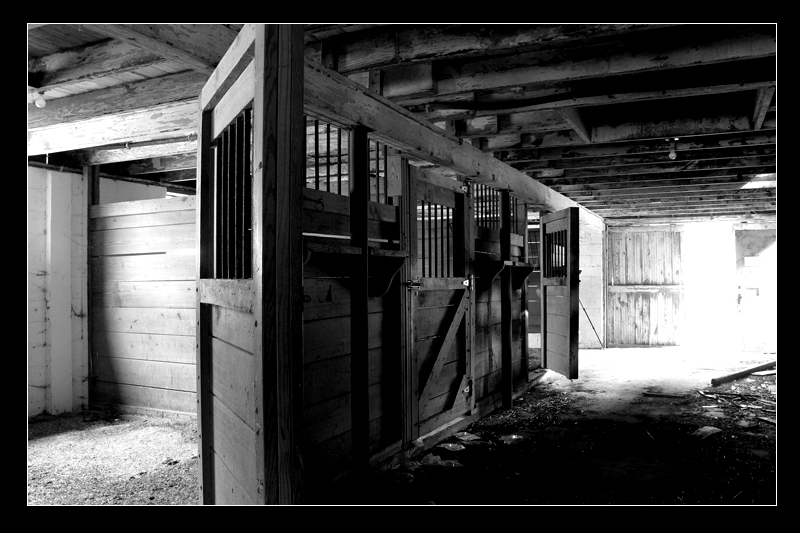
The horse they heard from a distance whinnying continued through the walls of the locked stable nearby. It appeared as if the Bernhardt’s had just vanished into thin air, leaving the animals and farm unattended. Suspicion mounted within the three men as the crept up to the lock on the stable and broke it.

Photo courtesy of Don Wright Designs
The horse they had heard from the outside roughly hit the gates that separated it from the approaching men. The sun was setting and an eerie glow shadowed them as they cautiously entered.

They could certainly sense that something was awry. The hay thrown on the floor in a way that no farmer would bed his animals.

As the horse excited from their entrance, his hooves loosened some of the straw within the small space. The three men’s faces turned white as a ghost when they saw what was hidden beneath the hay in the stall. Earl kicked the hay a little more to reveal blood-soaked clothing and the shoulder of one very, very dead man.

Although unrecognizable to most, the assumption from the postman was that the battered and broken-in face was none other than George Bernhardt.

They didn’t need to get closer in order to know this was a murder. Shocked and full of terror, they stumbled backward, slipping on the frozen ground as they turned away. Their boots kicked more horror into full-force when the hay parted and revealed a second body next to George’s corpse.

“It must be his mother,” Earl surmised, shaken and in disbelief as they quickly backed out of the barn and down the lane away from the farm.

Oh, but there was much more terror masked beneath the ground cover.

The three men ran to the nearest telephone at a neighboring farm and called Olathe. Sheriff John S. Steed sprang into action. A murder in Johnson County? Even when the population was 3% of the population today with just over 18,000 people living in the entire county, one murder- let alone two- was extremely uncommon.

To put that into perspective. . . more people today live within the city limits of Prairie Village (6.2 square miles) than lived in all of the county (480 square miles).
Photo courtesy of Caro Wallis

45 minutes later as dusk settled into the skyline, the sheriff, County Attorney C.B. Little, and Coroner D.E. Bronson arrived at the foot of the long drive leading up to the Bernhardt farm. Word undoubtedly spread like wildfire; awe-stricken farmers were waiting on the side of the county road eager to take a peek at the horror hidden under the hay.

Unlike today’s police investigations, “securing the scene” wasn’t yet in practice in most jurisdictions. Even as the officials from Olathe arrived, the crowd of farmers followed without any hassle from them; Sheriff Steed led all the onlookers up the drive.

Sheriff Steed shoved the hay aside from the victim thought to have originally been Mrs. Emeline Bernhardt, and there was quite the surprise burrowed underneath.

“This ain’t a woman!”

The red-stained clothes were clearly those of a man, and as the shrieks of surprise subsided, the investigators leaned in for a closer look. The face was distorted; an ax had been used to mutilate the corpse well-past the death stage.

“Is that the boy, Tom Morgan!?” exclaimed one of the neighbors present.

Sure enough, the second victim of this horrifying scene was 17 year-old Rosedale, Ks. resident, Thomas H. Morgan. He recently had been hired by the Bernhardt’s.

They rummaged around the stable, and the crowd of spectators gasped when a third body of a man, also unrecognizable due to his gory injuries, was uncovered right next to the other two. The coroner reached into his saturated pocket and pulled out papers that suggested this man in his 40s was a man named Glenn Cotner.

“Hey, that’s William Graves! He was hired on by the family,” one of the farmers argued.

Three victims of an ax murder, lightly covered up with hay in the freezing temperatures, had been uncovered in a rural community unprepared for what came next.

Where was 78 year-old Emeline Bernhardt?

Even as the last light sunk into the horizon, the men continued their search of the area in haste. The party advanced on the looming two-story farmhouse. The final search on December 10th, 1910 was done by the light of lanterns.

Some searched the lower level while others descended the creaking staircase to the bedrooms above. Near a narrow stairway leading to an attic in a small closet, the decaying, bludgeoned body of Mrs. Bernhardt was found.

A clock weight was found covered in blood within close proximity to this murder, most likely the murder weapon used to continuously mutilate the elderly woman.

The body, before photos or a proper crime investigation was launched, was carried outside and laid next to the other three victims.
Olathe Mirror front page headline from Dec. 15, 1910

The 1910 quadruple murder of the Bernhardt’s and two hired hands shook the community and the nation. Several hasty arrests of possible suspects followed for months, yet no killer was ever officially charged with this heinous crime. Emeline’s daughter from her first marriage, Nancy Mason, added $500 to the reward money in hopes that someone would come forward and justice served.

She never did get her day.

**************************************

24 years earlier in 1886, a baby boy named Albert “Bert” Dudley was born to parents Barnett Dudley and Alice Parish near Freeman, Cass Co., Mo. Barnett and Alice were married a year earlier and went on to have two more children, Thurman and Elise.

Something just must not have been stable on the home front with the Dudley clan; Barnett struggled to keep steady employment. After having three children, Alice passed away in 1897, leaving her children motherless. Bert, only 11 years old, was left with his siblings in the care of his maternal grandmother, Candace Parish.

Their dad, in the simplest of terms, wasn’t exactly “present.”

Little in general is known about Bert’s childhood, but he seems to leave Cass Co. as a young man. He bounced his way around farms throughout Kansas working as a hired hand. He never stayed anywhere too long- probably because he was up to no good.

By May 1907, Bert’s dad Barnett got hitched to 26 year-old Verdancia “Verdie” Sexton in Harrisonville, Mo. She was 20 years younger than Barnett, and her stepson Bert was only 5 years older than she.
Harrisonville, Missouri in the early 1900s

It’s hard to determine what would have gone wrong in Bert’s life to assist his slip into darkness. Some people are born with a twist of evil within them, while others are raised that way.

While Barnett married younger, Bert seems to have preferred the older ladies. Bert was only 21 at the time he decided to get married to Laura Huehn, a 38-year-old divorcee with two young children living in Junction City, Kansas. Bert’s new life as a husband certainly didn’t slow his lust for illegal activities.

Laura may have regretted her decision to marry Bert; in January 1909, Bert was arrested for beating his wife. We have to consider the lack of support for victims of domestic violence during this time period. In 1910, the U. S. Supreme Court ruled in Thompson vs. Thompson that a wife had no cause for action on an assault and battery charge against her husband because this "would open the doors of the courts to accusations of all sorts of one spouse against the other."

Considering this court case was after this arrest of Bert, it’s probably safe to say this abuse had to have been pretty ruthless.

Junction City Daily Union, March 15, 1910
But Bert must’ve not felt so bad about his actions, because as he was locked up in the jail in Hutchinson, he asked a guard to turn on the gas in his cell. As the officer complied, organized prisoners surrounded him and Bert escaped from prison. He was later found and served a quick sentence.

A year later in March 1910, Bert was working as a delivery man for a grocery store in Junction City; he was arrested for bootlegging… and got away.

There is a theme developing here.

Bert was transient; even though he was married, he was clearly moving from place to place, working odd jobs and committing crimes right and left. He would float in and out of Freeman, Mo., picking up work here and there.

In December 1910, on the cusp of the quadruple murders of Emeline and George Bernhardt and two farm hands at current-day 119th and Roe, Bert’s location from research of documents is unknown. He isn’t listed with his wife in Junction City, and he was known to bounce around the Kansas side of the state line to pick up work as a farm hand.

Trust me, this comes into play soon.

Early Harveyville, Ks. where Bert Dudley took 16 year-old Amanda Lander
Another arrest for bootlegging followed in early 1912 in Topeka, showing that Bert, although married, was transient and moving solo from place-to-place. He had been in Emporia, Ks. just before his arrest.

By the end of December 1912, the Dudley family found themselves in a few sticky situations that were plastered across the headlines in the Midwest. Just a week before the two-year anniversary of the gruesome murders at the Bernhardt farm, good ole’ Bert was up to his hair-raising ways.

After Bert was released from jail again, he returned to Lyon Co., Ks. Laura, his wife, was left abandoned 70 miles away in Junction City. Maybe Bert was getting a little lonely, because the 26 year-old lured the naïve 16 year-old Amanda Lander off her father’s farm in Miller, Ks. They raced to Harveyville in a buggy and a quick affair ensued.

When Bert was finished with her a few days later, he returned to his job as a farm hand. Embarrassed and unsure of what to do, Amanda hid in shame as her family started to look for her. Once she was found, she confessed to the affair and Bert was quickly arrested on December 4th, 1912. It is said when he faced the sobbing Amanda in court, he completely denied the affair and talked negatively of her.

Meanwhile back in Kansas City, Mo. at Holmes Park, Bert’s father was up to no good. As Bert awaited his final sentence in Lyon Co., Barnett Dudley was about to wreak havoc on the small community of Holmes Park. The small railroad town was quite far south of Kansas City at the time and would have sat just south of Bannister Road in between I-49 and I-435 off Marion Park Drive. The town itself has been completely erased.

But in 1912, this small community was known to have its fair share of problems. The Kansas City Star wrote, “The district has been likened to that of the mountains of Kentucky or Tennessee. It is rough, hilly, and the roads are mere paths through the tangle of shrubbery and forests. The inhabitants are clannish, poor, and hold their grudges long. And their passions are easily aroused.”

This proved to be quite true for 51-year-old Barnett Dudley and his 31 year-old wife, Verdie. A son named Charles, a half-brother to Bert, was born to the couple in 1910. Around that time, Barnett took off and left his wife in Holmes Park with her brother, Duffy Sexton. Court records suggest that Barnett deserted her and mistreated their son. As with many small communities, the neighbors took sides and feelings became bitter.

Barnett had a jealous side to him, a fact probably spurred from their significant age difference. Barnett believed a neighborhood boy, an 18-year-old named Charlie McGhee was starting to “pay attention” to his wife.

On December 10th, most likely aware of his son, Bert’s new home at the Lyon Co. jail, Barnett suggested to his brother-in-law, Duffy a game of cards with neighbors. Meeting at Mr. Large’s house, Barnett, Duffy, young Charlie McGhee and his mother gathered for the hands to be dealt. A bottle of whiskey was passed around courtesy of Barnett and the men anxiously indulged.

An artist's sketch of Barnett Dudley, featured in the
Kansas City Star December 11, 1912
As Barnett rose to leave the table, he spotted his wife across the street. Was her presence a trigger for him? One will never know.

He hastily turned toward the table and drew the pistol hidden in his pocket. The action happened so fast that the poker party couldn’t even react quickly; he pointed the trigger first at Charlie McGhee’s mother but it misfired. As the men began to rise from the table, the trigger was aimed at young Charlie’s face. As the gun’s barrel released, a fire echoed throughout the small community and the bullet struck the young man behind the ear.

He crumbled to the floor and died an hour later.

Duffy Sexton had leaped from his chair to try to get out of the line of fire, but Barnett turned the gun on his brother-in-law and shot his left arm. His arm was shattered, but he survived.

The screams resonated throughout Holmes Park as Barnett Dudley dashed out of the home on foot. He last tried to shoot a young child playing in the front yard just five feet from his aim, but the defective cartridge failed to load. The child, thankfully, was spared of Dudley’s wrath.

Barnett ran a mile north on foot to edge of Swope Park. Standing at the San Francisco Railroad crossing near present-day 71 highway and Blue River Rd., Barnett got the attention of the flagman on duty inside of a shanty house.

His gun was concealed inside his pocket. As the man came out to see what the noise was about, Barnett asked, “Why don’t you flag me?”

A photo depicting the early job of a flagman on the railroad crossings
This was a curious question to the flagman, as he was there to flag automobiles and buggies when they rang a bell in order to guide them across the tracks when it was safe.  

“You didn’t ring your bell,” the flagman hesitatingly replied.

Barnett shuffled within his pocket and produced the pistol, swaying in delirium. “Well, I will ring it then.”

With that, Barnett Dudley shot himself in the forehead in the middle of the tracks.

This murder-suicide ironically happened two years to the day when the Bernhardt quadruple murders were discovered eight miles away in Johnson County, Ks.

And there Bert was, locked up in Lyon County, Kansas awaiting his sentence for rape. Just a few weeks later, the judge threw the book at Bert and sentenced him to five to 21 years. On Christmas Eve 1912, Bert was escorted into his new full-time residence of the Hutchinson Reformatory Prison to serve out his sentence.

Merry Christmas, Bert.

While in prison, Bert’s wife filed for divorce and it was granted.

The reformatory system of Hutchinson Prison at the time included an eight-hour workday followed by two hours of school at night. They hoped to develop upstanding citizens that could return to society and be productive.

Today's view of the Kansas State Industrial Reformatory (KSIR), founded in 1885.
Known since 1990 as Hutchinson Correctional Facility
They didn’t hold onto our buddy Bert for nearly long enough for this “reform” to soak in.

Maybe like today the prisons were crowded and they needed more room. Maybe Bert Dudley had won the guards over with good behavior.

Hutchinson Daily News headline
January  29, 1915
Maybe we will never grasp what actually happened inside that parole hearing. But in the summer of 1914 after only serving two and a half years, Bert was out on parole.

To no surprise, Bert didn’t stay free for long. After his release, Bert returned as a farmhand in Missouri, sometimes working in the Freeman, Mo. area where his grandmother still lived. He was arrested again in Missouri and was placed in the county jail. Before he could be returned to Kansas for parole violation, Bert was able to escape prison yet again.

In January 1915, he was back in jail, and the mugshot sent out by the Kansas prison confirmed to Missouri that they had Bert Dudley in their custody. And how did Bert land in the county jail this time? He was there for white slavery- a term used at the time to describe human sex trafficking of Caucasian women.

Yep.

This time Bert was sent off to Lansing to serve the rest of his sentence due to his parole violation. But just over a year later, Bert filed in the office of the governor of Kansas an application for pardon or parole.
Kansas Governor Arthur Capper,
 in office at the time of
Bert Dudley's pardon

And wait for it…. Wait for it….

He was granted parole. By the governor.

Unbelievable.

In March 1916, Bert Dudley was a free man. And this free man needed work.

Harvest season was upon the farmers of Johnson County, Ks. and Bert knew work would be easy to find. 55 year-old Henry Muller, a Wisconsin-born transport to the Stillwell area was in need of labor on his rented farm. He and his 43 year-old wife, Gertrude were childless yet happy in their 13 year marriage.

Gertrude Muller with her mother (sitting)
and Henry Muller
The farm they rented at 199th and Antioch contained 160 acres of prime land and was known as the Watts Farm. When Bert rolled into town looking for some quick change to fill his pockets, the Muller’s more than welcomed the manpower. Described as an unpleasant man who kept to himself, Bert Dudley did his duties. After the crops had been harvested, the Muller’s broke employment with Bert in the heat of the summer. Bert’s fire was already lit by a girl in the Stilwell area, so he decided to stay put in a boarding house to continue this courtship.

On August 22, 1916, a young man claiming to be Henry Muller rode up with grain to a grain elevator in Bucyrus, Ks. about six miles southwest of the Muller farm. After this young man pocketed the cash from the sale of grain, the elevator operator became suspicious of the man’s actions. Isn’t the farmer Muller much older? he wondered as he watched the young man drive away.

Wary of the man’s demeanor, the grain operator telephoned P.K. Hendrix, a Stilwell banker and former sheriff of Johnson County to confess his doubts of this recent transaction. Active Johnson Co. Sheriff E.G. Carroll was then contacted. They found Bert Dudley in Stilwell at a boarding house.

Original Warrant for the arrest of Bert Dudley
Courtesy of Johnson County Archives
Bert fully admitted that he knew the Muller’s and claimed they had gone to California. Not for one minute did the sheriff believe this story; a group assembled and went straight out to the Muller farm to investigate.

Sheriff E.G. Carroll searched the farm on that hot August day. As the wind died down and the landscape stilled to silence, a sharp, pungent odor crossed in front of his senses.

It was the recognizable scent of death.

They followed the dreadful aroma to an old, unused storm cellar. The door was shut, but the aroma resonating from inside required it to be gingerly opened. As the light of day struck and shadowed the contents inside the small space, the sheriff gasped.

The mutilated bodies of Henry and Gertrude Muller rested inside, covered by hay and straw.

Covered by hay? That sounds familiar.

The face of Mr. Muller was also smashed with what was thought to be an axe, as was also Mrs. Muller. Her hair had been pulled out by the roots from the blunt trauma she had faced in her final moments.

The sheriff immediately returned to arrest Bert Dudley for the murders of the Muller’s, as he was positively identified as the man who went to Bucyrus to sell the stolen grain.

An early photo of Henry Muller
Published in the Olathe Mirror
After a lengthy interrogation, Dudley confessed to the murders. He stated in his confession that he was out hunting while Henry Muller was ploughing nearby. An argument over the use of some mules ensued and confessed, “He opened a knife and ran at me. I grabbed up the shotgun and when he whirled I shot him.”

He later states he went to the house. When Mrs. Muller asked where her husband was, he shot her. He confessed to hitching both of their bodies up to a horse and dragging them a quarter mile before leaving them in the cellar.

Old habits for Mr. Dudley.

Bert Dudley showed no emotion while giving his lengthy confession. Once his cell was locked the night of his confession, he was said to have “dropped to sleep immediately.”

Bert shacked up with prisoner Fred Sickler. He was in for hog stealing and won Dudley’s trust. While time stood still inside the dark and damp jail cell, Dudley relayed Sickler stories that would, in fact, make most of us sick.

Dudley showed a spirit of a bravado after his confession. He was talkative. . . and Sickler listened.

According to his cellmate, Bert learned some valuable lessons from earlier crimes he had committed. “I suppose this Muller affair would blow over for I kept the mail box empty. I made no mistake this time, as we did in the Bernhardt murder in letting the mail accumulate and the alarm was given by the rural carrier,” Fred Sickler recounted.
Photo courtesy of Duane Hallock

So when he went to the Muller’s farm and killed them, he was sure to remove the mail from the mail box to ensure there was no suspicion. He was said to have lived in their home for three days after this heinous crime.

The jailhouse informant also declared some more of Dudley’s thinking when he talked openly of the murder charge against the Muller’s. He boasted that he wouldn’t be put to death, as Kansas had no death penalty. Sickler stated that Dudley told him “he would be paroled by the governor for good behavior in about ten years.”

Well, Dudley had good reason to believe that his good behavior would erase his wrongdoings and set him free yet again.

Sickler stated that Dudley warned him that after he was paroled he would come back “and cut the throat out of all those who testified against him.”

The trial of Bert Dudley lasted one very short day. The jury found him guilty of the murder of both Henry Muller and his wife, Gertrude. As his life sentence was read the next day, people present at the hearing noted that he just cockily smirked and chewed his gum.

The last night that Bert Dudley would spend in the downtown Olathe jail was September 20, 1916 before he was transported- yet again- to Lansing State Penitentiary.

Just after midnight on September 21st, 1916, a mob arrived outside the Olathe jail. Sheriff E.G. Carroll lived with his wife inside the jail and was awakened by the nearing commotion caused by the 60 men assembled. The sheriff watched in horror as the mob broke down the door and entered. He fired a warning shot to try to dismantle the mob, yet they continued without much fear from his gun. As he raised his gun for his second fire, the sheriff was overtaken and held down by the men on a mission.

It was clear to the sheriff what they were after. They wanted Dudley dead.

Unable to find the keys to the cell that held Bert Dudley, the mob broke down the door. For possibly the first time, Bert cowered, terrified in the corner, completely cognizant of what their intention truly was.

This was vigilante justice.

Original coroner's report of Bert Dudley's death
Courtesy of the Johnson County Archives 
Members of the mob yanked him out of his cell and threw a noose around his neck as he shrieked in fear, “I didn’t do it! I didn’t do it!”

They threw him in the back of an automobile and left downtown Olathe and drove east on Park St. Ironically, the mob turned their motorcade down aptly-named Dudley Road (now current-day Ridgeview at approximately Wabash) a mile east of town and stopped in the dead still of the summer night. The mob marched toward the nearest electrical pole and threw the rope attached to the noose around Bert’s neck.

With a garish pull by part of the party assembled, Bert Dudley was hoisted into the air, hanging from the noose. He grabbed at the rope burning his neck as he gasped for air. His legs kicked in defiance, his body contorting in pain.

But that wasn’t enough for the mob. Several drew their guns and aimed with aid from the idled automobiles’ headlights. Gunfire crackled and engulfed the cicada’s summer night’s song. As his legs stilled and his bloodied body relaxed in death, the mob disappeared into the darkness of the country road.

Photo circa 1994 of a barn on a neighboring farm to the west
of the Bernhardt's on the north side of 119th St. to the west of Roe.
The sheriff’s office tried to find who was responsible for this lynching, but no one was ever held accountable. It was assumed enraged farmers from the Stilwell area assembled for their frontier justice and organized the murder of a murderer.

The body of Bert Dudley was found a few hours later and taken to undertakers in Olathe. They pulled 12 bullets from his body. His brother, Thurman and sister, Elise were contacted in Cass County, Mo. but both declined to come and claim the body. Thus, Bert was buried at Potter’s Field in Olathe in a fittingly unmarked and forgotten location.

The lynching of Bert Dudley was the last in the entire state of Kansas and the only one on record for Johnson County.

So, is Dudley responsible for the quadruple homicide at the Bernhardt’s?

If you take the word of the jailhouse informant, then yes. And if you noticed the similarities of the crimes, then it’s plausible. If you consider the fact that neighbors of the Bernhardt’s claim that Bert Dudley had also been employed by the Bernhardt’s months before the murders, then it’s an even higher probability. When I reason that I cannot find Bert Dudley in jail or anywhere else during the time period of December 1910 when these crimes occurred, then I reason that with the preponderance of the evidence that he was, in fact, responsible for the murders at the Bernhardt farm at 119th and Roe.

A recent article caught my attention when I was finishing up my three-month research on this peculiar and disturbing case. It is suggested that the Bernhardt's could have been murdered by a man that rode the rails.

The review by the Kansas City Star of a recent book released suggests that the Bernhardt farm stood "near 135th Street on the Kansas side of the state line. . . Their internet searches reveal the farm sat close to train tracks that still curve from Kansas into Martin City."

I am sure this book included hundreds of hours of research well past the Internet as this quote suggests.

My research doesn’t just include “internet searches” but ample time and research with my friends at the Johnson County Archives in Olathe. The good stuff is in primary documentation. And the Bernhardt farm is clearly at 119th and Roe- the house would have stood near McDonalds and their land extended both north and south of that location. It’s not on 135th St. as the article mentions.

The profile of their mass serial killer includes that he would kill near railroad tracks. The railroad tracks at Martin City are over five miles away.


Regardless, Bert Dudley’s dreadful finale on Earth as the “victim” of the final lynching in Kansas still doesn’t balance the horror of his crimes I could find that he committed. He was a wife beater, human sex trafficker, a rapist- and a murderer of many.

And he was the son of a murderer.

Bert Dudley shut the doors on the barns and cellars; he lightly covering the remains of life lost with hay. He continuously disappeared into the darkness, ran from the law and worked the system until he was brought to light by the skeptical eye of a grain elevator operator. Bert Dudley had reason to be arrogant, as his head swelled with the next chance to abscond the law.

He got away with so much. But he was never equipped for the mob that overtook him in Olathe and dealt him his final justice. The last to face terror was that of Bert Dudley; his eyes widened in fear as his hands yanked at the noose smothering him. The last thing he saw were those men as they raised their guns and fired flashes of light into that summer night.

*Want to see a really cool short video about the lynching of Bert Dudley? Watch the video here!