Gangs. Violence. Vendettas. Harbored feelings blossomed into hatred when torches were lit, shots were fired and families were forever torn apart.
Even before the Civil War, men were willing to sacrifice everything for what they deemed as right.
Some Southern sympathizers didn't comfortably "fall" into the Confederate ranks; their ideals, ethics and morals were more questionable than many. In the southern Jackson County area, especially in Washington Township, many families merged themselves into a much, much deeper connection that grew under the principles of a notorious leader.
These families, many living minutes from the border between the free and slave state, followed, protected and praised an Ohio-born school teacher named William Clarke Quantrill.
Let's take a step back in time and travel to a farm in Washington Township in present-day Grandview, Mo. where the original landowner, specifically his sons, influenced the rebel cause in more ways than one....
Some of them died and others went to jail.
Sometimes these stories just fall in my lap when I'm least expecting it. This was the case when I discovered the unique and violent history of one parcel of land with documented history that began well before the outbreak of the Border Wars or the Civil War.
Today, the land I'm describing sits in Section 22 and 27 of Washington Township.
Yeah, I know. You have no clue where that is. Let me tell you. :)
This land's current address falls in Grandview and includes where Arrington Road is today. The parcel is just east of Martin City (accessible from 139th Street) and just southeast of Main Street in Grandview.
 |
1877 map showing the location of Josiah Vaughn's land that was over 300 acres. His farm was 5 miles from New Santa Fe,
2 miles from the future site of Martin City, and about 1.5 miles from the future location of downtown Grandview. |
And boy, did this Iand and the people that lived on it see some action. . .
Josiah Vaughn, born in 1810 in Green County, Ky., was the first documented landowner there and entered his federal claim in 1848. Before heading from Kentucky to Missouri, Josiah made a pit stop in Knox County, Illinois, where he met and married his wife, Mary Faqua in 1832. She was around 14 years old.
Yikes...
By 1848, he and his young family had moved to Jackson County, Mo. Did they squat on the land prior to this documented claim? Quite possibly.
And thousands of miles away from Josiah's farm in Washington Township, a baby boy named William Clarke Quantrill was born in 1837, the oldest of ten children.
Little did anyone know the impact on history that this child would have.
 |
| William Clarke Quantrill |
Josiah built a log cabin and tilled the land and his wife, Mary reared their ten children: William (b.1833), John (b.1835), Thomas (b.1838), Daniel (b.1839), James (b.1842), Martha (b.1844), Margaret "Maggie" (b.1847), Susan "Susie" (b.1849) and Alexander (b.1853). Neither Mary or Josiah could read or write, but they did work to educate their children as best they could.
Life as a Jackson County landowner during this tumultuous time in U.S. history was far from peaceful. By the time Kansas Territory was opened up to white settlement, the battle over the border began.
Strong viewpoints on slavery severed the area into two factions- those for it and those against it; however, the border served as even a harsher dividing line than that of states further removed from it. While most states had a clear division of "free" and "slave," Jackson County and other border counties in Missouri wrestled with the notion that slaves were steps away from freedom in Kansas.
Blood was boiling in these border states, and as more and more people settled from the north into Kansas Territory and landowners from Kentucky, Virginia and Tennessee laid claim to land on the border in Missouri, a recipe for disaster was quickly unfolding.
Josiah Vaughn and his brother, Rueben, are perfect examples of former Kentuckians who chose southern Jackson County, Mo. as their permanent residence.
By 1860, only 13% of Missourians owned slaves, but if you look at Jackson County alone, that number gets much bigger. One in four families- 25%- living in Jackson County owned at least one slave at this time, but most of these slaves didn't live on large plantations. The average slaveowner here held four slaves.
 |
Kansas-Nebraska Act map showing free states, slave states,
and those being determined by popular vote |
The Kansas-Nebraska Act had these early settlers of Jackson County shaking in their boots. Even though many farmers, including Josiah Vaughn, didn't own slaves at this time, it didn't mean they were crazy about the fact that these northerners were moving into Kansas and were vehemently opposed to slavery. In the mid 1850s, this was seen as a huge problem.
By 1860, Josiah's two oldest boys, William and John, had traveled to El Dorado, California and built lives there. Martha Jane Vaughn, the oldest of Josiah's girls, married Brainard K. Lindsey. Her husband later joined the 12th Regiment, Missouri Cavalry (CSA).
Ah, but three of Josiah's remaining sons, Thomas, Dan and Jim, were still living in Jackson County in the area now known as Grandview... and they had a different agenda. Thomas was already married to divorcee Nancy Jane Gray, and she had one son from her previous marriage.
Wedded bliss certainly didn't stop him from fighting.
Hostility on the border had been going on for years, and raids from Jayhawkers had residents up in arms. Before the war, numerous farms on the border were raided and burned. Southern sympathizers were physically assaulted.
Even if you weren't crazy about the notion of slavery, these guys were pretty angry about the ransacking of their property.
 |
| Marcus Gill (1814-1886) |
The Watts-Hays letters are a tremendous source of historical information about the Jackson County area. Margaret Watts Hays married Upton Hays in 1852, a well-known colonel in the Confederacy. Before his death in 1862, he was known to have been associated with the border ruffians, including Quantrill. While his wife struggled for survival, moving place-to-place, she wrote letters to family members that have been preserved and are online.
In one letter dated January of 1861, Margaret wrote, "They [Jayhawkers] burned over 15 or 20 houses. Burned Mr. Vaughn's house, robbed all the Keeney's of all they had."
The Vaughn house she wrote of was none other than Josiah Vaughn's home.
Well, this is one way to get the family riled up.
Fearing further attack, the instincts of some farmers in Washington Township that did own slaves was to flee the area and ride south. After being introduced to William Quantrill, then just a school teacher, Marcus Gill of the town of New Santa Fe (certainly an acquaintance of the Vaughn family) decided to take off with his family and slaves to Texas.
 |
The Marcus Gill house in 1976, demolished to make room for suburban
development. The original log cabin is on the right side of the house.
Courtesy of Janice Bugler-Reeves |
In the winter of 1860 and into the new year, Quantrill stayed with Marcus Gill on his farm just north of New Santa Fe.
Many neighbors fell in this same category and wanted to get their slaves safely to Texas. Another resident of the area, Samuel Gregg, was aquainted with Marcus Gill through the Bethelem Church of Christ in Hickman's Mill. Gregg, his wife, children and eight slaves joined them on the journey.
Samuel Gregg's land was in the heart of what is now known as Grandview.
And Marcus Gill hired Quantrill to take them there safely.
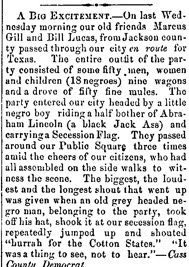 |
Liberty Tribune, April 16, 1861
Courtesy of Missouri Digital Heritage |
Quantrill wasn't a household name by this point, but his reputation as a good shot and protector was reason enough to ride with him to the Lone Star State.
He had seen what these Jayhawkers had done to people's land and was ready for retribution.
Taking up on the chance to showcase his skills, Quantrill returned from his first trip to Texas in late 1861 and was inspired to form his own unit. The Quantrill Raiders operated in the border area between Kansas and Missouri, targeting Union forces and the Jayhawkers.
As did many of the young men of Jackson County at the time, Thomas, Dan and Jim decided to fight for their backwards beliefs.
The Vaughn brothers loaded their guns and joined the Confederate cause. Like many of his neighbors, Dan served in the Missouri State Guard in 1861. But staying in an organized troop wasn't in the cards for these young, ambitious men.
Nope, these guys chose to join the now-notorious Quantrill and became bushwhackers, raiding Kansas residences, killing innocent people and terrorizing the border during the Civil War.
Jim Vaughn was one of Quantrill's earliest recruits, joining him on December 25, 1861.
Merry Christmas, Missouri and Kansas!
This piece of writing isn't meant to focus on the subject of Quantrill- there is plenty of material out there for the masses to read. But the influence and direction Quantrill had on these young men altered the course of their lives forever- and even altered the future of the area.
 |
1861 Harper's Weekly drawing showing Southern women
searched by the Federal soldiers in their home |
In a deposition by Mary Vaughn taken in 1865 by the Union Provost Marshal, the mother of these bushwhackers stated, "In 1861 rebels frequented my house and I had to feed them. I left home to get rid of them."
Sorry, but I'm not sure if I believe Mary.
So much happened on the land near Grandview, Mo. where Josiah Vaughn and other farmers lived. Some evidence of these undocumented skirmishes, most likely involving Quantrill's men, can be found in some trees situated on the landscape. According to residents who grew up in the area, Minie balls still penetrate the old trees, a permanent scar of the seasons when Quantrill sought protection from these early pioneers.
By 1862, Thomas Vaughn, the oldest of Josiah's kids to follow the Confederacy, was the father of two infants. He had left home to defend the border at any cost. The fate of Thomas is hard to make heads or tails of, but the story goes that he was traveling down a road nearby and was robbed and then shot dead.
Did the Jayhawkers hunt and find him? Possibly. Was it unrelated to his relationship with Quantrill? Maybe....?
The string of bad luck for the Vaughn's didn't end there.
The area of New Santa Fe, Hickman's Mill and the future site of Grandview was inundated with Quantrill's men in the Spring of 1862. They had hundreds of allies in the area. In early March, Confederate guerillas, most likely including Dan and Jim Vaughn, raided the small Kansas town of Aubry, near present-day Stilwell.
The Olathe Mirror reported on March 20th that "Quantrill's band murdered four men in Aubry, drove off horses and destroyed private property."
 |
1859 map showing the location of Aubry (starred), Westport,
Kansas City and New Santa Fe on the border of MO & KS
Library of Congress |
I can only imagine the fear of the farmers in the area when these border ruffians unleashed their anger on Aubry.
But they didn't stop there.
On March 22nd, 1862, just over two weeks after the senseless killings at Aubry, Quantrill and his men rode into familiar territory- New Santa Fe. Just three miles from New Santa Fe, Quantrill and 25 to 30 of his men stopped and rested at David Tate's home near present-day Red Bridge. Many of his men, including Dan and Jim Vaughn, went to stay in other nearby homes of sympathizers.
... Not too far from Josiah Vaughn's farm.
Did they stay there, too?
Little did Quantrill and his gang know that the 2nd Kansas Cavalry, led by Col. Robert B. Mitchell, was hot on the rebel's tracks. At the town of New Santa Fe, less than 100 yards from Marcus Gill's abandoned farm, Mitchell sent a squadron led by Maj. James M. Pomeroy to arrest David Tate. They'd received word that he was known to harbor bushwhackers, but they had no idea they were about to meet Quantrill face-to-face.
In Alfred E. Casteel's book, William Clarke Quantrill: His Life and Times, he describes that Pomeroy banged loudly on Tate's door, unaware that over two dozen heavily-armed men were slumbering inside. An unassuming Pomeroy and his 200 men were rattled to the core when men inside began to fire, a Minie ball barreling through the front door and into the night.
 |
Col. Robert B. Mitchell
(1823-1882) |
Pomeroy demanded that the women and children be sent out. He waited, and when no one removed from the home, officers began to open fire. Two days later when recalling the events, Col. Mitchell wrote that when officers resumed their firing into the farmhouse, they could hear cries of women and children.
Pomeroy ceased fire and the women and children ran from the home. Quantrill's men continued to fire from upstairs windows and Pomeroy was shot. The first attempt to light the brick home on fire failed, and two men came to one of the windows and surrendered.
The second attempt by Pomeroy's men to torch the home was successful.
At this infamous skirmish just three miles from New Santa Fe, Quantrill and his men inside busted through the weather boarding at the back of the house and whisked into the woods nearby.
Only two of Quantrill's men were killed as they fled, but Col. Mitchell ascertained that at leave five died in the flames.
Pomeroy's group of men headed to the Wyatt farm, just a few farms north of Josiah Vaughn's land and part of present-day Grandview. As they drew nearer to the home at daybreak, six or seven of Quantrill's men ran from the homestead and into the brush.
 |
1877 county map, zoomed into part of Washington Township, showing the locations of this Quantrill event
|
|
This intense event in the scheme of things was quite minor, but it was covered nationwide in the papers and gave Quantrill recognition in the South as being a fierce leader.
Quantrill, Dan and Jim Vaughn narrowly escaped... for now.
Even during these tumultuous times on the border, men and women found time to fall in love. One of Dan and Jim's pals riding with Quantrill named Samuel L. Clifton (ironically a future police officer in Kansas City) married Maggie Vaughn in 1862.
On April 30, 1863, Maggie was arrested outside of Westport, Mo. for being a guerrilla spy. Her brother and a companion had robbed a steamer, killing a Union soldier in the process.
Jim Vaughn, one of Quantrill's first recruits, was just shy of 22 when his second year with Quantrill came abruptly to an end.
While in Wyandotte County, Ks. on May 17, 1863, Jim knew the Jayhawkers and Union soldiers were hot on his tail. One afternoon, Jim opted to alter his appearance and shave off his facial hair. Thinking he wouldn't be recognized, Jim took off his pistols as he popped into a barber shop. He was in midst of getting a close shave when Union troops tracked him down and arrested him.
The Union soldiers stationed at Fort Union located in what is now downtown Kansas City wanted to send a clear message to Quantrill and his gang. Gen. James G. Blunt brazenly struck back at the guerillas when he ordered Jim Vaughn to be publicly hanged.
 |
| Fort Union, Kansas City |
On Tuesday, May 27, 1863, less than one week after being caught, "large and powerfully built" Jim Vaughn was led up to the gallows erected at 13th and Central.
The Kansas City Journal of Commerce reported, "As soon as [Jim Vaughn] ascended the scaffold he looked about with an unconcerned, nonchalant air of bravado."
He whispered to a Union soldier on the scaffold, handing him both Confederate and American dollars. He wished for his money to be sent to his two married sisters, Martha and Maggie, who were being held in a Leavenworth prison for "aiding bushwhackers."
Jim didn't let the situation get to him. As he mounted the gallows, he addressed the crowd below. "You may kill me, but you'll never conquer me, and taking my life today will cost you a hundred lives and this debt my friends will pay in a short time."
And guess what? Retribution was in the cards.
 |
Margaret Watts Hays in 1860
www.wattshaysletters.com |
Another letter written by Margaret Watts Hays referred to the Vaughn's and their fate. In May 1863, she wrote, "Yesterday Jem Vaughn was hung in Kansas City, Tom was shot about a year ago, D(an) is in the Bush, Marthy Jane and Mag is prisoners in Leavenworth. The old man (Josiah) is South, Mrs. Vaughn and the children was Banished to the territory, their house burned, everything they had taken."
Wow.
So Martha Jane Vaughn Lindsey and Margaret (referred to as Meg in the letter) Vaughn, freshly married to a Quantrill guerrilla, were locked up in Leavenworth. And, for a second time, their home in Jackson County was burned.
... Just add another reason Dan Vaughn was fired up.
While the war roared on, Quantrill's band of guerillas spread out even further. Famous future outlaws Jesse and Frank James, the Younger brothers and Dan Vaughn were cohorts and working together by 1863, occasionally visiting neighbors in the Grandview area to collect supplies from their allies.
Vendettas against those who had caused harm on families in the Jackson County area were common during this time period. Dan Vaughn, now a commander in Quantrill's company, became close to Jesse and Frank James. He was a highly respected man within Quantrill's closest.
And good ol' Dan had an ego on him.
I laughed out loud when I read a newspaper account from the Fort Worth Star-Telegram from June 20th, 1920. It was told by Will W. James, another one of Quantrill's men.
Will claimed that northern soldiers were terrified of Quantrill's guerrillas- and he reminisced about the good ol' days with friends, family... and the newspaper.
 |
"Ballad of Quantrill's Raiders" by Joe Coleman
Spencer Museum of Art |
One story involved Dan Vaughn. Will claimed that Dan was home visiting his folks, and the enemy heard he was there. Dan claimed 80 of them surrounded the house and called him to surrender. "Dan could not see why he should surrender, so he threw the door open."
"With a pistol in each hand [Dan Vaughn] began firing and yelled, "Come on, Quantrill; here they are!"
The soldiers fled in fear.
This sounds like one of those stories that would be told around a campfire.
Embellished? Most likely. But Dan's message was clear; Quantrill's name shook fear in the Union and he maintained that he was able to scare away eighty armed men.
The stories certainly didn't end there. Quantrill's men, especially Dan Vaughn, had it in his mind that he would avenge his brother's hanging.
And when General Order No. 10, making it illegal to aid bushwhackers, was put in effect, hundreds of people were arrested- including all of Dan Vaughn's family. The collapse of a makeshift prison in Kansas City at 1425 Grand, killing some of these prisoners being held (including Bloody Bill Anderson's sister), was the straw that broke the camel's back.
So what better of a way to make your message clear than a massacre of innocent people in Lawrence?
 This is an event that many have heard of: Quantrill's Raid on Lawrence, A.K.A. the Lawrence Massacre. On August 21, 1863, these guerrilla outlaws rode into Lawrence, Ks., killed between 160 and 190 people (including innocent children), and burned much of the town.
What was the response from the Union? General Order No. 11, issued four days after the massacre, forced all residents in rural Jackson, Cass, Bates and part of Vernon County to evacuate immediately. The Union was fully aware that Bushwhackers were
buried in the brush of these rural counties, and they were being enabled by friends and family.
In October of 1863, the bushwhackers under Quantrill's lead headed to Texas for the winter. On their way, they stopped at Baxter Springs. Dan Vaughn and the rest of the men wore Union uniforms so they could travel incognito.
They happened upon a group of Union men escorting Maj. Gen. James G. Blunt to his new headquarters. Due to their disguises as Union men, Quantrill's men were able to surprise the much smaller group of Federals and began to fire on them.
103 people were killed, including men who tried to surrender.
On the way out of town, Quantrill's men tacked a note to a tree that stated, "Hellow, Jim Blunt! do you recollect the letter you wrote to Col. Parker, last Spring, and the execution of Jas. Vaughn? Stop and turn your eyes to Lawrence and Baxter Springs, and see what your amiable policy has brought you to- see what you have done for your fellow soldiers- and then remember the dying words of James Vaughn."
....Dannnnnnnnnng.
This is an event that many have heard of: Quantrill's Raid on Lawrence, A.K.A. the Lawrence Massacre. On August 21, 1863, these guerrilla outlaws rode into Lawrence, Ks., killed between 160 and 190 people (including innocent children), and burned much of the town.
What was the response from the Union? General Order No. 11, issued four days after the massacre, forced all residents in rural Jackson, Cass, Bates and part of Vernon County to evacuate immediately. The Union was fully aware that Bushwhackers were
buried in the brush of these rural counties, and they were being enabled by friends and family.
In October of 1863, the bushwhackers under Quantrill's lead headed to Texas for the winter. On their way, they stopped at Baxter Springs. Dan Vaughn and the rest of the men wore Union uniforms so they could travel incognito.
They happened upon a group of Union men escorting Maj. Gen. James G. Blunt to his new headquarters. Due to their disguises as Union men, Quantrill's men were able to surprise the much smaller group of Federals and began to fire on them.
103 people were killed, including men who tried to surrender.
On the way out of town, Quantrill's men tacked a note to a tree that stated, "Hellow, Jim Blunt! do you recollect the letter you wrote to Col. Parker, last Spring, and the execution of Jas. Vaughn? Stop and turn your eyes to Lawrence and Baxter Springs, and see what your amiable policy has brought you to- see what you have done for your fellow soldiers- and then remember the dying words of James Vaughn."
....Dannnnnnnnnng.
 |
| Harper's Weekly drawing published to show the Lawrence Massacre |
In November of 1863 in Collin, Texas, Dan Vaughn married Mary A. Hall. He'd been in Texas less than one month.
That was a quick courtship.
Dan and some of his men captured Sergt. John Bay and Private Fox of the 2nd Colorado Cavalry while on their return from Texas.
Union soldiers had a plan to get their men back.
Dan's parents, Josiah and Mary Vaughn, his sisters and brother were arrested yet again August 31, 1864. They also arrested Thomas Vaughn's widow, Nancy and her children.
They were taken into custody "for the purpose of saving the two soldiers captured by D. Vaughn, a bushwhacker."
They used them for collateral. He threatened to kill them if they did not release his sister and his sister in law, Nancy.
Less than a month later, they were charged by the Union Provost Marshal with "aiding and giving information to bushwhackers" and it is noted that "their reputation for disloyalty is notorious."
It worked.
The exchange of prisoners did happen in November of 1864.
But the Vaughn family wouldn't be free for long. It seems as if their neighbors had betrayed them.
 |
January 16, 1865 affidavit of Henry Tull of Hickman's Mill listing sympathizers and bushwhackers
Union Provost Marshal Papers |
Pressure from Union troops stationed at Hickman's Mill led many anxious men to sign statements incriminating their neighbors in the area.... including the Vaughn's (shocking, right!?). Both James H. Harris and Henry Tull in January 1865 accused several neighbors of aiding the bushwhackers.
 |
| Gratiot State Prison, St. Louis |
Naturally, by March of 1865, they were arrested again, but this time the plan was to move them as far away from the area as possible.
Gratiot Prison in St. Louis was the place chosen.
Mary Vaughn and her children were transferred to this prison along with her daughter-in-law, Nancy and her children.
Tragedy struck the day after they arrived at Gratiot Prison. Nancy had not fared well on the journey and died March 17, 1865, leaving three children orphans.
In 1908, she was one of only two woman honored with a headstone at Jefferson Barracks National Cemetery outside of St. Louis.
 |
Nancy Vaughn's grave
Courtesy of Connie Nisinger |
Quantrill's days were coming to an end as the Confederate cause slowly lost footing. His 400 men had quarreled in Texas, and most of them bailed. Dan Vaughn's own Confederate Pension record filed in 1902 states he served the last 12 months of the war in the 12th Missouri Cavalry, although no records exist to prove or disprove his claim.
Quantrill died on June 10, 1865 after being shot in the back and paralyzed.
Dan Vaughn, once a leader and trusted companion of William Quantrill, returned with his new wife to his father's farm in the Grandview area. Josiah Vaughn, the first man to till the land on Arrington Road, died in 1873. Mary, his wife, is rumored to have moved to Texas but no documentation of her whereabouts exist. Shortly after his father's death, Dan returned to Texas and settled in Fort Worth.
Josiah's settlement in this area of present-day Grandview was erased. His grave is unmarked, most likely deep underneath the rested soil off Arrington Road. This common yet unexamined example of Southern sacrifice at any cost has now been brought to our attention.
So, this is my goal- to tell these lost stories.
Dan worked after the war in Fort Worth as a furniture mover and a saloon keeper. He was blind in one eye and had a large "aneurism" between his throat and neck according to his pension file. He was a charter member of the Robert E. Lee Camp of United Confederate Veterans in Fort Worth.
In 1904, Vaughn jumped from a burning building and never fully recovered from his injuries. He died in 1913.
Dan Vaughn, although noted in some books on Quantrill's terror in the heart of America, was a predatory man with a deep tie to the Grandview, Martin City and New Santa Fe area of Jackson County, Mo. that has escaped deep research by historians. The deciscions and actions of this cunning character forever changed history.
I want to leave this post on a positive note, as I'm sure your head is swimming in the cess pool of these unreal stories.
It's fascinating, isn't it?!
 |
| Dan's headstone at Oakwood Cemetery, Fort Worth, Tx. |
Dan Vaughn, Jackson County-born guerrilla fighter, even has a part of the history of the University of Kansas, specifically KU Medical Center.
KU Med wouldn't be where it is today without Dan Vaughn's "mercy."
Yeah, you read the right.
In December 1864, a man named Fred Wellhouse (1828-1911), known through the country as the "apple king" due to his extensive apple orchards in Kansas, was riding with a Fort Scott man named Armstrong to the quaint town of Aubry, Johnson County, Ks.
Mr. Wellhouse recounted his story for the Kansas City Star in 1904.
At this time during the war, a man by the name of Dr. Simeon Bell (1820-1913) owned a store in Aubry. According to historian John H. McCool, "During the war years, the outspokenly pro-Union Bell was a favorite target of cross-border marauders, known as 'Bushwhackers,' from the slave state of Missouri. Time and again, they pillaged his property, stole his horses, looted his store, and sent him fleeing from his home before a hail of bullets."
 Armstrong rode ahead of Wellhouse to Dr. Bell's store in Aubry on that December day in 1864. When Wellhouse reached there, Armstrong was nowhere to be found. He went ahead and entered the store, meeting up with Bell. Seven or eight men, described as looking like "country people," entered the store. One man, who turned out to be Dan Vaughn, searched Wellhouse and demanded he give up all his money.
Wellhouse only gave him the $6 in his pocketbook... but he had $50 more hidden in his vest. He lied to Dan and told him that the $6 was all he had.
Mistake.
Another bushwhacker insisted on searching Wellhouse again, and when he found the wad of fifty bucks on him, he was not too pleased.
This sent Dan Vaughn into a tailspin. He ordered that everyone but Dr. Simeon Bell leave the store at once. Dan, you see, was convinced Bell was hiding more money.
Dan torched the store... with Bell inside. He ordered that Dr. Bell not leave the store under penalty of being riddled with bullets.
Horrified, panicked and clouded with the idea that he was going to watch his friend, Dr. Bell burn alive, Wellhouse begged Dan and the bushwhackers to let him out.
"Shut up!" the bushwhackers screamed.
Finally, as the building was completely in flames, Dan yelled, "Come out if you're alive!"
Amazingly, Dr. Bell came barreling out the doors of the engulfed store.
It turns out Dr. Bell was a witty man; he had put his mouth up to a knothole in the wall inside the store and was breathing as much fresh air as he could while flames roared around him.
 |
Dr. Simeon Bell
kuhistory.com |
Dan wasn't finished yet. He announced that he planned to take Dr. Bell to the woods and hang him.
Dan then questioned Wellhouse further and then turned to whisper to his companions. Wellhouse stated, "Suddenly I heard a revolver click and, turning quickly, I saw the bushwhackers gun cocked and leveled at my head."
Just in the nick of time, a woman screamed Dan's name from the street.
It turns out she knew Dan and begged him to spare Wellhouse and Bell.
Dan lowered his gun, snatched Dr. Bell, and rode him into the woods.
For whatever the reason, Dan decided to spare Dr. Bell's life at the last moment. As Wellhouse quickly rode out of town, he saw his buddy, Armstrong's lifeless body on the side of the road.
This, according to many, was the last raid into Kansas. And it was led by none other than Dan Vaughn.
Thirty years later, Dr. Bell offered to give $75,000 to the University of Kansas, home of the Jayhawks, to build a medical school in Rosedale, now incorporated into Kansas City, Ks. Legislators weren't thrilled with the idea of the medical school being so far from the state capital.
 |
Eleanor Taylor Bell Memorial Hospital cir. 1906
Future site of KU Medical Center |
In 1905, Bell offered even more money and more land in Rosedale, and the offer was too good to turn down. The first KU hospital was named and built in honor of Dr. Simeon Bell's late wife, Eleanor Taylor Bell.
This land was the future site of world-renowned KU Medical Center.
We should be grateful that Dan Vaughn granted Dr. Simeon Bell his life that fateful day in 1864.
Fate won over Dan that day, yet so many others died in the hands of these border ruffians.
Dan Vaughn's destiny was no doubt initiated while he watched from a little farm in Washington Township, Jackson County, Mo. his family and others roughhoused by the Border Wars.
Without this history, the landscape would look completely different today. We certainly don't agree with the outlandish ideals of these border ruffians, but we must acknowledge the past so it is never repeated.
And so my mission continues.
 |
1911 Quantrill Reunion held in Blue Springs, Mo.
Courtesy of Harry S. Truman Library |


